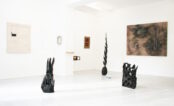
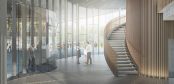
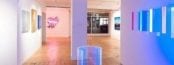
In some respects art like this could be called ‘perspective art’, in that it asks viewers to engage with how they view art objects as templates for both meaning and experience. Whether as a subsection of conceptual art or standing on its own, work of this nature takes performative cues from artists such as Joseph Beuys (1921-1986). Its aim is an ‘art’ experience that gallery convention does not codify. The gallery trades on an assumption: a thing sits inside it, so it reads as art. The works here refuse that shortcut. Their scale, oddness and presence open a new space. The accompanying text teases that visitors should train themselves on experiences outside the norm, the better to perceive the world through other discursive lenses, perhaps none at all.
Art lovers dream of seeing things with fresh eyes, even if philosophically and literally that’s highly unlikely. But we can hack our perception in reflexive ways and at an exhibition that gives perception a lead role we’re offered a route away from the ordinary maps. The twelve artists on show offer a ‘parcours’ through Kunsthaus Baselland’s new home at Dreispitz. A new site that promises an immersive experience from the start, framing the sky, a birch grove and the surrounding city through its windows (Kunsthaus Baselland 2026).
Cristina Iglesias (b. 1956) could hardly fit the brief more neatly. For four decades she has built spaces within spaces, immersive chambers of cast vegetation, water and metal that draw the viewer inside rather than hold them at arm’s length (Guggenheim Bilbao 2023). Trebuchet featured Iglesias in its Ecology issue, so her return to view is doubly welcome, and chances to see this work are rare. Anish Kapoor, who studied alongside her at Chelsea, comes at the same problem from the far side, hollowing perception until the eye loses its footing, while Ernesto Neto and Douglas Gordon carry the register from the bodily to the cinematic. Choices made by the curatorial team, Ferran Barenblit and Ines Goldbach, who lean on Thomas Fuchs’ (Heidelberg psychiatrist and philosopher) work on perception who suggested there is more in play than just the brain, the physical act of placing oneself within a situation creates knowledge (Fuchs 2018). His example is the mountain climber who acclimatises season by season, training balance and orientation under real pressure, and the exhibition borrows the analogy. Can a museum visit school the senses the way altitude schools a body? We shall see.
Senses Enchanted runs at Kunsthaus Baselland, Dreispitz, Münchenstein, from 25 September 2026 to 4 April 2027, in collaboration with the ‘la Caixa’ Foundation Contemporary Art Collection. Curated by Ferran Barenblit and Ines Goldbach.
Exhibition notes: Senses Enchanted 25.9.2026 — 4.4.2027 In collaboration with the “la Caixa” Foundation Contemporary Art Collection
Geneviève Cadieux, Esther Ferrer, Douglas Gordon, Cristina Iglesias, Anish Kapoor, Ernesto Neto, Tobias Rehberger, Maya Rikli, Giacomo Santiago Rogado, Hagar Schmidhalter, Soledad Sevilla, Rémy Zaugg
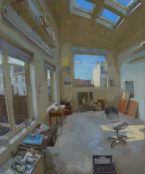
An exhibition devoted to perception is a natural fit for Kunsthaus Baselland’s new home at Dreispitz. After all, the building itself encourages visitors to move through its spaces with an attentive eye, taking in not only the artworks within their spatial context but also the many views framed by the architecture—toward the sky, the surrounding birch grove, and the urban landscape. The exhibition extends this experience by making perception itself its focus. Each work approaches perception from a different perspective, inviting visitors to experience the artworks and large-scale installations firsthand while becoming more aware of, and perhaps even refining, their own ways of perceiving.
The exhibition takes as its starting point a selection of works from the renowned “la Caixa” Foundation Contemporary Art Collection. One of Spain’s leading private collections, it has grown steadily since the 1980s and today encompasses an exceptionally wide range of contemporary art. Through its ongoing acquisitions—including a number of large-scale installations—it has played an important role in supporting contemporary artists around the world.
The idea of presenting a selection of works from the “la Caixa” Foundation Contemporary Art Collection through the lens of perception originated with Nimfa Bisbe, Director of the “la Caixa” Foundation Contemporary Art Collection, and Ferran Barenblit, independent curator, former director of MACBA – Museu d’Art Contemporani de Barcelona, and chief curator of the 16th Shanghai Biennale (2027). Kunsthaus Baselland’s new home offered an ideal setting for this project. At the same time, it aligns closely with the museum’s curatorial program, which regularly highlights artistic practices from France, Spain, and South America while seeking meaningful dialogue between art and architecture and maintaining close ties with artists working in the region.
A broad selection of works from the “la Caixa” Foundation Contemporary Art Collection is complemented by contributions from artists based in the Basel area or with longstanding ties to the canton of Basel-Landschaft. Among them are Maya Rikli, Giacomo Santiago Rogado, Hagar Schmidhalter, and Rémy Zaugg, whose works enter into dialogue with the selection from the collection.
Also opening on the museum’s upper floor is a solo exhibition by Basel-based artist and musician Yanik Soland, whose practice explores new ways of experiencing sound and music beyond listening. The exhibition is the first comprehensive presentation of his work.
Together, the invited artists—Geneviève Cadieux, Esther Ferrer, Douglas Gordon, Cristina Iglesias, Anish Kapoor, Ernesto Neto, Tobias Rehberger, Maya Rikli, Giacomo Santiago Rogado, Hagar Schmidhalter, Soledad Sevilla, and Rémy Zaugg—create a parcours through the Kunsthaus that invites visitors to navigate the galleries in new ways. The exhibition’s title, Senses Enchanted, evokes the desire to move among the artworks with all the senses, almost as if riding on a wave, while allowing oneself to be moved in return.
Philosopher and psychiatrist Thomas Fuchs argues that human perception depends on our ability to situate ourselves physically in the world. Rather than relying solely on the intellect, or on the brain as the body’s central processing organ, perception requires that we place ourselves physically within a situation. One might think of extreme climbers who, season after season, gradually acclimatize to changing conditions, continually training their perception, orientation, and sense of balance under demanding circumstances. Perception can be cultivated—but it can also fade through neglect. One might hope for something similar in the context of an exhibition or museum visit: that through the direct, embodied experience of art, visitors can “train” themselves and their perception, thereby developing greater openness, agility, and resilience in the face of the sometimes extreme demands that everyday life places on each of us.
Curators: Ferran Barenblit and Ines Goldbach

Bibliography
Fuchs, T 2018, Ecology of the Brain: The Phenomenology and Biology of the Embodied Mind, Oxford University Press, Oxford.
Guggenheim Museum Bilbao 2023, ‘Cristina Iglesias’, Guggenheim Museum Bilbao, viewed 18 August 2026, guggenheim-bilbao.eus.
Kunsthaus Baselland 2026, ‘Senses Enchanted’, exhibition notes, Kunsthaus Baselland, Münchenstein.
Marian Goodman Gallery 2024, ‘Cristina Iglesias’, Marian Goodman Gallery, viewed 18 August 2026, mariangoodman.com.
Images courtesy of Kunsthaus Baselland. SINNESUMSCHMEICHELUNGEN 25.9.2026 —4.4.2027 In Kooperation mit der Contemporary Art Collection ”la Caixa” Foundation

The aim of art is to represent not the outward appearance of things, but their inward significance. – Aristotle




_web-174x126.jpg?lossy=1&strip=0&webp=1)