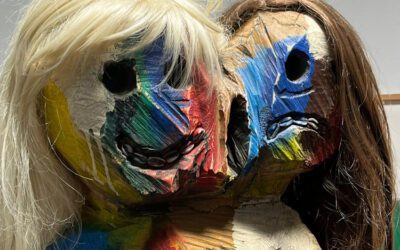
Amid mixed reviews of Tate Britain’s The 90s: Art and Fashion, the Guardian’s art critic Jonathan Jones (Jones 2026) argued that Jake and Dinos Chapman’s Great Deeds Against the Dead (1994) brings “this dismally shallow show closest to a moment of depth”. Based on a Goya print of Napoleonic war atrocities, the sculpture hangs dismembered, bleeding mannequins from a tree, and Jones credits it with raising questions about war, art and the representation of pain.
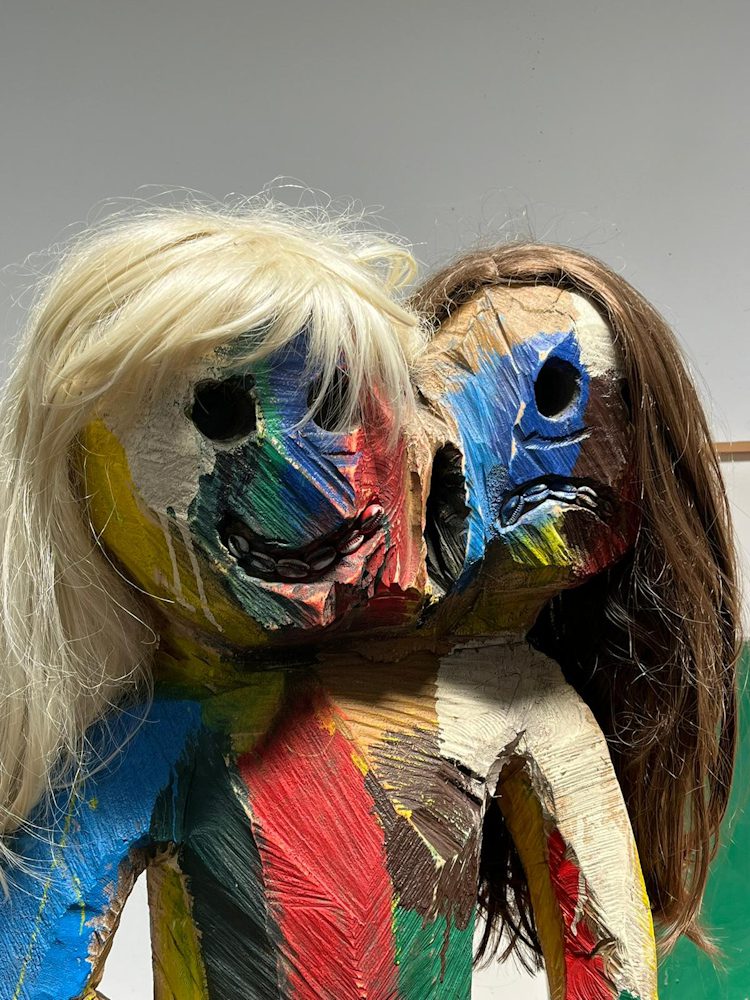
Once the shock of the image recedes, the question of why we are shocked remains. Art and media have long created a mediated distance from the world. A distance Jake Chapman has worked to explode since striking out alone in 2022, when he ended a partnership of some three decades with his brother Dinos and showed solo at Paradise Row, London. For Trebuchet 19: Beyond Bodies, we spoke to Chapman about art, philosophy and biopolitics. He ranges from Florentina Holzinger’s Seaworld Venice and a robot failing to climb stairs, to extinction, transhumanism and the Marxism of wellness culture. Here is that interview in full.
Trebuchet: What do you think about campaigning for the social recognition of bodies of water as entities within the law, so that harming them constitutes “murder” or “grievous bodily harm,” meaning that damage to them leads to direct prosecution, and “human rights” are extended to them more generally?
Jake Chapman: It was all going so well! It starts off interesting, thinking about bodies without anthropomorphising them, like object-oriented philosophy. But then the ethical component kicks in, and this newly conceived objective ‘object’ suddenly attains ‘human rights!’. Is there a specific group calling for this? I think they missed the point. It reminds me of Florentina Holzinger’s installation at the Venice Biennale, Seaworld Venice (2026) — the jet ski going round and round, and you think, wow, this is utter excess, pure profligate expenditure. But then it’s recuperated to the usual narrative, a dystopian warning against the future. And it was all going so well…
You liked it when it was blank decadence?
It’s not that. To propose a different outcome we need to consider how these dynamic, atmospheric entities interrelate and how humans abuse this relationship, and that’s certainly not going to come from constraining things to mundane utility. It’s going to be the opposite. It’s about embracing the forms of excess that, for example, allow the idea of extinction to more profoundly extend beyond its anti-ecological or anti-human superstition. It’s about saying, well, we could be a bit more graceful about the thought of extinction as a ‘terrible cosmic mistake and an injustice to human life’. Extinction is locked in as a planetary process. So Douglas Adams’s fatalistic “don’t panic” seems to me quite critically interesting.
It just means that the exuberance of endlessly circling and thrashing around on a jet ski is really interesting when it’s about wearing human utility out. But when it’s recuperated to the idea of restraint, when its excess becomes a demonstration of what’s bad about humans, the morality suddenly becomes overbearing. It’s saying, look, this is how not to be, rather than how to be. In its melodrama it’s saying, don’t act like this, this is terrible, this is how you waste useful minerals and fossil fuels, so it enacts a prohibition.
Benjamin talks about divine violence and counterposes it to systemic violence. Systemic violence is consigned to use, useful warfare, gain, whereas divine violence has no purpose other than purposeless violence, an expression of the sacred rather than the utile.
Francois Bonnet employs the same argument in After Death: contrasting the difference between the finite and the infinite, that the only value given to finite life is the fact that it must dissipate into infinity. It’s interesting to think about art as something that offers the possibility of self-disappearance, a jettisoning of the artist’s ambitions in favour of the indifferent outcome of the art. And when someone’s speeding round on a jet ski, you think, yes — it starts off as a whirlpool, or maelstrom, but the gaping abyss caused by its circular motion turns into the plug-hole of empathic optimism, in which all the nihilistic energy becomes domesticated, and what the fuck is the point of that? To use the melodrama of energy obliteration as an object lesson in economic conservatism? I do like it though.
Of course, I’m obviously taken with that image — it looked really good fun. It condensed the contradictory nature of ultra-civilised humanity in one image. Watching someone on a speeding jet ski is almost the absolute apex of human civilisation, because its circular motion makes no progress and expends fuel in a coquettish display of petulant waste. It’s a coquettish display of petulant waste. It’s the absolute sublime chasing the tail of high culture. But the pleasure is derailed and pulled back into menial work, so, don’t worry, this extremely profligate work of art is done to shore up the notion of what it is to be human, and what we need to protect, by the most base means. She’s demonstrating an absolute delirious pleasure and then saying, but look, this is bad, delirious pleasure exceeds necessity, and we should remember that via this demonstration.
Thinking about biopolitics, I watched yet another video of an anthropoid robot trying to climb some steps, but failing, and skittering around like an epileptic, and I was thinking, what is the most human element of this pantomime—the walking up the steps or the epileptic fit? It seems to me that the spasmodic fit is more neurologically human-like than the synthetic ability to walk up steps. Surely we would assign intelligence to a robot in its moment of erratic breakdown, which raises the question: what is an equivalent term for the anthropoid robot’s other as it skitters on the floor— given that the robot is already the human’s inhuman, the terms and their differences begin to wear thin.
That’s it, isn’t it? A robot walking up the stairs is banal and has an uncanny valley aspect to it, but a robot accidentally falling over seems precisely human, something we can actually relate to.
It’s failed, and its failure is all too human. VR is a great marker of the problem with AI. Virtual reality prioritises sight, the valorisation of sight over everything, and that’s the limit problem with human-oriented AI. The primary sensory organ given over to this supposed transcendent shift from human existence to some cyborgian transcendence is predicated on optics. VR is always crawling up to the edge of a cliff, looking down, feeling vertigo, or reaching out to touch things. It’s literally simulating effect over affect. Considering how brutally crude our perceptual mechanism is at deciphering our surroundings, the simulation we generate for ourselves has such low resolution that it doesn’t accurately correspond to the world — it’s an illusion without provisional correlation. So the only chance of human continuity with AGI would be through ego-death, in which thought belongs to infinity without any neural demand. Existing in some esoteric sense is already an anthropogenic vulgarity. The only chance the human race has of connecting to the singularity is to offer its inertia. That would be its most refined sensual relation to matter.
I’m going to paraphrase you, but you were talking about how limiting AI to the reproduction of human experiences is such low-hanging fruit, that it should really be aimed at something completely other.
I defer to Freud’s death drive, the tendency towards dissipation to zero. Discussing the pleasure principle, he’s saying sexual pleasure isn’t the pleasure of the sex itself but the void it produces — the death. We can imagine this as a Promethean, synergistic slide into the machinic continuum, but without preloading it with the precondition of human consciousness. The idea of the human as the precondition of the future means any interaction with emerging intelligences is already kaput. We’re going to be essentially incompatible with anything that might want to engage with us as an assemblage.

Going back to Douglas Adams — if we build a higher intelligence and ask it about the ‘ultimate question of life, the universe and everything’ and it comes back with the answer “42” this suggests the answer is so other to our consciousness that we have to build an even bigger computer just to translate the question itself into something comprehensible.
If you go back to the notion of infinity — to be finite means you’re just awaiting the moment you become infinite. Infinity seems quite a glorious figure in that sense, way more abstractly impressive than the finite. The problem we have with stepping off the flat earth into the infinite is that we’re still assuming we can drag something with us, some neural, expedient consciousness that will survive the dimensional deterritorialisation. Once you reconceptualise what it is to be human and what it is to have thought, all of this is just a disavowal of thought as anything other than an elaborate mistake. A fluctuation of intensity that requires comprehending scale in order to arrive at a humble disposition. After all, what does thought do, other than produce its own simulacrum of cosmic pain counterposed by cosmic insignificance?
People are talking about an evolutionary idea of the body around transhumanism, but I’m not sure there is actually any evolution in how we think about our bodies. How do you see it?
There are versions of transhumanism that mistake transvaluation for progressive biology, the idea that augmenting bodies will evolve better humans. I don’t see it that way. The body is already transhuman. I don’t think transhumanism is an emergent thing, but a description of porosity. It’s already written into how bodies are — they’re not one unified or closed thing.
This is against the backdrop of human desire being synonymous with capital, not that capital exploits desire, but that capital and desire are the same thing. Considering that the psychic self emerged historically in an atmosphere of radical self-doubt; the modern self treats morality, desire and time as contingent — already a kind of transhumanism in which the body doubts its identity, its sexuality and its unity, even as it tries to conform that scepticism to realism. When I say body, I mean all of it. Its porosity is demonstrated in how it seeps into the virtual. Digital technology isn’t just an apparatus or platform, it’s part of what Deleuze calls the body without organs. It’s more conceptually laborious to argue for human integrity than to abolish the terminology of self-identity altogether.
It’s a mistake to think of transhumanism as an evolutionary goal — to me that’s just anthropomorphic exceptionalism. Transhumanism goes back to a Nietzschean “transvaluation of all values.” It’s not body-orientated in that sense — it’s an assemblage of sensations and affects, and their interactions with other sensations and affects.
Wellness is really interesting because it’s neoliberal body panic and body horror, drowning in an oceanically abstract sense of wellbeing. Wellness is oceanic panic. Longevity is the managed approach to death which treats death as an unacceptable outcome — the Pilates-cum-yoga preparation for extinction… breathe in… breathe out… breathe… out… ou… o… Even extrapolating nirvana through wellness and yoga is preparation for a death without dying. Wellness, from the ruins of late capitalism and new forms of virtual life, is an attempt to excavate transcendence from the abjectly material ruins of Capital, to find something ethereal in the illusions of hyperreality, which, ironically, was always vapid as perfume. Everything solid melts into thin air.
Wellness is never fully defined, probably necessarily so, an idea you reach towards but never attain or fully realise. I wonder if this meta-idea is replacing the hole left when we moved away from the idea of the physical soul through praxis. Or it’s a remanifestation of it, one we work towards through stretching and drinking green things instead of thirty Hail Marys and a sip of Communion wine.
That’s right. But the soul — the secularisation of Christianity is nothing more than an introjection of God into the superego as an internal snitch. I’m all for hive-mind group-think, all for the reality of being a species rather than a dogmatic species-of-one, which seems an absurd existential fantasy.
For instance, naughty people who go to prison, and have their name replaced by a number suffer this as the highest form of dehumanisation. If you go on a bus, you’re likely to bump into a gaggle of ‘Johns’, but never another “prisoner 241542376.” The authenticity of John against 241542376 is revealing — the phobia of numbers relegates authenticity to the hideous social intimacy of the singular. What wellness does is produce an ambiguous notion, not God, because that’s defunct, but a kind of spiritual, capitalistic belonging.
Not desire itself — not buying something online and experiencing a temporary fidelity to an affect before promiscuously moving on. Sex too is a kind of oceanic feeling, ambiguous, each time a best guess at what dying will bring, which is nothing at all, of course. If you’re unprepared to die, wellness will help you blot it out with incensed transcendence. Consider longevity from a neoliberal point of view — what is longevity on the population scale? Surely wellness should invite us to die early, to relax the burden on the planet? Voluntary euthanasia, cosmic voluntary euthanasia, and everything will be fine.
The idea of maximising life to such an extent that by 35 you’re done.
Youth is wasted on the young, like wisdom is wasted on the demented — I’m somewhere towards the demented end of that equation. I asked my daughter Blythe when she was six, what humans are for, and she said: to destroy the planet. I think that truth is entirely observable, even from the perspective of a small child.
There’s a slightly perverse element to the idea of planetary governance — we’re sinners whose past is catching up with us, we must repent and save the planet. It’s true, of course. But there’s a death-cult element to the fixation on our demise.
If you consider the Enlightenment — emerging from “man’s immaturity,” out of the darkness, the shadows, from the depths of superstition, propelled by reason and rationality towards harmonised self-realisation and truth revealed at the end — but halfway up, the ascent starts to curve. Humanistic thinking begins to peel away like a first-stage rocket engine, or more aptly, like the Challenger explosion, leaving reason and rationality to continue upwards undeterred. That’s the point at which the machinic continuum takes over, revealed as the true vehicle and goal-directed beneficiary of algorithmic thinking. And so the jilted human plummets back to earth, and as logic achieves ultimate singularity, we revert to superstition, to God, morality — to sentience and the soul as what distinguishes us from intelligence. It’s a nice story, anyway.
We crawl back into the cave, sliding back into comfy superstition, which is ultimately what all of this was in the first place. Thought is already superstitious, and reason and rationality, as occult occurrences meant to deliver us from our flaming superstition, turn out to be exactly that. Saying, look what humans have done to the planet, the wars, the genocides — well, that’s a precondition for how humans exist, on varying scales. Concern about the planet, offset against the actuality of how we’ve acted against it, doesn’t really match up anyway. It’s tempting fate to say, well, what if we just defer to more wars and more genocides, more ecocide, omnicide, eventually municide, accepting that as the continuity of what we do, our nature, is to destroy the planet? Because if “work” is meaningful, it means the colonisation of all matter, compounded into the systemic sacrifice of all matter.
That’s a strange fatalism.
“Why did the chicken cross the road? To get to the other side” is not funny. “Why did the chicken kill itself — to get to the other side” is slightly funnier. So it’s like saying, we’re already lamenting the end of humanity. We co-produce forms of synthetic life that threaten resistant modes of humanity, teasing the future with forms of life that will learn to hate us — though that’s still sci-fi angst, since it’s predicated on a tangible surviving “human” to be teased at all. Part of the fantasy of creating an enslaved new working class of intelligent machines who threaten to revolt and annihilate us is that this narrative still maintains the illusion of “human superiority but under threat.”
Wanting to stop or slow down human dissolution is part of the narrative of human exceptionalism that makes ecocide tragic. There’s nothing more vilified than man-made plastic, yet it’s been responsible for human hygiene — it ensured the species would survive long enough to comprehend the fatal toxic load added by synthetic polymers upon the planet, so that delivering ourselves to total success is also the point at which we meet total failure head on.
That’s one way of looking at it. Another model would be that technological evolution has been driven by the unexpected consequences of previous technological evolution — fast cars produce pollution, so we deal with pollution, we invent something new, and so on.
But it’s diminishing returns. If you talk to someone who wishes to stop extinction — I’m not foreclosing the desire or attempts to slow things down, but I’m not sure citing “our children’s children’s” ability to breathe fresh air counts as a real appreciation of time and extinction. “Children’s children” is two ejaculations, two eggs, two petit-morts. Nothing more. Our relation to time is obligated to recognise the difference between the world-for-us and the world-for-itself. The world-for-itself includes us, but only as nascent beings with very limited domestic agency and a very limited time frame. With such an inaccurate sense of who we are, every deviation from happiness seems an injustice.
Sinister population ‘alterations’ seem unfair, yet we’ve already seen industrialisation produce the labourless precariat. Thinking about the motivations for childbirth — a hundred years ago it was about populating industry, inputting a biological necessity for childbirth, as if it were the only reason for being. The biological imperative is the mechanism that produces workers — or what Samuel Butler calls “machine-tickling aphids.”
The capitalist family is self-motivating — daddy and mummy want children for some instinctive private reason, but of course the instinct is manufactured. Families aren’t spontaneous eruptions of self-intent, they’re part of the wider social mechanism. Over time, as the economic base shifts and the need for child-workers diminishes, the innatist desire for reproduction persists as “the meaning of life,” and because it’s been inserted as instinct, it’s impossible to switch off. Once asserted as “nature,” it can’t be rescinded as “unnatural.” Biology then develops pushback against the very foundational values it inscribed as absolutes — philosophical objections, political objections, on macroscopic and microscopic levels begin to unpick it. Feminist rejections of the family are amplified because the family is obsolete. Non-reproductive forms of sexuality enjoy a “new sensitivity.” Leisure time begins to outweigh the Protestant work ethic, and time itself is no longer predicated on the time of work.
But fundamental contradictions appear: we want our children’s children’s children to breathe fresh air, in the same breath as discussing longevity and self-optimisation — extending human life while increasing the load on poor Mother Nature. “Live longer” plus “low mortality rate” plus “the biological imperative” doesn’t add up — or rather, it adds up to something that radically undermines the optimism of its constituent parts.
Optimism is contradictory, and requires even more fantastical optimism to keep wellness delirium and planetary happiness alive. It’s not the plastic that’s the problem, it’s the entropic vitality of happy humans that will be the end of everything — smile, and the dying world smiles with you.
I suppose a Marxist take on the economic world we have is that we need to create consumers more than we need workers.
You can’t mention Marx without his poetically atomised workforce languishing in alienation — labour dissected so that ten different people producing a car never meet or interact with each other. Work doesn’t produce a social formation, it produces an anti-social one. The person who makes the tyre might buy the car, but they’re so alienated from their own production that if they broke down in it, they couldn’t change the tyre they helped make.
What’s interesting about wellness culture, digitalised wellness culture and self-optimisation is that Marxist alienation has come full circle — like the tyre no one can change. The sociability of digital culture produces a kind of accidental digital communism, but not for any emancipatory gain — everything solid melting into thin air… A Marxist singularity, maybe.

Read more in Trebuchet 19: Beyond Bodies
Edith Dekyndt | Alessio Boni | miart | Milan | Venice | TBA21 | Eileen Cooper | Kara Walker | Benjamin Spiers | Jake Chapman | Félix González-Torres | Guggenheim Bilbao | Scotland | Jupiter Artland | RSA | Robert Stilin | the body | phenomenology | biopolitics | ecology | the telluric
Bibliography
Jones, J 2026, ‘The 90s: Art and Fashion review – this isn’t an exhibition, it’s a magazine spread’, The Guardian, 6 October, viewed 15 November 2026, https://www.theguardian.com/artanddesign/2026/oct/06/the-90s-art-and-fashion-review-tate-britain-london.
Reading list: thinkers and works Chapman mentions
Violence, excess and the sacred
Benjamin, W 1978, ‘Critique of violence’, in P Demetz (ed.), Reflections: essays, aphorisms, autobiographical writings, trans. E Jephcott, Harcourt Brace Jovanovich, New York, pp. 277-300.
- Chapman: divine violence versus systemic violence, “purposeless violence” as an expression of the sacred.
Death, finitude and infinity
Bonnet, FJ 2020, After Death, trans. A Ireland, Urbanomic, Falmouth.
- Chapman: the value of finite life as dissipation into infinity; art as self-disappearance.
Freud, S 2003, Beyond the pleasure principle and other writings, trans. J Reddick, Penguin, London.
- Chapman: the death drive and the “tendency towards dissipation to zero”.
Body, desire and transhumanism
Deleuze, G & Guattari, F 1987, A thousand plateaus: capitalism and schizophrenia, trans. B Massumi, University of Minnesota Press, Minneapolis.
- Chapman: the “body without organs”, digital technology as part of the body.
Nietzsche, F 1990, Twilight of the idols and The Anti-Christ, trans. RJ Hollingdale, Penguin, London.
- Chapman: transhumanism traced to the “transvaluation of all values”.
Labour, capital and wellness
Marx, K 1959, Economic and philosophic manuscripts of 1844, trans. M Milligan, Progress Publishers, Moscow.
- Chapman: alienated labour, “the tyre no one can change”.
Marx, K & Engels, F 2002, The Communist manifesto, trans. S Moore, Penguin, London.
- Chapman: “everything solid melts into thin air” (the Manifesto’s line on modernity).
Machines, AI and human exceptionalism
Butler, S 1872, Erewhon; or, over the range, Trübner & Co., London (see ch. 24, ‘The Book of the Machines’ continued).
- Chapman: the “machine-tickling aphid”; humans as parasites upon the machines.
Adams, D 1979, The hitchhiker’s guide to the galaxy, Pan Books, London.
- Chapman: “don’t panic” as a fatalist stance; the answer “42”.
Kant, I 1991, ‘An answer to the question: what is Enlightenment?’, in H Reiss (ed.), Kant: political writings, 2nd edn, trans. HB Nisbet, Cambridge University Press, Cambridge, pp. 54-60.
- Implied rather than named: Chapman’s “emerging from man’s immaturity” is Kant’s definition of Enlightenment.
Object-oriented philosophy
Harman, G 2011, The quadruple object, Zero Books, Winchester.
- Chapman: thinking about bodies “without anthropomorphising them”.
Wolfendale, P 2014, Object-oriented philosophy: the noumenon’s new clothes, Urbanomic, Falmouth.
- A critical counterpoint, useful for readers who want the argument against.
Art
Goya, F 1810-20, The disasters of war (etchings), the print source for Great Deeds Against the Dead.
Holzinger, F 2026, Seaworld Venice, Venice Biennale (check title, year and venue before publishing).
Chapman, J 2021, 2+2=5, K-Pulp, Urbanomic, Falmouth (Chapman’s own writing; confirm details with the publisher).
Images courtesy of the artist © Jake Chapman

Ex-London based reader of art and culture. LSE Masters Graduate. Arts and Culture writer since 1995 for Future Publishing, Conde Nast, Wig Magazine and Oyster. Specialist subjects include; media, philosophy, cultural aesthetics, contemporary art and French wine. When not searching for road-worn copies of eighteenth-century travelogues he can be found loitering in the inspirational uplands of art galleries throughout Europe.