What makes a city want to reinvent itself? The contemporary world places cities under many pressures. Some come from success; others arrive from global forces such as economic downturns, immigration, and the open question of how to serve a local population in a period of political and ideological instability. Barcelona, capital of Catalonia, does not face these questions alone. Spain, like Italy, has been struggling with tourism’s impact on local life, and many cities are responding to municipal pressure for a solution that eases housing and travel for residents. Change is afoot, and the answer is yes to conditional tourism, otherwise known as high-value tourism. In April 2026 Barcelona doubled its tourist tax (Hotel Online 2026), and the city plans to retire around 10,000 tourist-flat licences by the end of 2028 (Travel Daily News 2026). Is this code for the ‘right sort’ of populism? Perhaps, but is this direction of travel necessarily bad?
Trebuchet‘s writers are often asked to have a look at things. That is the remit of the job. But context matters. Barcelona in 2026 offered a fantastic platform from which to view a city coming to terms with its international reputation as a beautiful place to immerse oneself in culture. One shouldn’t ignore the mire that surrounds its ambitions and aesthetic triumphs. The timing sharpened the view: 2026 is Barcelona’s Gaudí Year, marking a century since the architect’s death on 10 June 1926.
And there were many triumphs. First, though, more context: what is a city gallery weekend? Formats vary, but at heart it is an organised presentation by associated galleries that stage special exhibitions and events to promote the city’s art. Galleries show the pick of their rosters, expecting international collectors and art lovers to appreciate the deep cuts, rare treasures and thrill of local discoveries beyond the business-as-usual fare that galleries and artists produce regardless. Of course, this also cements the prominence of ‘what we do’ for the city itself. Cities that host such events at once tease that there is something special and remain nonchalant, declaring that this is simply the world they inhabit. Just a regular week? Yes, but we’ve got something great here. Barcelona Gallery Weekend, organised by the galleries’ association ArtBarcelona. Galeries, reached its 12th edition from 17 to 20 September 2026. It brought 38 free exhibitions to 25 galleries, 23 in Barcelona and two in L’Hospitalet de Llobregat, alongside a FLASH programme of 12 shows open for those four days alone.
Barcelona Gallery Weekend is a tasteful affair that takes in grand museums and organisations as well as plucky upstarts. For the visitor, the pleasure lies in the move between the grandeur of big names (Picasso, Gaudí) and the relatively unknown. There is a certain cachet in saying one appreciates the new, that one is overfamiliar with the known, that one yearns for fragmented visions and sketchy outsider artists. Yet the honest answer is that emotional connection drives any appreciation of art, and in the current climate of image and identity that connection feels harder to establish than it did at school. Were we driven by the authority of the textbook, laying out the importance of the historically significant? It’s the baggage we carry, and as we’re often reminded, we must ensure we’ve packed those bags ourselves.
The Museu Picasso, which opened on 9 March 1963 in the Palau Berenguer d’Aguilar on Carrer de Montcada and now occupies five adjoining buildings on the same street (Museu Picasso), is both a beautiful building and a deep testament to 20th-century art. The artist’s story tracks art’s development from craft, to concept, to celebrity, a trajectory Robert Hughes charts in The Shock of the New (1980). The collection traces Picasso’s formative years. His first forays show a young painter moving past technical mastery towards a personal voice. That voice then becomes a stylistic lens for his intellectual pursuits, before the denouement familiar to many artists, when recognition dulls the impact of the work itself. Picasso was ever a protean artist, who started good and got weirder, more intense, and, against the pitfalls of notoriety, wore his failures as a badge of honour. The collection contains those bold missteps alongside the obvious triumphs. Its strength lies in revealing inspired mastery in pieces that struggle.
Barcelona’s other grand name is Antoni Gaudí (1852 to 1926), a singular visionary whose architecture gives the city something unique and romantic. The intense experience at Casa Batlló allows visitors to understand his life, temperament and work. Unlike Picasso’s canvases, Gaudí’s creations were buildings, realised with vast numbers of people and great sums of money. By many accounts he was an intractable obsessive whose dedication ran roughshod over detractors, creditors, contractors and relationships. Yet his personality and vision cleared more obstacles than they created. Figures vary by definition, but he completed between 15 and 20 buildings, seven of which UNESCO lists as World Heritage. If one is to mythologise Gaudí and his Catalan roots, it would be to say that his work reflects something of the Catalan character. Gaudí was the leading figure of Catalan Modernisme, the cultural movement of roughly 1888 to 1911, a localised form of Art Nouveau that sought to imbue physical materials with spiritual symbolism and express a national identity. That identity was rooted in local textiles and crafts. For anyone walking around the decorated interiors of Casa Batlló, these forms resonate with the organic, flowing nature of the building itself. The building’s last private resident, a descendant of the Batlló family, died in 2019. After a three-year restoration, the third-floor apartment opened in May 2026, though as private rooms for hire rather than part of the museum route (Shields 2026). Many rooms still contain original decor or Gaudí-inspired and recreated pieces. The chief architect, Xavier Villanueva, notes that it is the only original dwelling left in the building, since the others were modified around 1950 (Ara 2026b).


On the second floor, the current exhibition Gaudí-Miró-Gomis: Deconstructed (8 July 2026 to January 2027), co-organised by Casa Batlló Contemporary and the Fundació Joan Miró and curated by Joana Seguro and Ester Ramos, looks at Gaudí’s influence on the painter Joan Miró and the photographer Joaquim Gomis through their respective works (Domus 2026). Miró himself noted in the early 1940s, ‘I believe that in my way of working there are great affinities with Gaudí’ (Casa Batlló Contemporary 2026). The centrepiece is an intense digital presentation, with a loud soundtrack and flickering jump cuts of close renderings by the London studio Tomorrow Bureau (James Earls and Jack Featherstone). It’s heart-racing stuff, pitched at the more than one million visitors who line up to experience the house each year (The Better Vacation 2026). For more staid appreciators, the building and its details offer a compelling experience, one that follows the visitor into the wider, living city.
Barcelona Gallery Weekend sits among the cultural monuments of Picasso and Gaudí, and visitors carry them along when they encounter new artistic visions. It’s a story of two halves. Younger or less familiar names, such as Alejandro Monge (b. 1988, Zaragoza), Joan Pallé (b. 1989, Lleida) and the Czech light artist Pavel Korbička (b. 1972, Brno), sit alongside established figures like Miralda, Mariaelena Roqué and Eulàlia Valldosera. The weekend also crosses the city limits. In the Santa Eulàlia district of L’Hospitalet, Galería Alegría pairs Luís Bisbe and Jacobo Castellano in a joint site-specific project, Ballestrinquers, which turns everyday objects strange. Nearby, ethall shows Eulàlia Rovira’s Clin., a sculptural installation about inclination that takes its cue from the gallery’s own architecture. As with Picasso, the nuance lies in seeing how they face the challenges that mark their careers. This raises the question, for Catalan artists and beyond: what is art supposed to be now?
For the newer artists, an appreciation of craft lays the foundation for concept. Monge’s Synthetic Nature, in 3 Punts Galeria’s new space on Trafalgar (17 September to 31 October 2026) (graf.cat 2026a), works in cement, pigment and resin. It contains anime-like sculptures of young girls on plinths, bas-reliefs and other distressed stonework suggesting an eroded or post-apocalyptic setting. The doll-like figures reference the fan sculptures associated with the anime industry, which gives the work a machinic, synthetic gloss. Is it a statement about the end of the natural world, replaced by something manufactured? His invented world has become anthropocentric, fabricated from our mythologising of nature and its demise. It recalls Mark Fisher’s remark in Capitalist Realism (2009), which he attributed to Fredric Jameson and Slavoj Žižek, that ‘it is easier to imagine the end of the world than the end of capitalism’. The message echoes Barcelona’s attempt to remake itself, in Gaudí’s time and now, around anthropocentric ideals. Is Monge’s work a warning or an open question on the nature of the future?


The same theme runs through Pallé’s Fantastic Planet. El planeta salvatge at ADN Galeria (17 September to 7 November 2026) (ADN Galeria 2026), his third solo show there. The title echoes René Laloux’s animated film La Planète sauvage (1973), released in English as Fantastic Planet, in which giants keep humans as pets. Pallé also co-runs the independent space Malpaís. Through maquettes of various scenes, the artist brings the viewer’s narrative baggage to bear on what he presents. The works mix cinematic references, such as They Live (1988), with events such as couples having sex in cars, alongside graphic tropes, so that our way of reading these codes becomes the work itself. The show includes a burnt-out Volkswagen, WV Golf II (2026). The approach recalls the challenging work of Jake and Dinos Chapman, but with a greyed-out treatment. As with Monge, this highlights that these are unfinished scenes, like the wireframes of early CGI. They’re realistic only as signs that we imbue with meaning, gestures we interpret and read by analogy with our own actions.
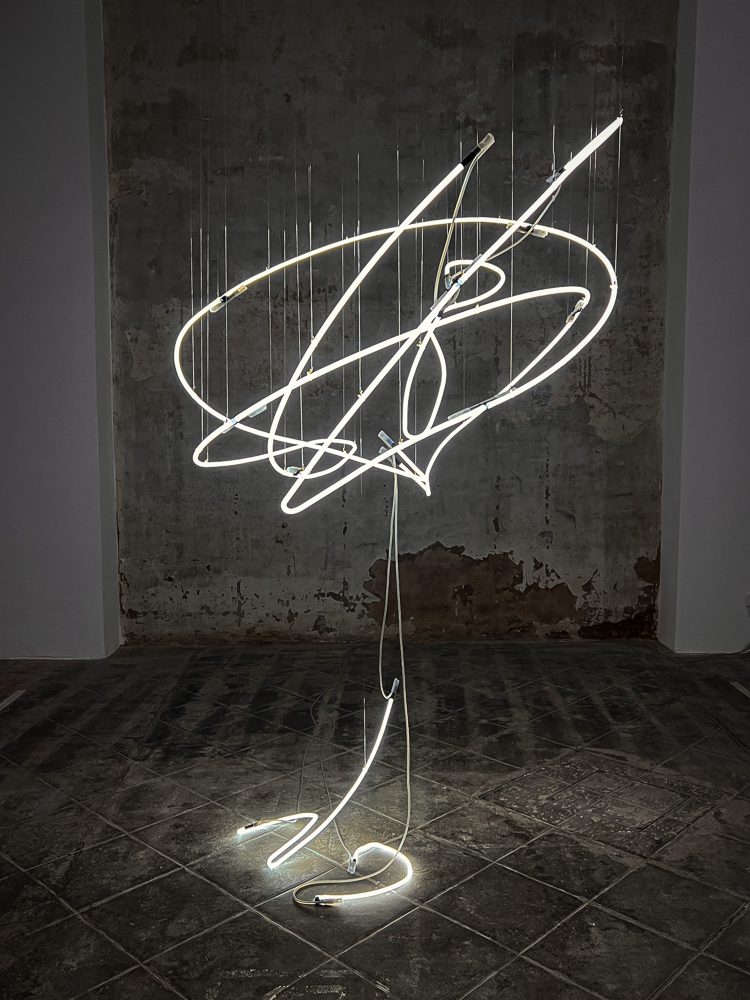
In Pavel Korbička’s Dance Calligraphy, curated by Mohamed Benhadj at Al-Tiba9 Gallery, a first-time participant in the weekend, the viewer is left with traces of a dancer as swirls of neon hung from the ceiling, each drawn from separate motion recordings of the same dance sequence. Light also features in Eulàlia Valldosera’s Anima Mundi. Pensament gràfic at àngels barcelona, here as the culmination of her research into cosmology and the psychic connections between beings and things. Her esoteric pictures, drawings and texts channelled over the past decade and shown together for the first time, explore how coloured light and geometry shape her conception of the human soul.
The thread running through these shows is a sense of embodiment: a question of what places us in the world, and the technical ways we conceptualise our position within it. What remains muted in these presentations is what that means. How does the biopolitical register on the grey outlines we draw around the shapes we make in our environment?


Two established artists who ask that question made a spectacular appearance at the weekend: Miralda and Mariaelena Roqué. Antoni Miralda (b. 1942, Terrassa), winner of Spain’s Premio Velázquez in 2018 (The Objective 2018), has pulled at the rituals and anthropology surrounding humans and food since the 1960s (Oolite Arts 2026). For Miralda: Open Arxiu, a pop-up with the gallery Palmadotze, visitors toured his studio, which also houses the FoodCultura platform. They could discuss with this artist, often underappreciated at home, how his work has evolved to incorporate multimedia assemblages and Beuysian social sculpture: participatory actions where collective rituals draw people together. Each gesture reaches further as it takes different forms across cultures. Consumption is at once universal and binary, a practical indeterminacy that stays engaging as humans find ever more ways to eat and to spend. The studio reveals the wealth of material he has made over the years, and a lucky few see the extensive archive. But a look across the vast collection, where pop meets the conceptual, makes one thing clear: he respects the space for humour in work whose source is deeply human.
Mariaelena Roqué (b. 1952, Tarragona) brings a similar visceral edge to her humanistic work, pursued with arch intent over several decades. Her practice is hard to pigeonhole, spanning performance, choreography, costume, assemblage, sex objects, photography and filmmaking. At its centre stands the artist herself, though the figure could equally be any of us. Her Gallery Weekend show at RocioSantaCruz, UnaDonaUna · AutoRetratRetratat, was her first in a gallery. For decades her output sat under the umbrella of the Companyia Carles Santos, which she co-founded. The exhibition ranged across almost every conceivable format, including erotically charged costumes, clay phalluses and an intense performance with saxophone and song. Throughout, she tackles social constructs of gender and patriarchy from a position of anger and perhaps resistance.


In conversation, the artist spoke of being moved by the plight of sex workers in various parts of the world, and by forms of tolerated violence. The complexity lies in how she presents violence as an ambiguous tool within a context that is often coercive or oppressive. Yet there is also something cathartic and revelatory in seeing it rendered as a language every viewer recognises.
One photograph shows her seated in funeral black on a rusty chair, caught in an anguished moment, about to hurl a pair of high-heeled shoes. It’s a stunning image, capturing in her contorted face an eternal existence of pain and frustration. And yet it’s not clear whether she’s throwing them at the patriarchy or simply venting her anger at another long, damn day on her feet.
The curious thing about Roqué’s work is that, despite her intensity and the depth with which she speaks about the plight of women, it can be funny. Rows of folk penises, latex outfits with horse tails, bondage attire paired with animal masks. Like Miralda, she recognises that to affect an audience, an artist must move past the facades of primary reactions. Shock, disgust and sex rarely connect with people directly. It is the nuance of humanity that brings viewers close enough to ask what those harder feelings mean. The approach widens in scope when one considers Barcelona positioning itself as both a historical site of art and a laboratory for new visions. Is there going to be a place for artists as bold as Picasso, Miralda or Roqué in this new Barcelona? Where does the soft human reside amongst the hard decisions that govern a city?
Art thrives, above all, when society as a whole is economically stable. It operates within a connected ecology: housing, casual work and disposable income all contribute to conditions in which most artists can create. Spain as a whole shows signs of economic growth relative to the rest of Europe; GDP rose 0.7% in the second quarter of 2026, and the OECD expects annual growth of 2.6% (Taborda 2026). Whether that has changed the living circumstances of many artists is debatable.
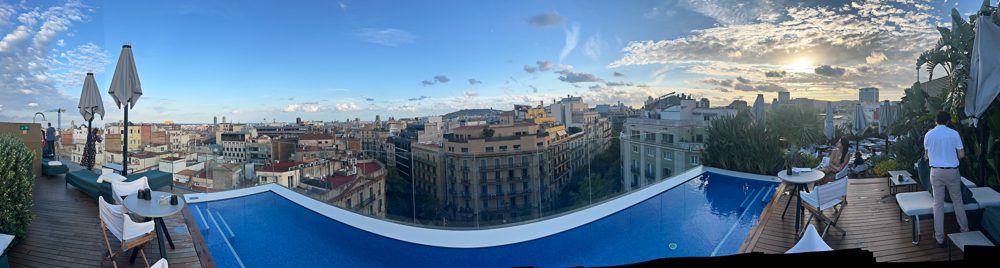
One estimate suggests that only about 2.7% of Spain’s visual artists earn enough from their art to register as self-employed and qualify for a contributory pension (A-Desk). An open question is whether a cap on tourism helps or hinders artists. Tourism brings money into hospitality and entertainment, which generates indirect income for artists through adjacent skills in media and through gallery footfall. Yet its impact on housing and studio space makes it harder for artists to live. The weekend itself offers one modest lever. Its Acquisition Programme, now in its 10th edition, commits companies and foundations, among them the Fundació Vila Casas, Eurostars Hotel Company, the Col·lecció Manuel Expósito and the law firm FILS, to buy work from participating galleries. It is a step towards recognising that answers are needed. But what can government departments and organisations really do?
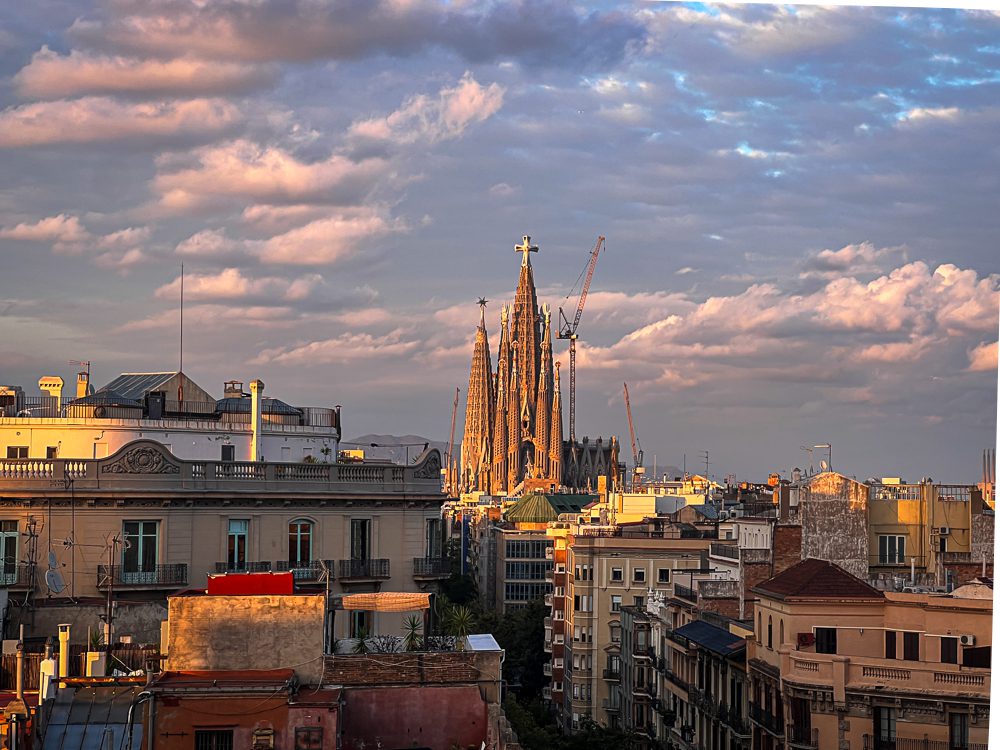
Barcelona is also the UNESCO-UIA World Capital of Architecture for 2026, and its museum honchos are answering in bricks and mortar. At MACBA, Ainhoa Grandes presides over the Fundació MACBA, with Cristina López as the foundation’s director. The museum itself entered a new phase in June 2026, when Valentín Roma was appointed director (MACBA 2026). Across the city on Montjuïc, Pepe Serra, director of the Museu Nacional d’Art de Catalunya (MNAC), is leading an extension into the neighbouring Palau Victòria Eugènia. Both museums are growing for twin reasons: to reach more people and to show more art. Both projects also carry the signature of the Catalan studio HArquitectes, working with the Swiss practice Christ & Gantenbein.
Each extension listens to its setting. The MNAC scheme recovers a historic palace and links it to the Palau Nacional, with completion planned for 2029, the centenary of Barcelona’s 1929 International Exhibition (Bonart 2026). MACBA’s new building, due in 2027, stands across the Plaça dels Àngels from Richard Meier’s white museum (3Cat 2026). Its architects state the aim without ornament: ‘We’re not interested in Instagrammable architecture’ (Ara 2026c). The MNAC respects its historical architecture; MACBA opens a dialogue with the changing interests of local people without dictating the terms. These are slow, structural projects, so visitors can watch the progress, or its absence, and judge for themselves.
The organisers of Barcelona Gallery Weekend have done something similar at street level, letting the established and the new join a citywide conversation. Within that conversation a difference of temperament emerges. The younger artists lean towards a glossy soul-searching. Miralda and Roqué still make urgent, emotionally charged work. The newer work carries a confidence that asks to be taken on its own terms, posing semiotic questions about the nature of being itself. Miralda and Roqué instead push audiences to consider how they read the physicality of their existence. They assume less about the viewer’s interpretation, using foundational precepts (consumption, sex, gender) as a platform and a field of play.
This is a gross generalisation, but the difference may reflect a generational outlook. One generation prizes the ability to make important, meaningful choices. Another treats meaning itself as something in motion, less fixed in its importance. Do today’s post-postmodern (or ‘reformationist’) artists, facing a glut of choice, crave the fixity of meaning? And did the late-modern and postmodern artists of the 1960s to the 1980s explore the fluidity of grand social structures, both personally and politically, because that fixity still surrounded them?
The same tension extends to cities, and to the role of galleries within contemporary art. On social media, some artists have recently asked whether galleries are needed at all, if artists can organise their own shows and sell from their own websites. Others have come to recognise the service galleries provide, not least in absorbing the admin that would otherwise fall to artists. That support lets them remain artists rather than small-business owners.
A romantic reading of a city is that it has a broad enough canvas for people to find themselves in the small, intimate places that live in the shadows of grander, shoutier edifices: places that receive light only at certain times of day, when one has to be in the right place at the right time to catch it. With that knowledge of where and when, one can return time and again to that moment. Barcelona Gallery Weekend 2026 succeeded because it presented a fine mix of old and new, conceptual and physical, through historical and contemporary lenses, equally valid and equally important.
The city is remaking itself, but all remakings are partial affairs. To see places, organisations, artists and rituals come together is to experience them at their most vital, before they become pamphleted and normalised. Barcelona and its organisations are dealing with tourism as best they can, seeking a cultural interest that spreads money through the institutions which enrich the city’s culture. Will this help Barcelona support its next Gaudí, Picasso or Roqué? It’s impossible to say. Yet Barcelona Gallery Weekend 2026 showed people at all levels of cultural institutions recognising the importance of a whole ecosystem: museums, galleries, artists, housing, education and access, creating the ordinary conditions from which the exceptional can emerge.
Images by Trebuchet. Travel and accommodation provided by Barcelona Gallery Weekend.

Gallery Weekend 2026
Barcelona Gallery Weekend 2026, 12th edition, 17 to 20 September 2026, 25 galleries across Barcelona and L’Hospitalet de Llobregat. Free entry. barcelonagalleryweekend.com
Alejandro Monge: Synthetic Nature, 3 Punts Galeria, Trafalgar, Barcelona, 17 September to 31 October 2026. 3punts.com
Joan Pallé: Fantastic Planet. El planeta salvatge, ADN Galeria, Carrer de Mallorca 205, 08036 Barcelona, 17 September to 7 November 2026. adngaleria.com
Pavel Korbička: Dance Calligraphy, Al-Tiba9 Gallery, Carrer del Comerç 11, 08003 Barcelona, 17 September to 14 November 2026. altiba9.com
Eulàlia Valldosera: Anima Mundi. Pensament gràfic, àngels barcelona, Carrer del Pintor Fortuny 27, 08001 Barcelona, from 17 September 2026. angelsbarcelona.com
Miralda: Open Arxiu, Palmadotze pop-up at FoodCultura, Carrer de Joan d’Àustria 88, 08018 Barcelona, 17 to 20 September 2026 (FLASH programme). palmadotze.com
Mariaelena Roqué: UnaDonaUna · AutoRetratRetratat, RocioSantaCruz, Gran Via de les Corts Catalanes 627, 08010 Barcelona, 17 September to 21 November 2026. rociosantacruz.com
Antoni Gaudí, Joan Miró and Joaquim Gomis: Gaudí-Miró-Gomis: Deconstructed, Casa Batlló Contemporary with the Fundació Joan Miró, Casa Batlló, Passeig de Gràcia 43, 08007 Barcelona, 8 July 2026 to January 2027. casabatllo.es
Museu Picasso, permanent collection, Carrer de Montcada 15 to 23, 08003 Barcelona. museupicassobcn.cat
Luís Bisbe and Jacobo Castellano: Ballestrinquers, Galería Alegría, L’Hospitalet de Llobregat, from 17 September 2026
Eulàlia Rovira: Clin., ethall, L’Hospitalet de Llobregat, from 17 September 2026
Bibliography and further reading
3Cat 2026, ‘Els interrogants i les certeses d’un nou curs cultural amb canvis de rumb en grans equipaments’, 3CatInfo, https://www.3cat.cat/3catinfo/els-interrogants-i-les-certeses-dun-nou-curs-cultural-amb-canvis-de-rumb-en-grans-equipaments/noticia/3426522/.
A-Desk, ‘Cultural conciliation for a real and sustainable artist’s statute’, A-Desk, https://a-desk.org/en/spotlight/cultural-conciliation-for-a-real-and-sustainable-artists-statute/.
ADN Galeria 2026, Fantastic Planet. El planeta salvaje: Joan Pallé, press release, ADN Galeria, Barcelona, https://www.adngaleria.com/usr/documents/exhibitions/press_release_url/205/2026_fantastic_planet_cdp_3-idiomas.pdf.
Ara 2026a, ‘Mariaelena Roqué: “They have treated me like a prostitute for being a free woman who defends her own language”‘, Ara in English, 17 September, https://en.ara.cat/culture/mariaelena-roque-they-have-treated-like-prostitute-for-being-free-woman-who-defends-her-own-language_1_5852404.html.
Ara 2026b, ‘Casa Batlló opens the last original dwelling of the building to the public’, Ara in English, 20 May, https://en.ara.cat/culture/casa-batllo-opens-the-last-original-dwelling-of-the-building-to-the-public_1_5733437.html.
Ara 2026c, ‘Emanuel Christ i Christoph Gantenbein: “We’re not interested in Instagrammable architecture”‘, Ara in English, 12 March, https://en.ara.cat/culture/we-re-not-interested-in-instagrammable-architecture_128_5676259.html.
Bonart 2026, ‘The MNAC faces its last exhibition stage before the expansion with only four exhibitions’, Bonart, https://www.bonart.cat/en/n/46011/the-mnac-faces-its-last-exhibition-stage-before-the-expansion-with-only-four-exhibitions.
Casa Batlló Contemporary 2026, Gaudí-Miró-Gomis: Deconstructed, Casa Batlló, Barcelona, https://contemporary.casabatllo.es/en/exhibitions/gaudi-miro-gomis-deconstructed/.
Developments, ‘Tomorrow Bureau’, interview with J Earls and J Featherstone, Developments, https://developments.media/interviews/tomorrow-bureau.
Diari de Tarragona 2026, ‘El universo de la artista multidisciplinar Mariaelena Roqué, en un libro editado por el MAMT’, Diari de Tarragona, https://www.diaridetarragona.com/cultura/arte/258106/universo-artista-multidisciplinar-mariaelena-roque-libro-editado-mamt.html.
Domus 2026, ‘Gaudí and Miró together for the first time: the artist’s works enter Casa Batlló’, Domus, 20 May, https://www.domusweb.it/en/news/2026/05/20/inside-casa-batllo-gaudi-joan-miro-works-first-time.html.
Figuera Raichs, A 2026, ‘D’un pseudosuperman a un VW Golf cremat: 12 propostes efímeres de Gallery Weekend 2026’, 3CatInfo, https://www.3cat.cat/3catinfo/dun-pseudosuperman-a-un-vw-golf-cremat-12-propostes-efimeres-de-gallery-weekend-2026/noticia/3429366/.
Fisher, M 2009, Capitalist Realism: Is There No Alternative?, Zero Books, Winchester.
graf.cat 2026a, ‘Synthetic Nature. Alejandro Monge’, graf.cat, https://graf.cat/en/events/event/synthetic-nature-alejandro-monge.
graf.cat 2026b, ‘Dance Calligraphy. Pavel Korbička’, graf.cat, https://graf.cat/en/events/event/dance-calligraphy-pavel-korbicka/.
graf.cat 2026c, ‘Miralda: Open Archive’, graf.cat, https://graf.cat/en/events/event/%e2%9a%a1%ef%b8%8e-miralda-open-arxiu/.
Hotel Online 2026, ‘Barcelona doubles tourism tax to one of highest in Europe to fund housing’, Hotel Online, https://www.hotel-online.com/news/barcelona-doubles-tourism-tax-to-one-of-highest-in-europe-to-fund-housing-1.
Hughes, R 1980, The Shock of the New, British Broadcasting Corporation, London.
La Pedrera, ‘Gaudí Year 2026’, La Pedrera, https://www.lapedrera.com/en/gaudi-year/.
MACBA 2026, Valentín Roma, nou director del MACBA, press release, 10 June, MACBA, Barcelona, https://img.macba.cat/wp-content/uploads/2026/06/Ndp-Nova-direccio-MACBA.pdf.
MNAC 2026, El Museu Nacional d’Art de Catalunya presenta el projecte arquitectònic de la seva ampliació, press release, 9 March, Museu Nacional d’Art de Catalunya, Barcelona, https://noumnac.museunacional.cat/wp-content/uploads/2026/03/
Moschopoulidou, G 2026, ‘This is Barcelona: the city that wants to welcome visitors without losing its residents’, Travel Daily News, 18 September, https://www.traveldailynews.com/uncategorized/this-is-barcelona-the-city-that-wants-to-welcome-visitors-without-losing-its-residents/.CA_Nota_Premsa_Projecte_Arquitectonic_Ampliacio_MNAC_2026.pdf.
Museu Picasso, ‘Historical and museographic tour of the collection’, Museu Picasso Barcelona, https://museupicassobcn.cat/en/collection/restoration/historical-and-museographic-tour-of-collection.
Oolite Arts 2026, Oolite Arts launches Oolite Arts Conversations with Antoni Miralda in dialogue with César Trasobares and Stephan Palmié, press release, 3 April, Oolite Arts, Miami, https://oolitearts.org/?p=71030.
Shields, C 2026, ‘Casa Batlló’s last original Gaudí residence restored and opened to public for first time’, Catalan News, 11 May, https://www.catalannews.com/culture/item/casa-batllos-last-original-gaudi-residence-restored-and-opened-to-public-for-first-time.
The Better Vacation 2026, ‘Casa Batlló facts’, The Better Vacation, https://thebettervacation.com/barcelona/casa-batllo-facts/.
The Objective 2018, ‘Antoni Miralda, Premio Velázquez de Artes Plásticas 2018’, The Objective, 22 October, https://theobjective.com/cultura/2018-10-22/antoni-miralda-premio-velazquez-2018/.
La Planète sauvage 1973, motion picture, directed by R Laloux, Les Films Armorial, Paris.
They Live 1988, motion picture, directed by J Carpenter, Universal Pictures, Los Angeles.
Taborda, J 2026, ‘Spain GDP Growth Rate Confirmed at 0.7% in Q2’, Trading Economics, 25 September, https://tradingeconomics.com/spain/gdp-growth/news/586837.
UNESCO World Heritage Centre 2023, ‘Barcelona named UNESCO-UIA World Capital of Architecture for 2026’, UNESCO, 3 July, https://whc.unesco.org/en/news/2579.
UNESCO World Heritage Centre, Works of Antoni Gaudí, UNESCO, Paris, https://whc.unesco.org/en/list/320.

Ex-London based reader of art and culture. LSE Masters Graduate. Arts and Culture writer since 1995 for Future Publishing, Conde Nast, Wig Magazine and Oyster. Specialist subjects include; media, philosophy, cultural aesthetics, contemporary art and French wine. When not searching for road-worn copies of eighteenth-century travelogues he can be found loitering in the inspirational uplands of art galleries throughout Europe.