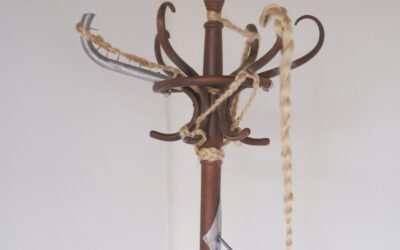
A coat stand, with hair braided around the ‘head’ and augmented with steel spikes, stands tall but wounded, its trunk pierced by arrows, while garments lie in disarray around its base. In Saint Sebastian (2024), the martyr is given an ambiguous treatment. While emotionally blank, the violence of the additions feels clinical and mechanistic. Stripped of its romance, the story is told in symbols, a narrative connected elsewhere. What are we supposed to see? What are we supposed to feel? Perhaps the gap in the meaning is where the message is held?
Installation artist Saki (b. 2000) graduated in 2025 with an MFA in Fine Art from Goldsmiths, University of London, after completing a BSc in Mathematics, Statistics and Business at the London School of Economics in 2022 (Saki 2026a). This foundation is not immediately apparent, though its rigour carries through in Saki’s regimented appraisals of rituals and objects from culture and history. One senses a judgement of how certain things are used, then a creative act of reversal or parallelism. It suggests a logical reading of the source and the resulting material. The danger is that such an approach can focus narrowly on one aspect of an object in order to react in a specific way. The slippage comes when the wider, more varied context of the thing pushes through the artist’s own conceptual frame. Is Saki able to corral those spectral meanings within the trajectory of her work? Or are they forces beyond her control?
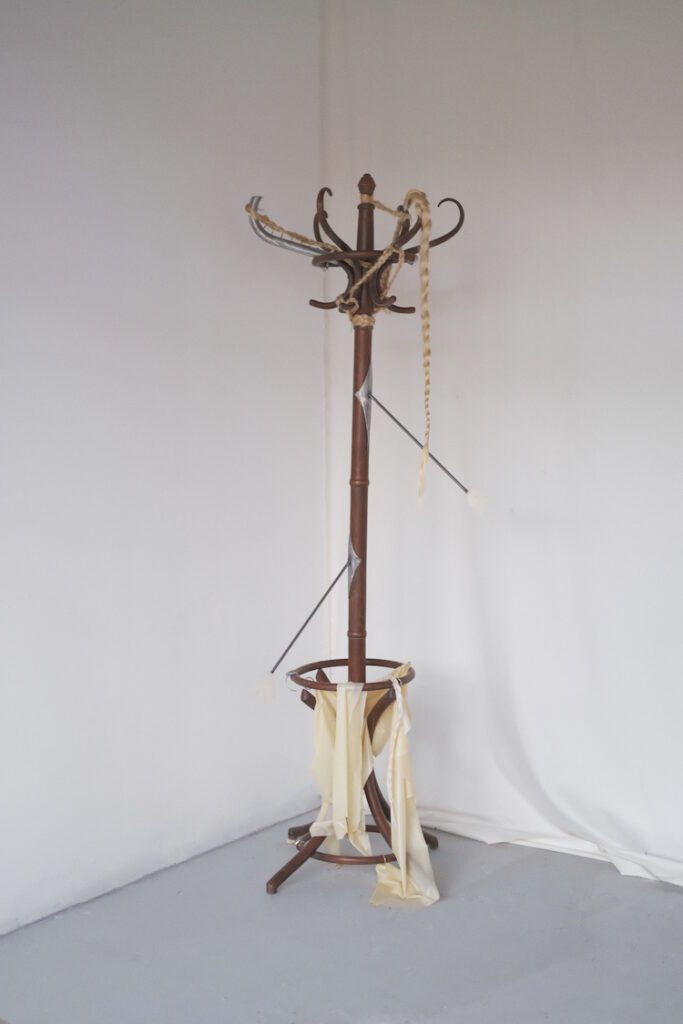
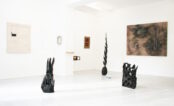
Her strongest works, Door (2025), Good boy/girl kneeler (2023) and Saint Sebastian (2024), have understandable binaries, comfort and pain, violence and desire, but contain several layers of accrued meaning that defy easy association. The coat stand of Saint Sebastian references the saint, whose symbolic presence in the LGBTQ+ community runs from Oscar Wilde, who saw Guido Reni’s Saint Sebastian (c. 1615 to 1616) in Genoa in 1877, and Yukio Mishima, whose Confessions of a Mask (1949) turns on a reproduction of Reni’s saint, to Derek Jarman’s Sebastiane (1976), which revolutionised the presentation of gay love (Wilde 1877; Mishima 1958; Sebastiane 1976). The religious story tells of a Roman soldier martyred under Diocletian (c. 288), tied and shot with arrows. He is said to have survived, only to be clubbed to death. For centuries he was the patron saint of plague victims, which made his acceptance into the gay canon poignant during the AIDS crisis of the 1980s.
Saki uses the violence surrounding the saint, and the sexual imagery of contemporary interpretations, to play with the idea of ambiguous gender identity. The coat stand becomes an asexual proxy for the saint’s body, pierced, spiked and draped in funeral cloth. Taken literally, the statement is that the symbolic saint is somewhere to put what we want, a coat rack of ideas in the waiting room of identity. The artist says, ‘I was interested in the strange beauty of these images. A body is being tortured, yet the violence is often made graceful, sensual and desirable. Saint Sebastian has also been sexualised over time, particularly within queer and LGBTQ+ visual culture’ (Saki 2026b). The coat stand, she adds, ‘remains ambiguous in gender’ (Saki 2026b). Presumably, then, the work asks why this tortured body has been glamorised at all. Yet in Untitled Martyrdom (2024), made the same year in PLA, latex and steel, a body of uncertain sex, close in form to her Woman with two butts (2024), is pierced.
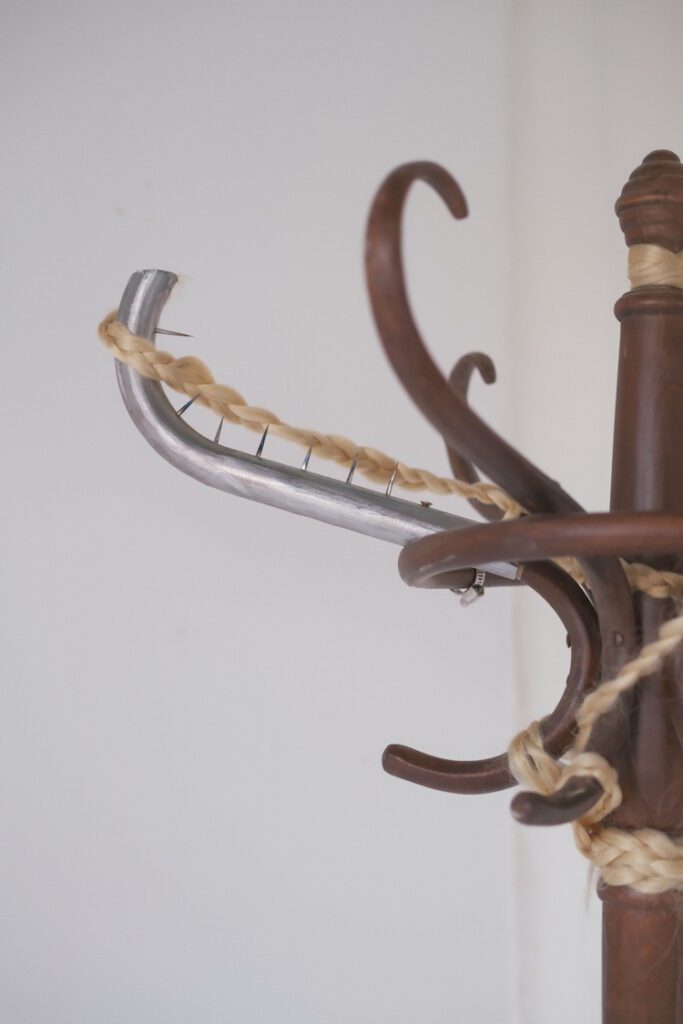
A basic reading would be that generations of LGBTQ+ artists have referenced the saint as a symbol of suffering, resistance and strength in the face of homophobic persecution and medical neglect. For many governments AIDS didn’t exist, or was sidelined as a gay problem unworthy of attention. The beauty of the depiction could then be read as a case that the persecuted deserve to live, and as a reminder that HIV affected many people considered young and attractive.
Which leaves a harder question. The writer and drag king Holly James Johnston acknowledges the saint’s history of persecution before making him her own (Johnston 2022). Saki’s statement doesn’t mention it, perhaps assuming the viewer brings it with them. Does stripping the saint of body and gender queer the icon further, or quietly loosen it from the history that made it one?

The tension in Saki’s work lies in not playing to these marks, instead presenting the saint as a piece of furniture, beset by violence, humanised by association, but bloodless, sexless and without pain. This recalls Michel Foucault’s Discipline and Punish (1975), which traces how punishment moved from the spectacle of the tortured body to machines like the guillotine, which kill almost without touching the flesh (Foucault 1977). Saki calls this ‘zero-degree torture’ (Saki 2026b). Georges Bataille pulls the other way. In Erotism (1957) he binds desire to violence and to the approach of death (Bataille 1986). Sebastian’s painters understood Bataille. Saki sits between them: she names the desire, then removes the body that could feel it. Are we seeing the tropes of Saint Sebastian amplified without a victim? Is the body irrelevant to the violence itself? And what does that ambiguity say about how the symbol operates in a contemporary field?

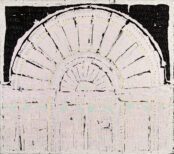
Door (2025) sits against Bataille’s warning not to hope for ‘a world in which there would be no cause for fear, where eroticism and death would be on the level of a mechanical process’ (Bataille 1986). It rebuilds a found Victorian door frame into a portal-like guillotine. Human hair falls through its centre while the blade-like mechanism hangs, suspended. Good boy/girl kneeler (2023) is a found wooden kneeler fitted with steel spikes and rings. These works highlight a sort of sadomasochistic transformational event, in which a participant might undergo a process whereby expectations of pain and pleasure are reversed, suspended in desire and fascination with the other’s shadow. Who drops the curtain? Who approves the supplicant’s prayer? Both works question the role of the participant within a mechanical, experiential context. Is Saki pointing us towards the world Bataille warned against? The tactile is real. Our reading, though constructed, is real to us. Which, then, is more important?
The artist’s fascination with the darker side of the human psyche runs deep through the works, but it also reflects the contemporary drift of symbols. In the case of Saint Sebastian, the drift runs from erotically charged to iconically erotic, as in Johnston’s 2022 reimagining of the saint within an androgynous, performative context. For Johnston, recreating Cima da Conegliano’s Saint Sebastian at the National Gallery was a way of connecting with the icon. She gave herself rhinestone wounds and held the arrows herself, ‘as a nod to the self-conscious mimicry at play’ (Johnston 2022). And though Johnston is knowledgeable about the historical framing of the icon within queer culture, it is the experiential effect of the symbol, its attractiveness, that harbours meaning. Similarly, the questions Saki’s works raise draw us into the uncertainty of experience that icons promise. Amongst the ambiguity of objects and signs, the outcome is suspended. The guillotine might fall, the kneeler of spikes might be rewarded, the arrows might pierce us, or would they? Saki’s pieces highlight the way we finish the story through symbolic understanding, and the process through which we feel the outlines of the darker icons that map our comprehension of the world.
Bibliography
Bataille, G 1986, Erotism: Death and Sensuality, trans. M Dalwood, City Lights, San Francisco.
Foucault, M 1977, Discipline and Punish: The Birth of the Prison, trans. A Sheridan, Allen Lane, London.
Johnston, HJ 2022, ‘Recreating Saint Sebastian’, Stories, National Gallery, London, viewed 29 September 2026, nationalgallery.org.uk/stories/recreating-saint-sebastian.
Mishima, Y 1958, Confessions of a Mask, trans. M Weatherby, New Directions, New York.
Saki 2026a, Saki: CV, artist’s CV, London.
Saki 2026b., Saki, artist’s website and portfolio, London, viewed 29 September 2026, amaisake.com.
Sebastiane 1976, motion picture, dir. D Jarman & P Humfress, UK.
Wilde, O 1877, ‘The tomb of Keats’, Irish Monthly, July.
Images courtesy of the artist © Saki.
This review is part of a supported series by emerging artists, including Saki. Written and edited independently by Trebuchet; all views are the critic’s own.

Ex-London based reader of art and culture. LSE Masters Graduate. Arts and Culture writer since 1995 for Future Publishing, Conde Nast, Wig Magazine and Oyster. Specialist subjects include; media, philosophy, cultural aesthetics, contemporary art and French wine. When not searching for road-worn copies of eighteenth-century travelogues he can be found loitering in the inspirational uplands of art galleries throughout Europe.