Chantal Meza, who was born in Mexico in 1989, is a painter whose art deals with some of the most significant questions that humanity is currently facing by means of the abstract. Since moving to the United Kingdom in 2018, she has built up an international reputation for her paintings, which examine themes such as disappearance, memory, violence, the ecological crisis, and the ongoing complexities of the human condition. By combining emotional intensity with philosophical inquiry, she has created a unique artistic approach in which painting becomes a setting where history, politics, ethics and lived experience come together.
Meza, who is entirely self-taught, has developed as an artist not through formal academic training but as a result of continuous experimentation, observation, and hands-on practice. Since she was brought up in the historic town of Tecali de Herrera in Puebla, she has lived among generations of master stone artisans whose traditions date back to pre-Hispanic Mexico. These surroundings had a deep impact on her grasp of materiality, craftsmanship, and the sense of touch. The relationship between hand, surface, and stone became the basis of her artistic approach and eventually led her to use her hands directly as an essential element of the painting process.
For Meza, painting is never just a technical exercise but an embodied action in which gesture, texture, and physical presence are inseparable from the meaning.
In her work, the interaction between traditional knowledge and current issues remains of central importance. By using old methods of creation and at the same time addressing important global questions, her paintings are situated both within the historical tradition and in the present-day discussion. They indicate that the emotional and ethical difficulties now facing humanity have their origins in common histories which still influence contemporary life.
Disappearance is at the core of Meza’s work. Far from seeing it simply as physical absence, she considers it as a state which transforms memory, identity, culture, community, and ecology. In her paintings she looks at what stays behind after violence, trauma, or loss and examines the delicate area where presence and absence meet. The void itself becomes a subject – not an empty space but one filled with memory, grief, longing, and possibility.
In 2017, the focus of her work began to concentrate more and more on the humanitarian and yet still deeply personal aspect of enforced disappearances, especially in Mexico, her home country, where thousands of families are still looking for their missing relatives. Rather than using documentary imagery, Meza created an abstract visual language which enables her to convey experiences that cannot be described in conventional terms. By means of layered surfaces, fragmented shapes, atmospheric colour, and gestural markings, her paintings bring forward emotional realities that go beyond the reach of language and encourage viewers to meet the phenomenon of disappearance not only as a political matter but as a profound human experience.
The investigations eventually led to the creation of State of Disappearance, an ambitious collection of work carried out over several years and focusing on the phenomenon of disappearance from political, psychological, ecological, historical, and existential points of view. The project has gone beyond painting to become an interdisciplinary collaboration with philosophers, scholars, humanitarian organisations, and public institutions. By means of exhibitions, publications, public discussions, and educational activities, State of Disappearance has become an important platform for investigating how art can enhance the public’s understanding of humanitarian crises and promote empathy as well as critical reflection.
Even though her work deals with political topics, Meza avoids the use of illustration and ideological certainty. She uses abstraction as a kind of philosophical language which can express emotional complexity. Rather than serving as a descriptive device, colour acts as a kind of psychological space, and the texture, movement, and layered surfaces promote an intuitive involvement rather than a fixed interpretation.
The paintings Meza produces do not aim at offering answers; instead they create environments in which difficult questions stay open. This is in line with her general belief that many of humanity’s most important experiences – such as grief, fear, disappearance, memory, love, and hope – cannot be completely conveyed through literal imagery. Each of the materials she uses – oils, watercolours, charcoal, ink, stone, and mixed media – brings its own expressive and conceptual possibilities to this developing visual language.
For over fifteen years Meza has taken part in a wide variety of exhibitions all over Mexico, the United Kingdom, Paraguay and Germany, showing both solo and group works in museums, galleries, universities and cultural institutions. The course of her career shows that she has always been committed to making contemporary art accessible and to promoting dialogue between different disciplines and cultures.
One of her most acclaimed exhibitions was Eden Bleeds, which took place at St Mary Redcliffe Church in Bristol in 2025. The show included thirteen large-scale paintings and thus became the first contemporary art exhibition to be held in the church over its eight-hundred-year history. The interaction between Meza’s emotionally intense abstract paintings and the building’s architectural and spiritual atmosphere set up a strong dialogue between current humanitarian issues and the cultural memory that spans centuries, drawing in considerable public interest and receiving extensive coverage in the national media.
Her later exhibition, Disappearance of Worlds, at Pembroke College, University of Oxford, further secured her standing as an artist who could combine aesthetic innovation with intellectual depth. The exhibition, which examined disappearance as a condition impacting societies, environments, and collective futures, was accompanied by a series of lectures, panel discussions, and interdisciplinary events that brought together artists, academics, policymakers, and humanitarian organisations. It was widely praised by critics, including the renowned art critic Will Gompertz, who called it “remarkably powerful” and “deeply profound”. A prominent work from the exhibition, Dreams of Disappearance, was bought by Pembroke College for permanent display.
Meza’s paintings have over the years been included in public collections where they are used for both educational and artistic purposes. The entire State of Disappearance collection was donated to the University of Bath and has been permanently displayed in the Chancellor’s Building, helping out with teaching, research, and public engagement in the fields of politics, philosophy, international relations, violence studies, and the humanities. This is in keeping with her belief that art should go beyond the gallery and make an active contribution to education, to dialogue, and to social understanding.
Her practice has kept on developing as a result of working with various humanitarian organisations and diplomatic institutions. In April 2026 her exhibition Absence was held at the Swiss Embassy in London in collaboration with the International Committee of the Red Cross, the British Red Cross, the Swiss Embassy, and the University of Bath. The exhibition, which was based on the humanitarian effects of people going missing because of armed conflict, migration and political violence, looked at absence not just as a matter of loss but as a condition that alters families, communities and generations. Together with a series of new abstract paintings, the accompanying programme gathered diplomats, humanitarian workers, policymakers and researchers to consider the protection of civilians within international humanitarian law and the global crisis of missing persons.
In this context, Meza’s paintings served not only as aesthetic objects but also as acts of witnessing, providing spaces where testimony, memory and ethical reflection could come together.
Her artistic career is now heading back to Mexico with the exhibition A Natural History of Violence, which is set to take place in 2027 at the Capilla del Arte Museum in Puebla. The show marks both her return to her home country and the conclusion of nearly ten years of research into the subjects of violence and disappearance; it extends this line of inquiry by looking at violence as a historical condition embedded in landscapes, bodies, memory, and systems of power. The exhibition will include new large-scale paintings to consider the intimate and violent relationships between humans and ecologies, technologies and the myths that govern our lives.
Alongside her artwork and public exhibitions, Meza also evidences a similarly important contribution to current scholarship. In 2023 Meza co-edited State of Disappearance, which was published by McGill–Queen’s University Press. The book combines the work of leading international scholars with a full catalogue of her paintings and thus creates a new interdisciplinary approach for understanding disappearance as one of the major political, ethical, and existential conditions of the twenty-first century. Instead of treating the artworks as illustrations, the book puts them into direct dialogue with essays drawn from the fields of philosophy, anthropology, political theory, cultural studies, and violence research, showing how artistic practice can produce kinds of knowledge that cannot be obtained through conventional academic discussion alone.
The discussion between art and scholarship will be carried on in the upcoming book Disappearance: The Normalization of the Extreme, which Brad Evans, a political philosopher, has co-written and which will be published by Edinburgh University Press. The book looks at a wide range of topics including forced disappearance, ecological collapse, migration, digital erasure, media, and the politics of visibility, and it claims that disappearance has moved from being a rare kind of violence to having become an increasingly normal aspect of contemporary political life. Throughout the book Meza’s artistic practice stays at the heart of the investigation, showing how abstraction can shed light on experiences that resist expression and thus open up new ethical and philosophical approaches to dealing with the disappearance of people, cultures, and life-sustaining worlds.
Education and public engagement are also a key part of Meza’s work. She has given lectures, seminars, artist talks, and workshops at a number of institutions such as Harvard University, the University of Oxford, University College London, the École Normale Supérieure in Paris, Goethe University Frankfurt, and the University of Bath. These engagements go well beyond a mere focus on artistic technique and examine the connections between aesthetics, politics, ethics, violence, and critical thought, which is in keeping with her view that visual art has a special ability to deal with questions that go beyond the usual terms used in academic or political circles.


Her efforts have also received recognition in the form of grants, awards, and public honours, all of which highlight both her artistic achievements and her broader cultural impact. In 2025, the University of Bath named her Artistic Engagement and Impact Research Fellow in recognition of her outstanding capacity to link artistic practice with research, education, and public engagement. In this position, she is still working on projects that show how contemporary art can promote critical reflection regarding the major humanitarian and environmental challenges of the twenty-first century.
Meza has also been recently appointed as Art director for the academic journal The Review of Education, Pedagogy and Cultural Studies.
Even though her work has gained an increasing international reputation, Meza stays firmly devoted to the personal and physical roots of painting that come from her hometown in Mexico. Every painting is the result of a long process involving layering, revising, and direct physical interaction with the materials, in this way retaining traces of the gesture which confirms the continued presence of life in the act of creating. Her paintings do not provide any reassuring endings or clear conclusions; on the contrary, they encourage ongoing thought about disappearance, historical violence, ecological collapse, and the delicate character of memory, and they pose the question of what it means to remain human in a world that is becoming more and more uncertain.
Chantal Meza is currently part of a generation of artists who are redefining the potential of modern painting by combining aesthetics, philosophy, scholarship and involvement with the public. She has shown that the abstract can act not as an escape from reality but as one of its most effective ways of bearing witness; her work converts absence into presence and silence into visual dialogue, and in this way extends the role of painting as a means of addressing the ethical and existential issues of our time.
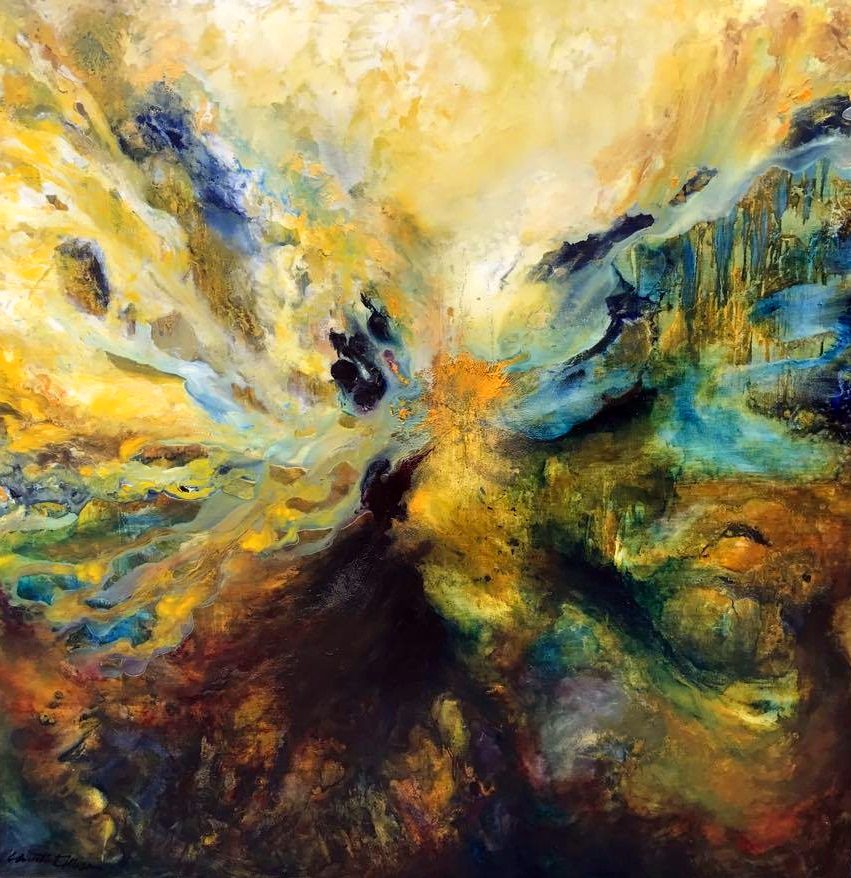
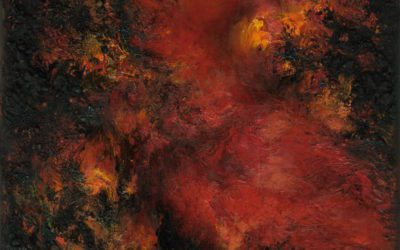
Encounter (2017)
“I have blended two different techniques in this piece, which traverse the beginning and the middle part of my life. Those two stages in my working processes are evident to me in this painting. I brought the explosion of the shapes and colours, which I subsequently polished, making them subtle and lightweight to create an embracing feeling.
There are colours in this piece I normally don’t use because they make me feel tranquil, but when I use them, it means there is a moment of calmness in my life. I bring those shapes to insinuate an expansion. But that tranquillity is not a ‘static tranquillity’, it is a ‘walking tranquillity’; like a feather being moved by the wind. This piece is about being open to the ‘Encounter’ of those moments in life where you are open to receive and open to give more of yourself to the world.’
A signed and numbered print of Chantal Meza’s ‘Encounter’ is included with every new Trebuchet subscription.

Artist prints are included free with each subscription.
(UK or Worldwide)