Language is a process of symbols that manifests thought forms — speaking is a physical act. And if language emerged from describing the world around us, the development of writing is a point where language becomes a cosmology all its own. The shape of letters contains isness defined by negative space; the totality of each letterform describes something, itself part of a wider context of meaning. Calligraphy is the personal process of shaping the forms that become meaning, and for artist Sirvon Azarm the play between process and the nuance of meaning is where his work finds its power.
Azarm (b. 1998, Iran) is a multidisciplinary visual artist and graphic designer based in Cheltenham. Having moved to the UK in 2022 to complete a Master’s in Graphic Design at the University of Gloucestershire, his practice spans typography, poster design, photography and logo work. But it is his Circle series that represents his most compelling artistic work to date. That series began with what he describes as a single unplanned gesture on paper, a work he later titled Careless. The act offered a way to express what fell between the gaps of language, whether from fear of being misunderstood or simply the weight of external communication itself. Growing up in Iran under conditions of war and instability, Azarm developed a practice rooted in the processing of experiences and the way language contains its own generalities and gaps. Those gaps are not empty. They are where the unspeakable accumulates — the pressure of a life lived under instability, the weight of emotions for which no political or personal vocabulary has yet been found. Art, for Azarm, does not decorate the edges of language. It traces them precisely, in order to describe what language cannot contain.


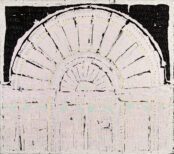
One can imagine that the tracing of a circle in sand was the first consciously artistic act. A line can happen accidentally; a drawn circle demands an audience. The closure of the two ends of a line is a statement. Someone did this. They made a choice and that thought can be read. Azarm’s exploration of a circle similarly presents us with a variety of ways the coiling back of the line might carry meaning. In 42 pieces he conveys the range of interpretation this shape might sustain: from a narrative reading of start to finish, the way in which the line exploits the assumption of closure, what the enclosure of the central area means, and what space is excluded by the boundary.
This is an idea that has resonated across cultures and millennia. In the Zen enso, brushed in a single gesture, the form is simultaneously painting, word, and self-portrait of the maker’s interior state at the moment of making. In Islamic geometric tradition, which carries particular resonance given Azarm’s Persian background, the circle is not decorative but generative: the structural unit from which all pattern propagates (Critchlow 1976). Among modern influences, Azarm acknowledges the concentric circle paintings of Kenneth Noland (1958–63), in which the circle’s lack of top, bottom or implied direction forces the eye inward, as well as the abstract vocabularies of Kandinsky and the distilled geometries of William Scott. What draws him to these figures is their ability to hold emotion within pared-back form, something legible throughout the Circle series.
It is important to note that Azarm’s process can be distinguished from purely formal abstraction, as his search into the areas where language fails begins with language itself: the germ of each work starts with writing.


Azarm describes the process as writing through some impetus until language exhausts itself. He then reads back through the text, tracing patterns, reducing it to a small group of words that hold the essence of the emotion. Only then does translation into visual form begin: into line, rhythm and tension, through sketching, before evolving further through digital refinement. The circle is what remains when words have been worked to their limit. Roland Barthes observed of Cy Twombly that his work ‘does not derive from a concept (mark) but from an activity (marking)’ (Barthes 1979, p. 158), and there is a kinship here with that formulation: Twombly’s loops and scrawls occupy similar territory to Azarm’s, where the space between writing and mark-making finds its resolution in refined gesture.
The circle became the foundation of the project, Azarm explains, because its wholeness felt closest to who he is: a shape without corners, without hierarchy, without a correct direction. It offered a space where emotion could exist without being categorised as right or wrong. This is formally precise. Unlike the rectangle, which implies orientation and reading direction, or the triangle, which implies hierarchy, the circle is genuinely open — but not without avenues of nuance and meaning. Over the 42 circles gathered in The Circle (2024–25), each piece carries the essence of a moment — heavy, light or uncertain — transformed into visual invitations for the viewer to complete.
The digitally rendered circle series (2024–25) makes Azarm’s process opaque. Some retain traces of their manual development while others look processed beyond the point of authorship. With the focus on the shapes themselves, they become conceptual exercises rather than experiential ones. Whether this causes a rift in the appreciation of the works is subjective, and contemporary audiences may have less investment in the physical mark than in the conceptual proposition.
The current phase of the project, the 2026–27 works, has shifted to exclusively hand-drawn circles on paper in varying scales, each a unique piece rather than an edition. Whether this reflects a response to that question of process visibility, or simply a natural evolution of the practice, is an open one. What it does suggest is that the question his earlier work raises is one Azarm himself is actively negotiating.
Miró, who spent a lifetime reducing forms to their pre-linguistic essence, wrote that he sought ‘the maximum of intensity with the minimum of means’ (Miró, cited in Rowell 1987). Azarm arrives at a related place from a different direction: not through reduction of the visual world, but through the exhaustion of language itself. His practice asks what is left of feeling when words have been worked to their limit. The answer, for now, is a curve returning to its origin, forty-two times, before spinning out again — each one complete.
BIBLIOGRAPHY
Barthes R 1979, Image Music Text, trans. S Heath, Fontana, London.
Critchlow K 1976, Islamic Patterns: An Analytical and Cosmological Approach, Thames and Hudson, London.
Miró J 1987, Joan Miró: Selected Writings and Interviews, ed. M Rowell, Thames and Hudson, London.
Noland K 1958–63, Circle Paintings, various collections; see Agee WC & Greene ADL 1993, Kenneth Noland: The Circle Paintings 1956–1963, Museum of Fine Arts, Houston.
Scott W, represented in Tate, MoMA New York, Metropolitan Museum of Art; see artuk.org.
WEBLINKS
www.sirvonazarm.com
www.tate.org.uk/research/in-focus/gift-kenneth-noland
www.metmuseum.org/art/collection/search/490214
www.artforum.com/features/marks-cy-twombly-208365www.piano-nobile.com/artists/1186-william-scott
Images courtesy of the artist © Sirvon Azarm

Ex-London based reader of art and culture. LSE Masters Graduate. Arts and Culture writer since 1995 for Future Publishing, Conde Nast, Wig Magazine and Oyster. Specialist subjects include; media, philosophy, cultural aesthetics, contemporary art and French wine. When not searching for road-worn copies of eighteenth-century travelogues he can be found loitering in the inspirational uplands of art galleries throughout Europe.