The relationship between the self and others has long been a subject of investigation for artists — and it might be argued that art is itself a means through which we come to see ourselves. After all, art is, if nothing else, a perspective. Tainted Love at Kristin Hjellegjerde Gallery presents a variety of perspectives on how humans interact: the complex bonds between people through love and intimacy, shades away from the primary colours of fairytales and Hollywood films.

Exhibition notes: Tainted Love, 22 May – 20 June 2026
Featuring artists: Brian Dawn Chalkley, Eileen Cooper, Ben Edge, Roxana Halls, Sally Kindberg, Colm Mac Athlaoich, Tamsin Morse, Mu Pan, Claire Partington, Cheryl Pope, Bethany Stead, Darcy Whent, Caroline Wong, Sverre Bjaertnes
Kristin Hjellegjerde Gallery is delighted to present Tainted Love, a group exhibition co-curated by Soheila Sokhanvari and Kristin Hjellegjerde. Borrowing its title from Soft Cell’s 1981 pop hit of the same name, the show explores the complexities of relationships in all their forms – from romantic heartbreaks to unrequited love, fractured family bonds, friendships that fade and internal fracture – tracing a turbulent terrain where intimacy is shaped as much by rupture as by connection.
In two feverish paintings, Roxana Halls explores feelings of delirium, precarity and distance. Laughing While Bolting captures a woman running through a rain-slicked street, her laughter complicated by the visible traces of mascara running down her face, suggesting an emotional aftermath which has left her both raw and newly free. Unnatural Women (Clear Mac Red Mac), meanwhile, stages an act of intimacy between two mannequins who perform a connection that is ultimately hollow. Invoking language historically used to marginalise lesbian desire, the work absorbs and inverts this accusation, asking what has been considered ‘unnatural’: the love itself, or the refusal to recognise it as real.

Similarly exploring the tension between surface and interior, public and private self, Caroline Wong’s ‘vampire’ paintings imagine women as unassuming predators, drawing a connection between the vampire’s double life and the pressure placed on women to perform. This disconnect is captured in their expressions – the reddish tint to their eyes suggesting something darker held just beneath the surface. Two paintings from her Happy Endings series, each depicting girlfriends of the artist in domestic settings, further explore suppressed rage and the desire for revenge, with subtle details – knives, peelers, bandaged fingers – hinting at latent violence.

Questions of desire and control continue in a painting by Tamsin Morse which explores the co-dependent relationship between mother and child, where a daughter is punished for acting on her desire, fracturing both romantic and familial bonds. This instability also echoes in Eileen Cooper’s Weather the Storm, where two interlocking figures appear caught between a dance, a struggle and a fall, their connection reflecting imbalance and a need for support.

Darcy Whent’s surreal works examine the transition between childhood and womanhood, evoking desire, uncertainty and disconnect. Her young female figures exist in a state of ambivalence, while the surrounding objects and animals – eggs tangled in golden curls, a white horse hooked through an ear lobe, a snarling dog – act as clues to their emotional landscapes.
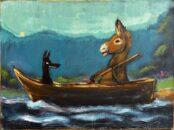
Sally Kindberg’s paintings consider love as a double-edged sword, capable of both creating freedom and causing harm. Each work remains deliberately ambiguous, opening onto moments of dissatisfaction, reflection and quiet heartbreak.
A ceramic work by Claire Partington serves as a contemporary memento mori, reworking the motif of death and the maiden. Surrounded by everyday signifiers of desire and status, her figure cradles death itself, reversing the historical trope to suggest not surrender, but a shift in power. Her Lover’s Eyes, by contrast, reimagine the 18th-century portable romantic memento, though the eyes here are filled with tears, frozen in grief and hurt.
Bethany Stead also looks to historic symbolism: her ceramic sculpture references the archetype of the incubus or ‘sleep hag’, a demon lover associated with sleep paralysis. The work reflects on how obsessive and toxic love can take hold psychologically, emerging as something both intimate and menacing.

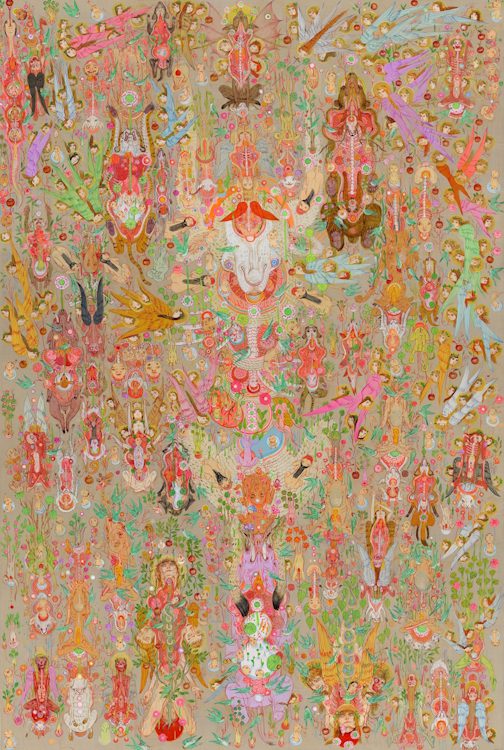
Paintings by Mu Pan and Ben Edge similarly reflect on cycles of death and rebirth in relation to both the self and wider ecosystems. Pan’s intricate composition continues his Blood Series, the artist’s reimagining of Paradise Lost, focusing on the nourishment of blood and spiritual transcendence, where animals serve as offerings as well as the ‘flesh of the earth’. Edge’s paintings, meanwhile, explore tainted love through the self as shaped by past experience: in Shadow Work (Self-Portrait), a string of leaves grows from the artist’s mouth, divided between demonic forms embodying shame and hurt and angelic figures striving toward goodness, while I’ll Be Your Mirror stages an encounter between these opposing forces within a landscape split between spring and winter, evoking the uneasy cycle of death and renewal.
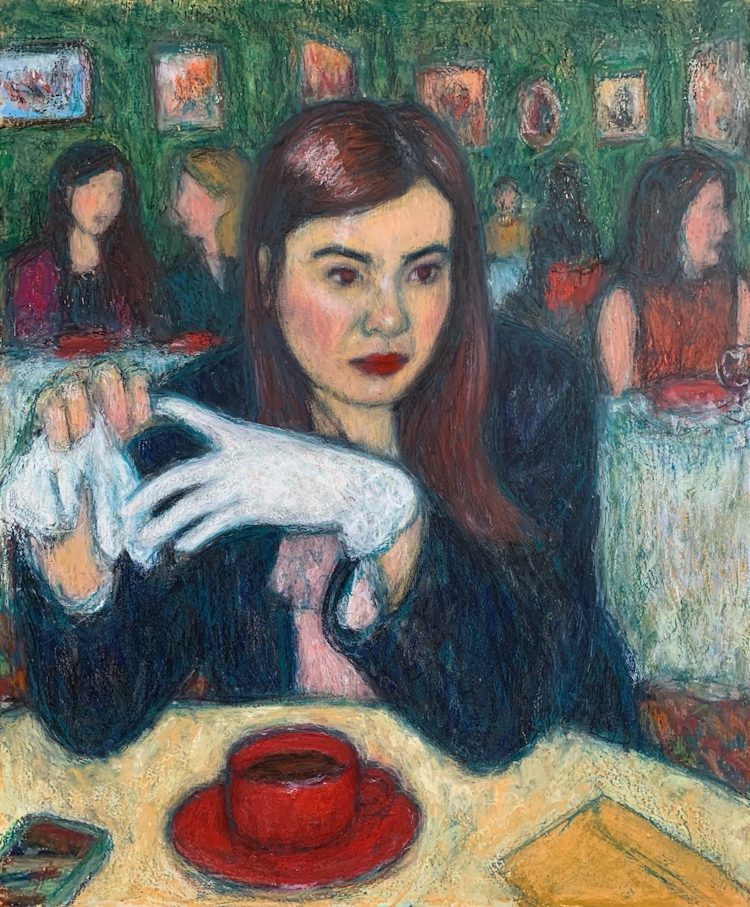
Paintings by Colm Mac Athlaoiuch focus on moments of proximity and parting: in Pillow Talk, two faces are compressed into a narrow space of potential communication, while Marathon Boy and Lycidas suggests an abrupt ending, where figures appear to part ways, their gestures marking the close of an exchange. A textile work by Cheryl Pope also examines the quiet tensions between tenderness, distance and vulnerability that shape lived experience. The work depicts a bedroom scene of a couple who appear together yet apart – the woman looking at her phone, while the man smokes a cigarette as he gazes out of the window.

For over three decades, Brian Chalkley has explored gender, sexuality and identity through his alter ego Dawn, who appears here in stormy landscapes. Through this dialogue, his works speak of melancholy, performance and the desire to inhabit another self, where intimacy is shaped by both projection and longing.Across the exhibition, love is stretched between knowing and unknowing, intimacy and distance, recognition and denial. What emerges is not a singular definition, but a series of unstable states in which love is felt most acutely at the point where it begins to unravel.
www.kristinhjellegjerde.com
Tainted Love
6 Tanner Street
SE1 3LD London
UK
Images courtesy of the artists and Kristin Hjellegjerde Gallery © as per artist


The aim of art is to represent not the outward appearance of things, but their inward significance. – Aristotle