“[L]ike every mass art form, photography is not practiced by most people as an art. It is mainly a social rite, a defense against anxiety, and a tool of power.” (Sontag 1977)
‘Most of my images are grounded in people. I look for the unguarded moment, the essential soul peeking out, experience etched on a person’s face.’ (McCurry 2010, p. 44)
‘Observing others is not simply an act of looking, but a way of navigating existence.’ (Meijun, n.d.)
Who makes a photo and who is made by that image? Steve McCurry’s words describe the pursuit of the genuinely candid — moments seized, unrehearsed, in the field. Maggie Meijun’s practice shares his vocabulary of the unguarded, but arrives at it through an almost opposite method: the carefully constructed scene, the staged encounter, the deliberate mise-en-scène. In this gap between found and fabricated authenticity lies the central question of her work — and of photography itself. The Canadian artist Jeff Wall, a foundational figure in staged photography since the late 1970s, described his own approach as ‘near documentary’ (Wall, cited in It’s Nice That 2019): images that closely resemble spontaneous moments but are, in fact, meticulous recreations. Meijun works in a related, though distinctly more intimate, register.
Maggie Meijun is a London-based artist originally from China whose work weaves personal experience into a deeply reflexive photographic practice. Since relocating to the UK in 2023, her work has become an exploration of displacement, alienation and the unguarded nature of being human — specifically, of humans performing humanity to a digital audience. At the heart of her practice lies a fundamental question: what does it look like when a person is briefly, fully present, given the constant surveillance of self and others? She addresses this question through the camera, but regards herself more as an observer of the human condition than as a technical photographer. Her intention is to delve into the nuances of human existence, focusing on those ‘unguarded moments’ in which individuals reveal their deeper selves within staged constructs. Yet is the line between the artificial and the authentic as clear as we imagine?
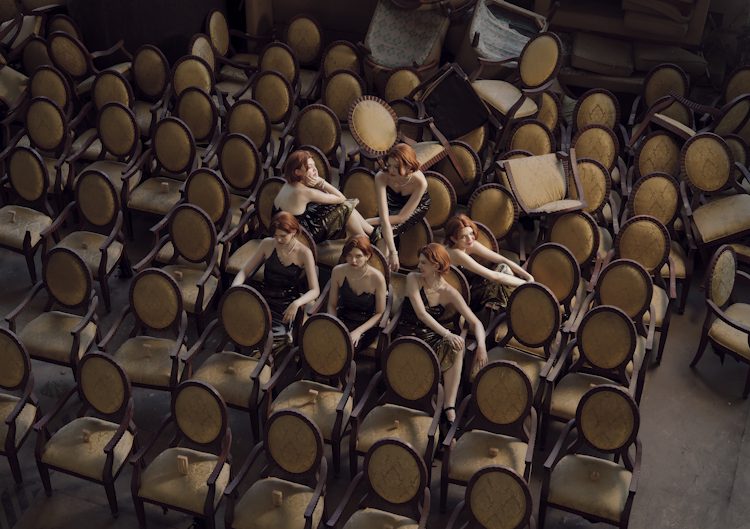
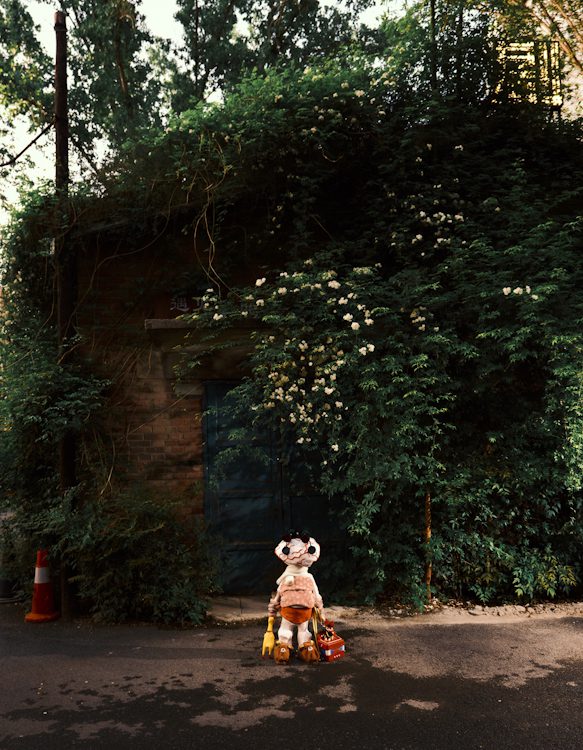
Her images are carefully constructed, with detailed consideration given to light, colour and atmosphere. The series Time Manager (2021–22), for instance, has the feel of works by Gregory Crewdson: psychologically charged, melancholy spaces in which time seems to stand still, pervaded by distance and a pervasive sense of loss. Colour in Meijun’s images is linked to psychological intensity, while light introduces direction and possibility. The interplay between these elements creates photographs that feel both real and slightly estranged, inviting viewers to engage with emotional truths rather than mere aesthetic effects. Some works tend towards the surreal and occasionally the sinister; Meijun emphasises these secondary emotions through colour palette, saturation and voyeuristic framing. This approach is felt most pervasively in Comme dans un rêve (2021–22), which features a strange, toy-like creature standing in what appears to be a road at night — the work at once comical and unnerving.

Meijun distinguishes herself from her contemporaries in significant ways. Having arrived in London alone, leaving behind a familiar life and landscape, she embodies the role of an outsider who understands intimately the complexities of interiority. Her own experience of displacement heightens her sensitivity to others navigating similar conditions. Her subjects — whether individuals carrying difficult histories or strangers caught in candid moments — never feel like mere objects; they are encounters suffused with feeling and emotional depth, drawing the viewer close to the work. Meijun considers herself first and foremost an observer, driven to capture what she cannot stop noticing: those quiet, revelatory moments that all humans share. As she has written, ‘Human psychology, to me, is never fixed. What fascinates me is not a stable identity, but the moments where it becomes unstable, where contradictions appear, and where something unguarded briefly surfaces’ (Meijun, n.d.).

Her subjects often carry difficult personal histories marked by displacement, emotional manipulation and systemic neglect. Rather than foregrounding suffering, however, Meijun emphasises resilience and the growth that emerges from the wounds people bear. The haunted portraits in The Soul in the Stranger’s Gaze (2023) show people caught in the midst of everyday life — walking, riding bicycles, using mobile phones — scenes immediately familiar, and yet ones that draw the viewer, through their lighting and the ordinariness of the street settings, to reflect more deeply on similar moments in their own experience. Meijun explains that she aims to capture a layered existential condition:
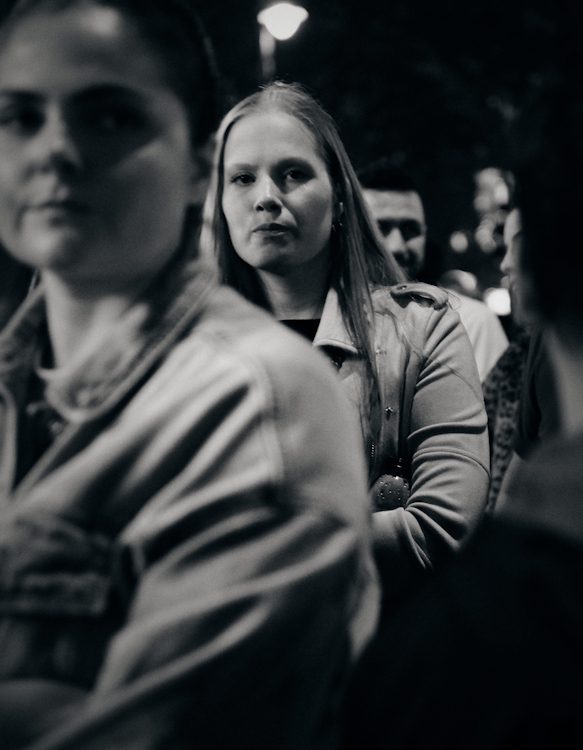
“The subjects are often captured at the exact moment they become aware of being seen, avoid eye contact, or briefly look back. Their expressions remain incomplete and unstable, closer to genuine reactions than posed portraits.
Spatially, the figures are usually surrounded and overwhelmed by the urban environment. They become part of the crowd, the architecture and the movement around them. Yet occasionally, a gesture or glance allows a figure to emerge temporarily from the background and become visible as an individual presence.
The work does not follow a narrative structure. Instead, it repeats the same emotional rhythm across different images: being unnoticed, being briefly seen, then disappearing again.” (Meijun, n.d.)
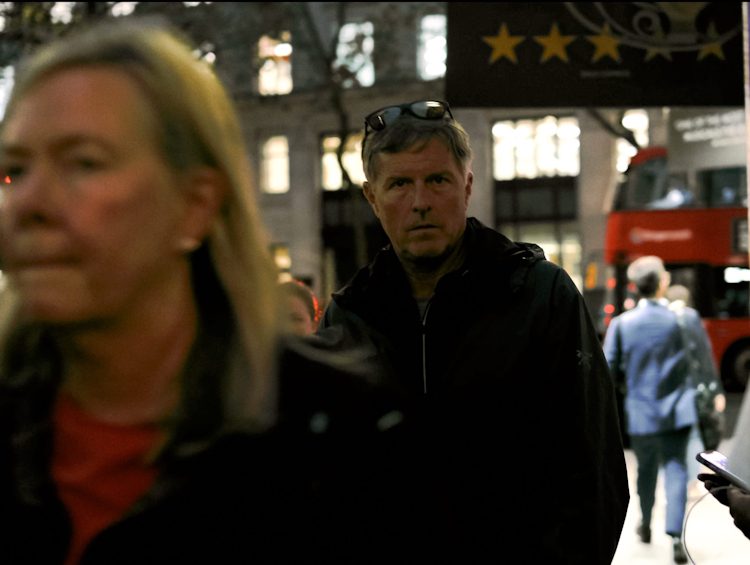
This quality of hovering at the threshold of visibility connects Meijun’s practice to Roland Barthes’s observation, in Camera Lucida (1980), that the moment a subject becomes aware of the camera, something fundamental shifts: the person ceases to be themselves and becomes a pose, a constructed social self — what Barthes described as the subject feeling ‘he is becoming an object’ (Barthes 1980, p. 13). Meijun is drawn precisely to this threshold moment, the instant before the pose is fully assembled, when something unguarded still shows through.
Intentional or not, a quiet strength is present in Meijun’s subjects, particularly through the women she features — a quality that comes to symbolise the beauty found in vulnerability. The women depicted in Chasing Hormones (2021–22) — whose overt staging would not look out of place in a fashion editorial — explore the strength and vulnerability of the female body through figures bent and contorted into familiar and unfamiliar positions, each tableau holding both qualities within a single captured moment.

The series invites comparison with the work of Cindy Sherman, whose Untitled Film Stills (1977–80) similarly occupied and exposed the archetypes given to women to inhabit — the ingénue, the housewife, the femme fatale — by embodying them from within (Sherman 1977–80). Both artists use staging not to falsify but to reveal: the construction of the image becomes the argument about construction itself. Where Sherman turned her lens entirely on herself, collapsing the roles of subject, director and photographer, Meijun turns outward, casting others in scenarios that nonetheless carry an equally interrogative force. The theoretical framework for this kind of practice was being laid at almost exactly the moment Sherman began shooting: Discipline and Punish appeared in English translation in 1977 (Foucault 1977), and Laura Mulvey’s foundational essay ‘Visual Pleasure and Narrative Cinema’, which exposed the structuring of the female body as spectacle through the male gaze, had been published in Screen in 1975 (Mulvey 1975). Meijun enters this lineage with full awareness, using the seductive surfaces of fashion photography to ask what those surfaces conceal and produce.
Clearly staged and yet filled with unforced emotion, these images speak once again to Meijun’s interrogation of internalised archetypes in search of honesty. Philosophically, the work engages with existential questions surrounding presence, belonging, commodification and authenticity. The act of observing and capturing moments of human experience emphasises the subjective nature of reality and the way in which that experience is packaged through image-making. The work compels the viewer to reflect on their own existence and on the way we mediate the interplay between self, audience and environment.
As Meijun explains, “This is why the series is called Chasing Hormones. People may initially believe they are searching for companionship or genuine intimacy, but what often remains is only physical desire and temporary stimulation. The work suggests that this problem is not simply caused by individual emotional weakness, but by the structure of dating culture itself. Dating apps reduce intimacy to a low-cost, highly accessible, and repeatable system, turning relationships into a cyclical form of consumption and disappointment.” (Meijun, n.d.)
The paradox of work such as Meijun’s is that it can be difficult for audiences to distinguish it from the images they encounter in daily life. Since she is largely producing photographs that are not unusual in subject, setting or narrative to our image-saturated eyes, the methodological and philosophical basis for her practice can get lost, leaving us with the question: so what?
Susan Sontag, writing in On Photography in 1977, observed that photographs teach a new visual code that alters ideas of what is worth looking at and what we have the right to observe (Sontag 1977). What Sontag could not have anticipated was the degree to which that code would be democratised half a century later, to the point where it threatens to dissolve the very distinctions it once created. Photography has undergone extraordinary expansion in recent decades, with the visual language of the medium diluted by the pervasiveness of social media, dating apps and advances in digital camera technology. While this has democratised image-making, it has created existential challenges for those who draw upon it in their artistic practice. The image is a contested object in a world awash in imagery, and artists working with the medium find themselves competing for attention not only with other artists but with the mass production of images on social media — particularly when they are playing with the clichés of that medium in order to examine it. This is an old critical hazard: satire or close observation of a subject, when presented in the same form, will often be mistaken for the thing it scrutinises.
Meijun’s work also exists within a cultural moment marked by a proliferation of young artists exploring similar themes of isolation and personal identity. Such concerns — belonging, intimacy, the fragmentation of self — have become increasingly prevalent, particularly among artists whose dislocation is both emotional and geographical. Meijun emerged from the postgraduate photography programme at the London College of Communication, where she was named a 2025 RAW Talent Award winner by Capture One (Capture One 2025). Her project Real Isn’t II was shaped by the experience of approaching graduation under visa restrictions, a situation she described as making time itself feel finite and therefore intensely visible (Capture One 2025). This biographical grounding gives her broader philosophical concerns — presence, performance, the construction of self under surveillance — a particularity and urgency that distinguishes her voice from a crowded field. Her treatment of these themes will therefore need to stand out amid that wider field of related narratives. Furthermore, while her use of colour and light to convey emotional truth is notable, certain aesthetic choices risk becoming overly stylised, which could lead some viewers to perceive the visual surface as the primary concern, leaving the emotional rawness of the human experiences she wishes to capture feeling secondary.
Meijun’s photographic practice presents as an exploration of human vulnerability, identity and the intricacies of belonging, while her creative vision is to reveal our mechanistic desire to maintain the performative churn of image-making as a form of being. Ironically, the underlying tonality of what this cyclical revelation discloses is itself vulnerable, performative and disengaged — her work as bound by a feedback loop as the subjects and methods it employs. The question of whether we are any closer to knowing the artist than the media she consumes remains open. This level of embodiment perhaps found its forerunner in Cindy Sherman, whose Untitled Film Stills (1977–80) revealed the archetypal forms given to women to inhabit — produced at broadly the same moment that Foucault was writing about normalisation and disciplinary power in Discipline and Punish (1975) (Foucault 1977). Where Sherman broke the representational contract by being simultaneously subject, director and photographer, Meijun extends that fracture outward: her subjects are not herself, and yet they are no less constructed. The signs of that double movement are everywhere in her work, and in the gap between the posed and the spontaneous she locates, however briefly, something that looks like truth.
Her perspective as an outsider, and her sustained attention to presence, allow her to capture emotional truths that lie beneath the surface of everyday interaction. Through her lens, she invites viewers to witness the exposed nature of being human, encouraging a deeper understanding of the resilience that emerges from displacement and the complex fluidity of identity. Her work stands as a testament to the beauty found in vulnerability, illuminating the quiet strength that exists within us all.

BIBLIOGRAPHY
Barthes R 1980, Camera Lucida: Reflections on Photography, trans. R Howard, Hill and Wang, New York.
Capture One 2025, ‘Speaking with our RAW Talent Award winners’, Capture One Blog, 23 July, viewed 30 April 2026,www.captureone.com/blog/speaking-with-our-raw-talent-award-winners.
Crewdson G 2024, Gregory Crewdson, Prestel, Munich, London and New York.
Foucault M 1977, Discipline and Punish: The Birth of the Prison, trans. A Sheridan, Allen Lane, London.
It’s Nice That 2019, ‘”Photography is still just evolving”: Jeff Wall in conversation with It’s Nice That‘, viewed 30 April 2026,www.itsnicethat.com/features/jeff-wall-in-conversation-photography-270819.
McCurry S 2010, quoted in Amateur Photographer, 13 March, p. 44.
McCurry S n.d., Portraits, Steve McCurry Studio, viewed 30 April 2026, www.stevemccurry.com/portraits.
Meijun M n.d., artist statements, viewed 30 April 2026, www.maggiemeijun.com.
Mulvey L 1975, ‘Visual pleasure and narrative cinema’, Screen, vol. 16, no. 3, pp. 6–18.
Sawalich B 2010, ‘The unguarded moment’, Outdoor Photographer, March, republished at Art + Math, viewed 30 April 2026, artandmath.substack.com/p/the-unguarded-moment.
Sherman C 1977–80, Untitled Film Stills, Metro Pictures, New York.
Sontag S 1977, On Photography, Delta Books, New York.
Images courtesy of Maggie Meijun © Maggie Meijun.
This review is part of a supported series by emerging artists, including Maggie Meijun. Written and edited independently by Trebuchet; all views are the critic’s own.
Barry Taylor writes and speaks about the intersections of philosophy, theology and contemporary culture. In past, he was the road manager for AC/DC during the Bon Scott era before becoming a Los Angeles theologian.