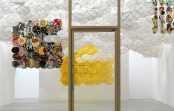
Vulnerability is a human condition. We all carry things deep within us, or a little closer to the skin, that we withhold from public view — out of fear, or in search of safety. The three artists in max goelitz’s current exhibition, Eva Hesse, Lukas Heerich, Rindon Johnson (16 May–until 4 July), embrace this obscuration. Through inky gestures (Hesse), dried skin and pigments (Johnson), and sculptural intervention (Heerich), their work makes us feel the weight and press of vulnerability: the contingent forces at the heart of human existence.
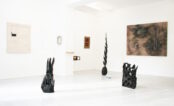
Heerich and Johnson each find inspiration in the work of Hesse. Known for her corporeal sculptures and her pivotal role in Postminimalism. Hesse’s materially and psychologically wrought work pushed geometric rigidity to a point near collapse. She passed away in 1970, aged 34, before reaching what many consider her artistic prime. Despite this, the works she realised manifest the instability of life: how the self is a multidimensional arrangement of physical and psychological states, held together by a precarious sociopolitical mortar. Encountering them, it is hard not to feel a sense of empathy. Heerich and Johnson’s attraction to her seems unsurprising in this regard. From their shared affinity, the pair have collaborated with the gallery, transforming the space into an eerie chamber, something almost maze-like. False partitions, lowered lights — the ceiling lights have literally been brought closer to the floor and dimmed — and the removal of max goelitz’s wall cladding alters the space in a way that echoes the multidimensionality of Hesse’s practice and the contingencies of self her work makes felt.

This exhibition does not feature any sculptural work by Hesse. And yet the three small ink drawings and petit painting included punch and pull with all the heft of Hesse’s sculptural might. The scarred impasto of No Title (1960) speaks directly to this bodily metaphor. Oozing tones of olive green and white, the painting depicts two buggish figures flanking a hazy central space, their elongated arms reaching across the bare space, waving with a kind of frantic energy. These gestures rest as traces gored into the painting’s plain; bodies and scene become interdependent. Such pained marks pull the viewer into the composition, where one can attend to the multiple layers of oil that vein the work — to feel something of Hesse’s hand pulse through the surface. Completed a year after she graduated from Yale University, while she was struggling to carve out a space for herself in New York’s macho art scene, the work testifies to the innovative approach to materials she would pursue in her later practice, where materials are used with a porousness to convey an existential self-reckoning.

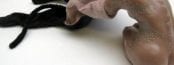
This fleshy unravelling resonates with the contributions Johnson makes to the exhibition, his rawhide and water works in particular. Recalling a crumpled brown paper bag, these skin forms rest in the exhibition below a low-hung light — something between a strip-light and a grow lamp. This architectural intervention draws attention to the effect a space exerts on the body: how spaces contain bodies, restricting their movement, while also nurturing their growth. Johnson frequently uses animal-derived materials such as skin to bring into view the relationship between human and non-human forms of life, as well as the corporeal, sociological, and technological forces that shape existence. Moulded after being soaked in specific pools of water, the rawhides trace these forces through the process of their production, lingering here as body-like stand-ins, vulnerable to their temporal and material surroundings. As they appear, bag-like, in the space, they almost goad this vulnerability, challenging the logics of bodily perception and bodily value. Read in this way, Johnson’s practice hums with a salient air of refusal: a refusal to be contained, to be discarded.

Manastabal, my guide, walks ahead of me with her hands in
the pockets of her jeans, the space is flat, flat enough to reveal
the circularity of the planet on the horizon, the sand passes
in fine hard blades over the beaten surfaces, what comes
through comes as protocol and is indifferent all that is serious
melts into cute, the eagle falls to the ground with a clanking
noise, Manastabal, my guide, normally static in appearance
has relaxed limbs and lively muscles, I have difficulty in attracting
her attention, quite suddenly she says you will have to find
the words to describe this place lest everything you see suddenly
disappears, the egg you already are keeps becoming an
egg again., 2026
Dimensions variable
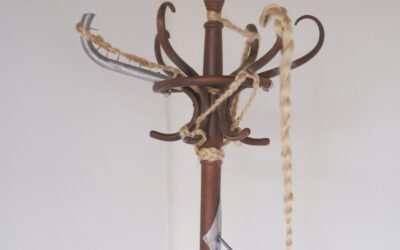
Johnson’s rawhides exist with the innate potential to transform and adapt to their situation. This potentiality sits at the core of Heerich’s work. Blurring sustained cultural research and spontaneous gesture, his sculptures often appear conflicted, out of place as personifications of phenomenological anomie. As with Johnson’s work, Heerich’s sculptures in this exhibition linger as objects susceptible to ideals of time and use, purpose and value, confronting these forces materially. Home (2026), a 3D-printed diptych cast from the polystyrene packaging in which a printer was boxed and delivered in, makes this conflict visible. Produced in translucent white wax, the work glistens in the furthest reaches of max goelitz’s dimly lit gallery, appearing as both a beautiful object of personal luxury and as an apparitional ghost — the spectre of that luxury’s labour. Home does not seek to resolve this duality. By making it physically present, the work prompts us to think about the layers with which we surround so-called valuables, and how we treat these protective layers as insignificant — as waste — when they hold value themselves, a constitutive part of value’s existence. With reference to Johnson and Hesse, this kind of abjected form speaks to the nature of human existence: the social, cultural, and political ideals that render certain forms of life as valuable and others as disposable. Such thinking elides the contingent nature of all forms of life — how a human body depends on the care and support of other bodies, as well as the conditions of its physical surroundings.

Eva Hesse, No Title, 1960
Considered in this light, the architectural exposé and reconfiguration of max goelitz takes on new significance. As a space, the structure of the gallery is one where care and value meet: where an artwork and its artist are nurtured and protected, while often — consciously or not — conforming to certain expectations. The exhibition’s spatial interventions complement the conceptual themes of the works on display in this regard, making the gallery as vulnerable as the art it houses. Within this logic, the body of the gallery becomes level with the body of the work, not one but becoming interdependent. With this in mind, the physicality of Eva Hesse, Lukas Heerich, Rindon Johnson echoes No Title (1960), with bodies emerging, beckoning towards each other across a murky space. Dwelling within the gallery, we become one among many bodies, vulnerable to and a contingent part of life in this chamber of existence. To walk through the exhibition is, in a sense, to wander into Hesse’s oeuvre — gut-punched and pulled towards a friend.

ARTIST BIOS
Born in Hamburg Germany in 1936, Eva Hesse is one of the icons of American art of the 1960s, her work being a major influence on subsequent generations of artists. Hesse cultivated mistakes and surprises, precariousness and enigma, to make works that could transcend literal associations. The objects she produced, at times barely present yet powerfully charismatic, came to play a central role in the transformation of contemporary art practice. In New York in the 1960s, Hesse was one of a group of artists, including Robert Morris, Bruce Nauman, Richard Serra and Robert Smithson, who engaged with materials that were flexible, viscous or soft: latex rubber, plastic, lead, polythene, copper, felt, chicken-wire, dirt, sawdust, paper pulp and glue. Often unstable and subject to alteration, these elements yielded works that were vital in their relativity and mutability. Hesse was aware she produced objects that were ephemeral, but this problem was of less concern to her than the desire to exploit materials with a temporal dimension. Much of the life-affirming power of Hesse’s art derives from this confident embrace of the moment.

Lukas Heerich explores liminal tensions reflected in personal and collective narratives of protection, isolation, and power. His sculptures, installations, and photographs are accompanied by years of research and usually incorporate historical and socio-cultural contexts. At the same time, Heerich draws on spontaneous situations and personal experiences to create multi-layered works in which seemingly ambivalent aspects are juxtaposed. His works often have a strong material presence and can hover on the threshold of visibility and invisibility, alluding to the past and emotions. Sound is the foundation that resonates throughout his work, and its fluid and ephemeral nature has a sculptural quality for Heerich. His rubber and stainless steel sculptures carry this mutable component, precisely reflecting industrial production processes and power structures. Influenced by fashion and club culture, his works show how the subject of control runs through many aspects of society in a multifaceted way.

Rindon Johnson (*1990 on the unceded territories of the Ohlone people, San Francisco) is a multidisciplinary artist and author whose works are rooted in language. Moving between physical and virtual space Johnson explores how language shapes our reality, through failure, contradiction and power. Text is only one of the numerous media that the artist appropriates and assembles into new combinations, using naming to raise questions of autonomy and value. Johnson examines the effects of capitalism, climate and technology on how we see and construct our personal realities. By combining word, technology and object, the artist creates multi-layered works. His forms of expression range from publishing, virtual and augmented reality to working with materials such as leather, wood and stone.
The exhibition Eva Hesse, Lukas Heerich, Rindon Johnson continues at max goelitz, Munich, Germany, until 4 July 2026. Further information
Suggested reading
Hesse E 1960, No Title, oil on canvas, The Estate of Eva Hesse, courtesy Hauser & Wirth.
Johnson R 2021, The Bathers, Inpatient Press, New York.
Kristeva J 1982, Powers of Horror: An Essay on Abjection, trans. LS Roudiez, Columbia University Press, New York.
Lippard L 1966, ‘Eccentric abstraction’, Art International, vol. 10, no. 9, pp. 28–40.
Lippard L 1976, Eva Hesse, Da Capo Press, New York.
max goelitz 2026, Eva Hesse, Lukas Heerich, Rindon Johnson, exhibition page, viewed 21 May 2026, www.maxgoelitz.com/en/exhibitions/70-eva-hesse-lukas-heerich-rindon-johnson/
Various Others 2026, Various Others: Contemporary Art Munich, programme listing, viewed 21 May 2026, www.variousothers.com/max-goelitz
Links
Eva Hesse Estate / Hauser & Wirth
Whitney Museum of American Art — Eva Hesse collection
max goelitz gallery — exhibition page
Rindon Johnson at max goelitzw.maxgoelitz.com/en/artists/58-rindon-johnson/
Various Others Munich 2026
Image courtesy of max goelitz and Hauser & Wirth © the artists. Photography by Dirk Tacke
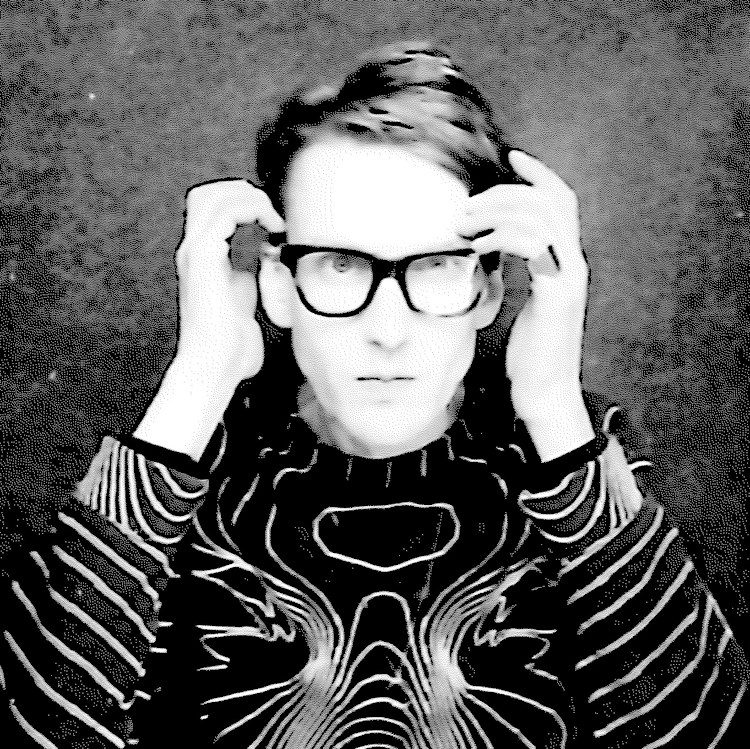
Toby Üpson, is a writer based in Glasgow. In 2025, his first collection of poems was published by La chaise jaune.