Art is a position. Perspective as a creative tool has shaped generations of artists, most visibly in the Renaissance. Yet the instinct runs far older. Some scholars argue that Neolithic cave painters used the curves of rock faces to animate a herd of bison as it appears to gallop across the surface, the viewer (who probably held a burning brand) casting flickering shadows that set the legs weaving into motion. The notion that a work requires, assumes and positions its viewer runs deep. Panofsky, in Perspective as Symbolic Form (1927), bound viewer and work into a single active scheme, and his account of perspective as a form that converts “psychophysiological space into mathematical space” (Panofsky 1927) reshaped the relationship between audience and artwork, whether painting, sculpture, installation, assemblage or moving image. The viewer becomes as much the material as the work itself, and we have been subservient ever since.
For Yuange Sheng (b. 1999, Beijing), who lives and works in London, the question of where the viewer stands draws directly from this history. Appreciating his work means moving from a passive to an active posture, and his practice originates in that tension. Sheng completed a BA in Architecture at Central Saint Martins in 2024, and he sets out to dismantle established systems: the module, the grid, the idea of order, practicality, function itself. The aim is not chaos but bold skeletons of structure that challenge the muscular assumptions embedded in contemporary building. The work originates, by his account, in an urge to dismantle established systems of meaning, taking inspiration from Clement Greenberg. Where Greenberg asked what makes a painting a painting, Sheng asks what makes a building a building (Greenberg 1960; Sheng 2026).
3D Digital Modeling
This theme places Sheng alongside a number of contemporaries, notably the Belgian artist Filip Dujardin, whose Fictions series (2007) splices photographs of real buildings around Ghent into impossible structures. Plausible at first, they tip into the imaginary the moment the eye snags on a missing floor or a floating cantilever. Dujardin disavows any wish to propose real architecture, insisting that “it is only the form that interests me” (Dujardin, cited in Huston 2016), the same suspension of function that drives Sheng. Where Dujardin lends the grammar, the Beijing artist Cao Fei lends the subject. Her RMB City (2007 to 2011) was a surreal Chinese metropolis created inside the virtual world of Second Life, a collage of landmarks, real-estate fever and boom-and-bust speculation rendered as utopia (Kunstmuseum Basel 2026). Sheng shares that skyline, the Chinese city as municipal fantasy and private aspiration built, rendered and left half-occupied, though he clears away her avatars to leave the housing block alone with its logic.
3D Digital Modeling
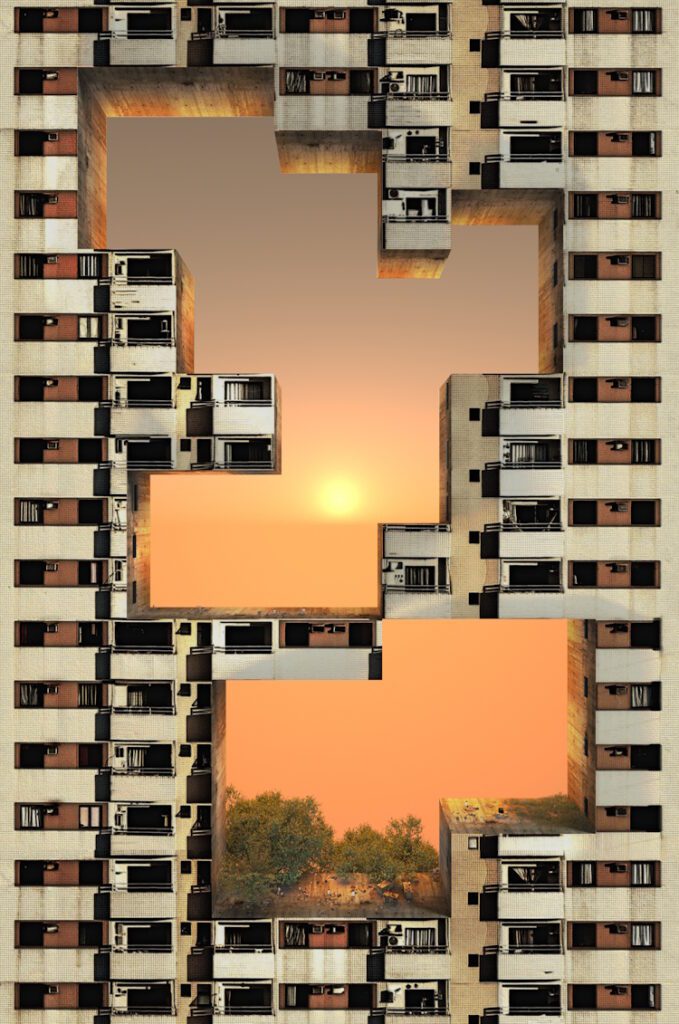
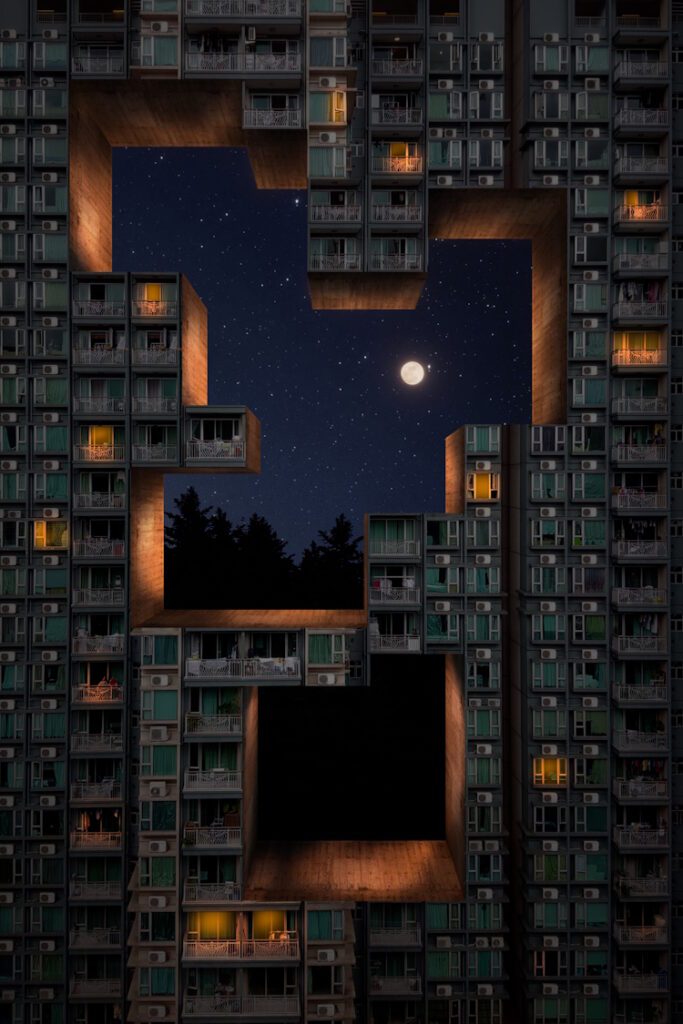
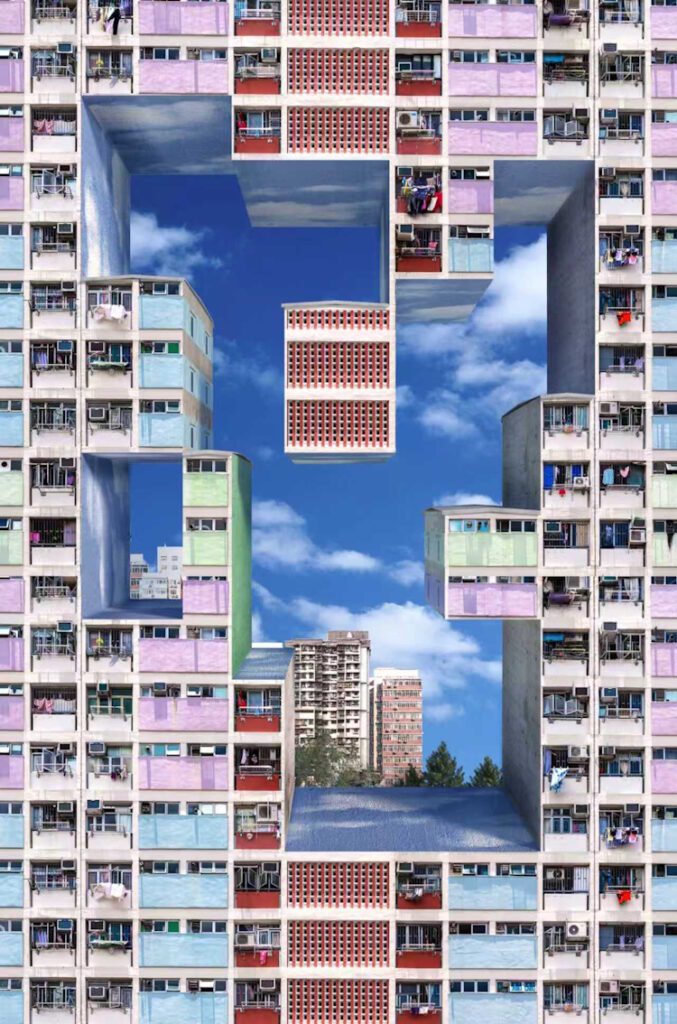
Sheng’s Sky Tetris series stages the question of what a building really is in surreal terms but with real foundations. During his travels through a number of Chinese cities he photographed residential architecture, which gave him the material for his investigation. In particular he treats the blocks not as documentary subjects but as modular units within a larger urban system, and by translating the photographs into digital textures and mapping them onto 3D models, he rebuilds the concept of the building. Through this reconstruction, the buildings detach from their original contexts and reorganise into surreal, Tetris-like formations suspended in virtual space. The interest, he explains, lies in “the moment when architecture ceases to function as architecture and begins to operate as an image, a symbol, or a speculative structure” (Sheng 2026). The results arrest the eye.
3D Digital Modeling
In Tetris Skyline – Unit 5, Xinxiang Community (2023), modular residential blocks hang incongruously in space. Peer through the window formed by the gaps in the main subject and the floating viewer catches other, more familiar tower blocks in the distance. Boxy, modern and teetering toward decay, they return us to the everyday reality of industrial satellite towns the world over. Its companions extend the mood across the day: Tetris Skyline – Sunset, Xinxiang Community (2023) bathes the suspended estate in a developer’s golden hour, while Tetris Skyline – City Night, Xinxiang Community (2023) lights it like a romanticised view of nightlife. But does the artist point to the impossibility of the ideas that occupy the foreground, or to the power of ideas to lift us above the norm? Treat the building as an ontological subject, though, and the work reads as a portrait of architecture dreaming about itself.
Tonally, the pieces mimic the shine and square sheen of a new-build prospectus. The cut-and-paste look of the buildings, the repetition of square flats, works both as a reflection on social experiment and as the lexicon Sheng treats as the foundational ontology of residential architecture. Strip human function from the equation (arguably a building’s primary purpose, though the number of empty skyscrapers in major cities suggests its real purpose is to be built rather than used) and the building stands freed aesthetically, open to new reading. What makes a building a building once nobody needs it? Sheng’s own gloss leaves the question ajar: “A brick is never simply a brick. It is simultaneously material, labour, infrastructure, ideology, memory, and image” (Sheng 2026). Graham Harman, distinguished professor at the Southern California Institute of Architecture, would press harder still. In Architecture and Objects (2022) he argues for “zeroing” a building’s function, severing it from stated purpose so that no object is ever spent by the use we assign it (Harman 2022). A building, by that logic, considers itself built, used, repaired and eroded by the flux of forces, by heat and by human feet, with a surplus no function exhausts.
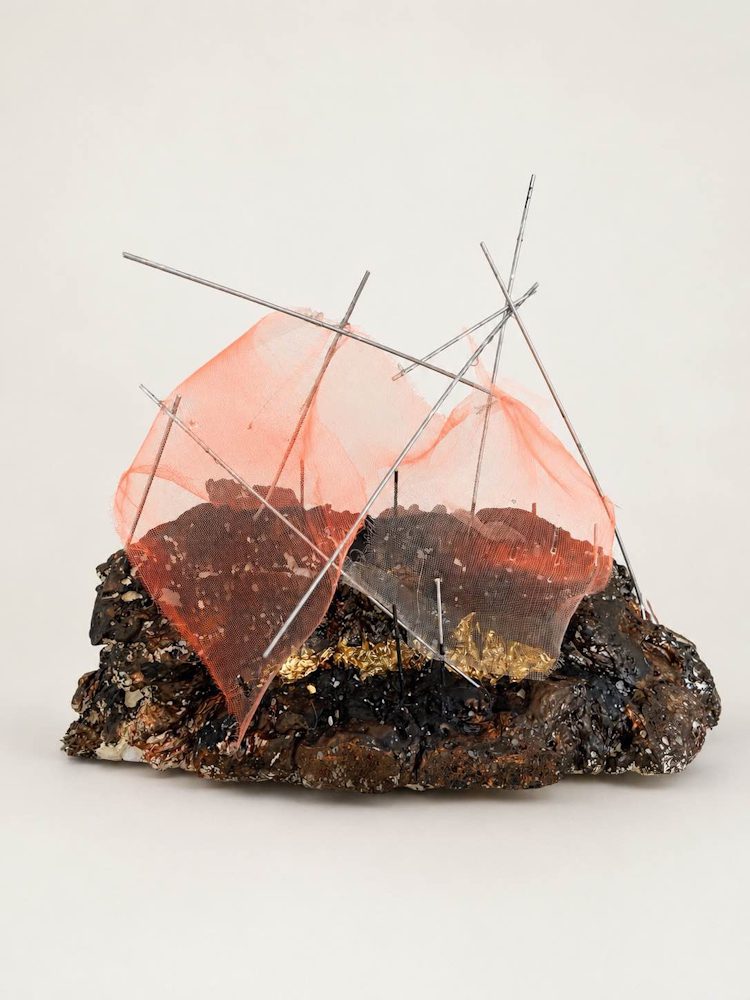
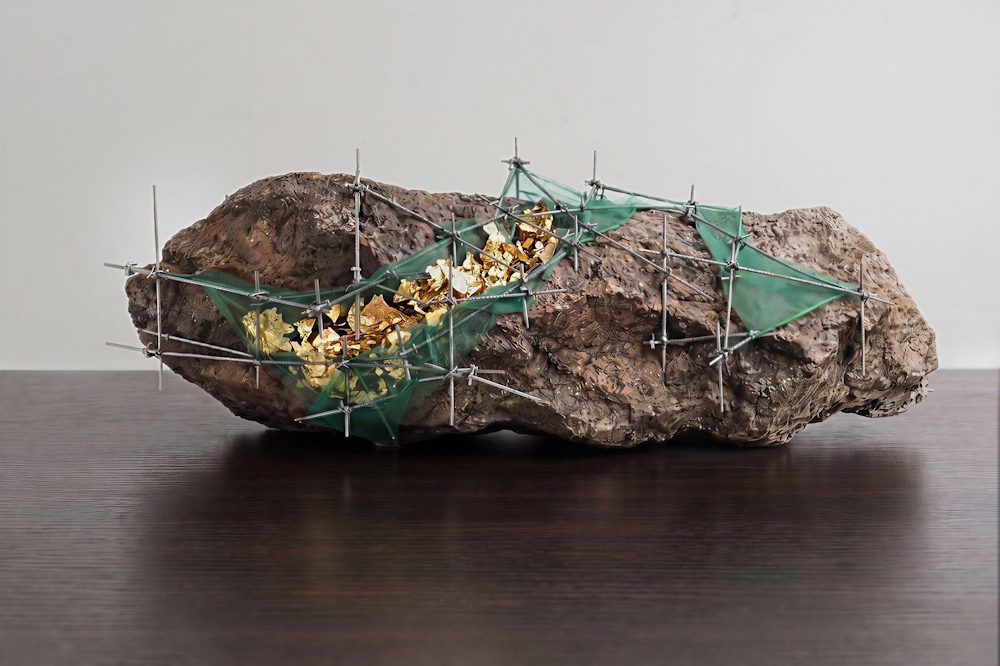
Foam board, expanding foam, mesh net, foil paper, UV glue, iron shaft, coating paint, paper, acrylic paint, filler. 45x40x30cm.
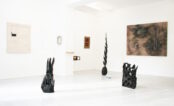
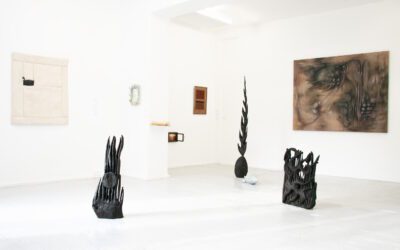
Sheng pursues that surplus into physical material as well. The Scaffolding works (2024) take the same unit and make it flesh: in Scaffolding 3 (2024), concrete and plaster form a fractured, body-like block, its central rupture bound by steel rods and a mesh skin that follows the fissures like a provisional dressing. The framework stops supporting and starts intervening, stitching a form that will neither settle into stability nor collapse outright. What the digital Tetris pieces propose as suspended image, the sculptures hold as matter under repair, the unit caught mid-becoming rather than mid-use.
Does the “Tetris” of the title indict the box-ticking of urban planners, or of those who must live with their choices? In the contemporary city, the burghers’ delusions of order meet the populace’s delusions of elevation. The challenge of these pictures lies in their vantage: the viewer, apparently flying high above the ground, witnesses impossible, beautiful structures that house the statistically improbable dreams of their inhabitants. Lives marked only by the anxious drying of clothes before another anonymous working day. For all their beauty, the three images stage a certain basic architecture, the dream of a caged and uniform humanity. After all, Tetris rewards perfect alignment with disappearance.
But do cities stay conceptually monolithic? In plans and municipal dreams they hold an optimistic, logical order; they bustle with mercantile gain; their buildings align with their ideology. These dove-laden dreams carry no pigeons, no recumbent history of dead ideas. In life, cities run as a cacophony of bleeding desire and undead philosophy, stumbling hungry shapes in search of souls and brains. Which vision does Sheng set himself against: divine order, or the cannibalistic system of culture? Or does the work hold a dynamic ambiguity between the two? The strength of the answer is that it refuses to settle. Sheng builds the standpoint from which his cities can be seen, then leaves us hovering there, suspended with the blocks, unsure whether we are looking at a utopia or its vacancy.
Bibliography
Greenberg, C 1960, ‘Modernist Painting’, Forum Lectures, Voice of America, Washington DC.
Harman, G 2022, Architecture and Objects, University of Minnesota Press, Minneapolis.
Huston, M 2016, ‘Filip Dujardin’s fictional architecture’, viewed 28 June 2026, mhuston.com.au.
Kunstmuseum Basel 2026, ‘Cao Fei’, exhibition text, Kunstmuseum Basel, viewed 28 June 2026, kunstmuseumbasel.ch.
Panofsky, E 1927, Perspective as Symbolic Form, trans. CS Wood 1991, Zone Books, New York.
Sheng, Y 2026, interview with Trebuchet Magazine, London.
Solo Exhibitions
Dust, Solo exhibition, T.H.E.M Institute, Shanghai, CN, 2025
SFZY Gallery, Beijing, CN, 2024
Changting Gallery, Tokyo, JP, 2023
Selected Exhibitions
2026
(Upcoming) Estuary Artist Residency, Trinity Art Studios, London, UK
DMG Zine Release exhibition, Dammit Media Group, London, UK
Expositiva Art Show Prize Museo MAIO – Cassina de’ Pecchi (MI) ITALY, Museo Maio Cassina de’ Pecchi (Mi) Italy, Tromello, IT
Density is not zero, Artcan, London, UK
The 38th Japan–China Art Exhibition: Tokyo Calligraphy and Painting Art Grand Exhibition, Tokyo Metropolitan Art Museum, Tokyo, JP
2024
Nomad Green, FLOHAUS Gallery, New York, US
Selected Press
Sculpture, Collect Art, Tbilisi, Georgia, 2026
DMG Zine Issue 1 Preservation, 2026
Visual Art Journal, 2026
Artron, 2025
Images courtesy of the artist © Yuange Sheng. This article is part of a funded series by emerging artists including Yuange Sheng. All unattributed photography by Yuange Sheng.

Ex-London based reader of art and culture. LSE Masters Graduate. Arts and Culture writer since 1995 for Future Publishing, Conde Nast, Wig Magazine and Oyster. Specialist subjects include; media, philosophy, cultural aesthetics, contemporary art and French wine. When not searching for road-worn copies of eighteenth-century travelogues he can be found loitering in the inspirational uplands of art galleries throughout Europe.