One of Britain’s most distinctive figurative painters, Eileen Cooper RA has spent five decades turning her own lived experience into allegorical tales of womanhood, populated by recurring companions: tigers, bears, ladders, mirrors and, most recently, the domestic cat. The first woman to hold the post of Keeper of the Royal Academy in its history, she is currently on show at Kristin Hjellegjerde Gallery, Tower Bridge, with her solo exhibition Learning to Fly (3 September – 3 October 2026).
We featured excerpts from this conversation in our profile of Cooper in Trebuchet 19. Here, we publish the interview in full: on symbols and their shifting meanings, mythology and reflection, life drawing and its discontents, and what it means to keep painting the body into her fifth decade as an artist.
Your figures are often depicted with symbolic companions: tigers, bears, ladders, swings. How do you arrive at these symbols, and what do they represent in relation to the female body and experience?
Eileen Cooper: That’s evolved over a long period of time, and sometimes these symbols carry different meanings from one group of paintings to another. There may be many years between my using one of those symbols and then returning to it.
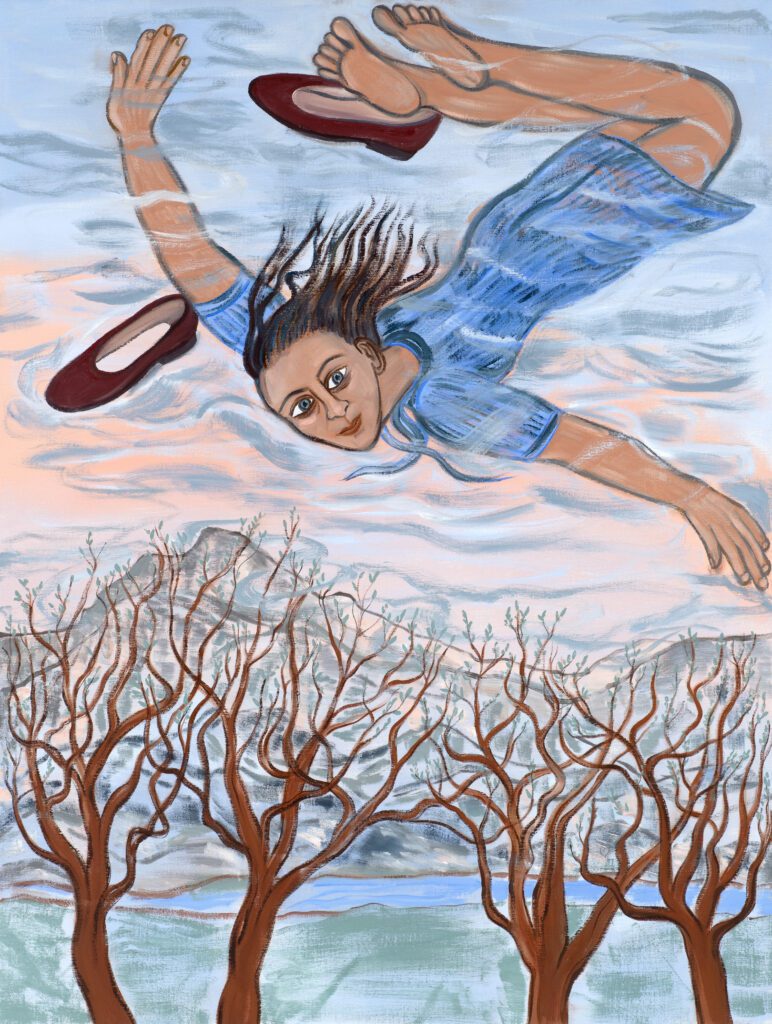
Ladders, for instance, feel very different now from when I first felt the need to portray figures with ladders in the 1970s. In those early works, the ladder seemed to allow the body to travel through stages, sometimes painful ones. The first tiger was very tied to motherhood for me, and now the tiger has become an occasional companion. The swing has always been about freedom, exhilaration, and fear, perhaps propelling the body into the world. The bear is relatively new; it first appeared when I made some illustrations for a Folio Society publication of Nights at the Circus by Angela Carter. I feel I’m not done with it yet. The bear is definitely a new companion to my recent figures. In a way, I have a feeling that all the animals have become part of the women.
You mentioned that the bear first arrived through your illustrations for Nights at the Circus, and that you feel the animals have “become part of the women.” Does that mean the boundary between the human figure and her companions is becoming less distinct in your recent work and is that a deliberate move toward something more hybrid or mythic?
To be honest, it’s just evolved. I’m not sure how much is ever deliberate or thought out in my paintings. At their best, they develop their own life and lead me to explore new areas. I think animals and people do share characteristics, and deep bonds develop. Symbolically, with the tiger, I was drawn to it because I recognised that it represented the wild, fierce, and protective nature of the mother. I think I’ve tamed that tiger. Perhaps she’s been replaced, to some extent, by the domestic cat — self-reliant, sensuous, and secretive. I can only speculate.
Mythology appears in your recent work, particularly through the figure of Narcissus. How does the act of reflection function in your practice, is it primarily a quest for self-knowledge, or does it speak to something broader about how women have historically been looked at?
Mythology and other stories have always been there for me since I was a child. Mirrors, reflection, and the shadow are all elements of that quest for self-knowledge. It’s certainly true that women are scrutinised — men also, more so nowadays. Subconsciously, perhaps, I’m tapping into that. I hope my female figures, in their confident bodies, do own their own space.
You have described your current work as the work of an older artist. In what ways has your understanding of the body, and your willingness to represent it, shifted across your career?
My passions are different now. I’m not concerned with sexuality and fertility in the way I was as a young artist. I’m also less inclined to paint naked figures. I used to think my figures in the 80s and 90s were clothed in colour. It seems natural to me now to keep the physicality and sensuality of the body, but the clothes play their part too.

Your figures seem to occupy a space between the personal and the universal female experience. How consciously do you negotiate that tension, and does it feel like a political act?
I’ve often said the female figure in my work is both personal and universal, it’s my standard answer when asked who the figures actually are. Yes, there is a tension there, and especially when I was younger, it was a way of deflecting the idea that my works were purely self-portrait or autobiographical. Of course, in truth there are elements of both in my work. I agree with the feminist slogan that emerged in the late 1960s: the personal is political.
Observers have noted that your stylised faces and figures carry echoes of a Fauvist sensibility, yet they seem to restore an interiority to figures that male painters in that tradition often denied their subjects. Is that a deliberate reappropriation of a historical visual language?
My faces are informed by art I have loved since I discovered it at art school, Egyptian art, Indian miniatures, icons, the Italian Madonna, Japanese prints. Picasso has always been important to me. I’m very happy with the phrase “seem to restore an interiority to figures.” I’m very open to others’ insights into my work.
Your practice has moved between direct life drawing, works of pure imagination, and back towards portraiture. What does that oscillation tell us about your relationship with the body as a source of truth?
As a student, in my first life room drawings, I often identified with the model and felt quite protective of her, it was usually a woman. There was often an uncomfortable atmosphere; I worried the models were in discomfort, even pain. I think that’s one of the reasons I abandoned life drawing. Working from imagination, feeling, and memory felt much more exciting and empowering. Right from the start, using the female body and my own experience was key to my work — so it was unavoidable that sexuality, fertility, and motherhood became big subjects for me. The body is very much a source of truth for me.
I began the portraits because I needed a new challenge, and as you might expect from what I’ve said, I go to great lengths to make the sitter feel comfortable. Now objective work sits side by side with the more imaginative, allegorical pictures, and these ways of working directly inform each other.
You described feeling protective of the model in the life room, and sensing her discomfort. That’s a striking ethical response to a situation most art students simply accepted. Do you think that discomfort, and your resistance to it, was formative not just in practical terms, but in shaping the kind of painter you became? In other words, did refusing that dynamic set you on the path toward figures who are active, autonomous, never passive?
Such good questions! Yes, absolutely. This was a formative experience, and perhaps it did set me on a path of fighting back on behalf of all the anonymous, passive, and objectified models. I hate hierarchical behaviour and hope I treat everyone with respect, so even at 17, when I drew my first model, I sensed this was a very challenging situation. I always preferred clothed models, even though the naked female figure became an important ongoing subject for me.
In conversation with R. Jones, you spoke about looking beyond intellectualisation as central to your process. How does that tension between instinct and intellect play out when the subject is the female body specifically?
I’m definitely not an intellectual artist, so there’s no tension I’m aware of. I learn through making and engaging with ideas and stories. New imagery develops through that process and continues to feed me.
The body in your work is rarely passive, it balances, swings, climbs, reaches. What is it about physical gesture and precariousness that interests you as a formal and symbolic device?
Correct, the figure is rarely passive. If the figure is leaping, crouching, crawling, stretching, I can depict that, or at least attempt to. Balance and the everyday precarious nature of living are often present in my work. Physical endeavour is a big subject for me: the dancer, the acrobat, the artist in the studio, the mother, the teacher, the gardener. I rarely paint a passive female figure. Though I do love sleeping figures, when she’s free in her own dreams.
How do you situate your representations of the female body within art history more broadly, and is there an artist such as Paula Rego whose engagement with female experience you feel in genuine dialogue with?
Art history is present for me all the time, as it was for Paula Rego. I was lucky to know Paula over a long period of time and went to all her exhibitions. I’m not sure I ever felt in dialogue with her exactly. Looking at her achievements now, the body of work is incredible, and she’s a touchstone for so many. My instinct was to look further back, to find the women artists who used their own experience and their bodies, as Paula did, to make groundbreaking work. In 1976, my final year at art school, Women Artists by Karen Petersen and J.J. Wilson was published, and that was groundbreaking for me.
I should also say that I continue to be inspired by many male artists and art from many cultures.
You said your instinct was to look further back than Paula Rego, toward women artists who used their own bodies and experience as raw material. But you also said you’re not sure you ever felt in genuine dialogue with her. Given how much territory you share — female experience, psychological charge, the refusal of passivity, what do you think kept your sensibilities apart? Was it temperament, visual language, or something harder to name?
Definitely not temperament. We both shared a dark sense of humour, and she gave me great advice on navigating the art world. She was especially helpful in forming my attitude to printmaking. It was probably more to do with Paula’s renewed interest in working from observation. In the 1990s, she became more and more committed to setting up scenes to work from in her studio, using models, costume, and so on directly. At that time I was still very rooted in working from imagination. Paula talked about Goya, Balthus, and Lucian Freud. I was more in dialogue with Picasso, Frida Kahlo, Francesco Clemente, and Ken Kiff. I did also look a lot at artists who worked differently from me. For instance, Marisol, Niki de Saint Phalle, and Helen Chadwick, whom I also knew.
In the past few years, developing the ongoing group of portraits, all from life, and now over 100 of them, perhaps there is a more direct creative dialogue with Paula Rego, and of course Alice Neel.
Scale, line, and form feel like active decisions in your paintings rather than neutral ones. How do those formal qualities carry meaning when the subject is the lived experience of women’s bodies?
You can’t make paintings without learning, understanding, and making formal decisions. So yes, these are active choices. We might add media and materials to that list. I don’t think this is at odds with any subject an artist uses. For me personally, materials play a huge part in adding meaning to the subject, and I think that’s especially apparent in my work when I’m trying to communicate the lived experience of the female body.
Many thanks for answering our questions.
A complete pleasure — and not your average interview at all. It really kept me on my toes.

Read more in Trebuchet 19: Beyond Bodies
Edith Dekyndt | Alessio Boni | miart | Milan | Venice | TBA21 | Eileen Cooper | Kara Walker | Benjamin Spiers | Jake Chapman | Félix González-Torres | Guggenheim Bilbao | Scotland | Jupiter Artland | RSA | Robert Stilin | the body | phenomenology | biopolitics | ecology | the telluric
Ruth O’Sullivan is a writer and curator. Her work explores the impact of digital technologies on contemporary art practices and challenging gender disparity within the visual arts.