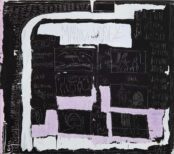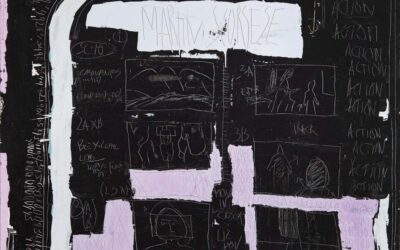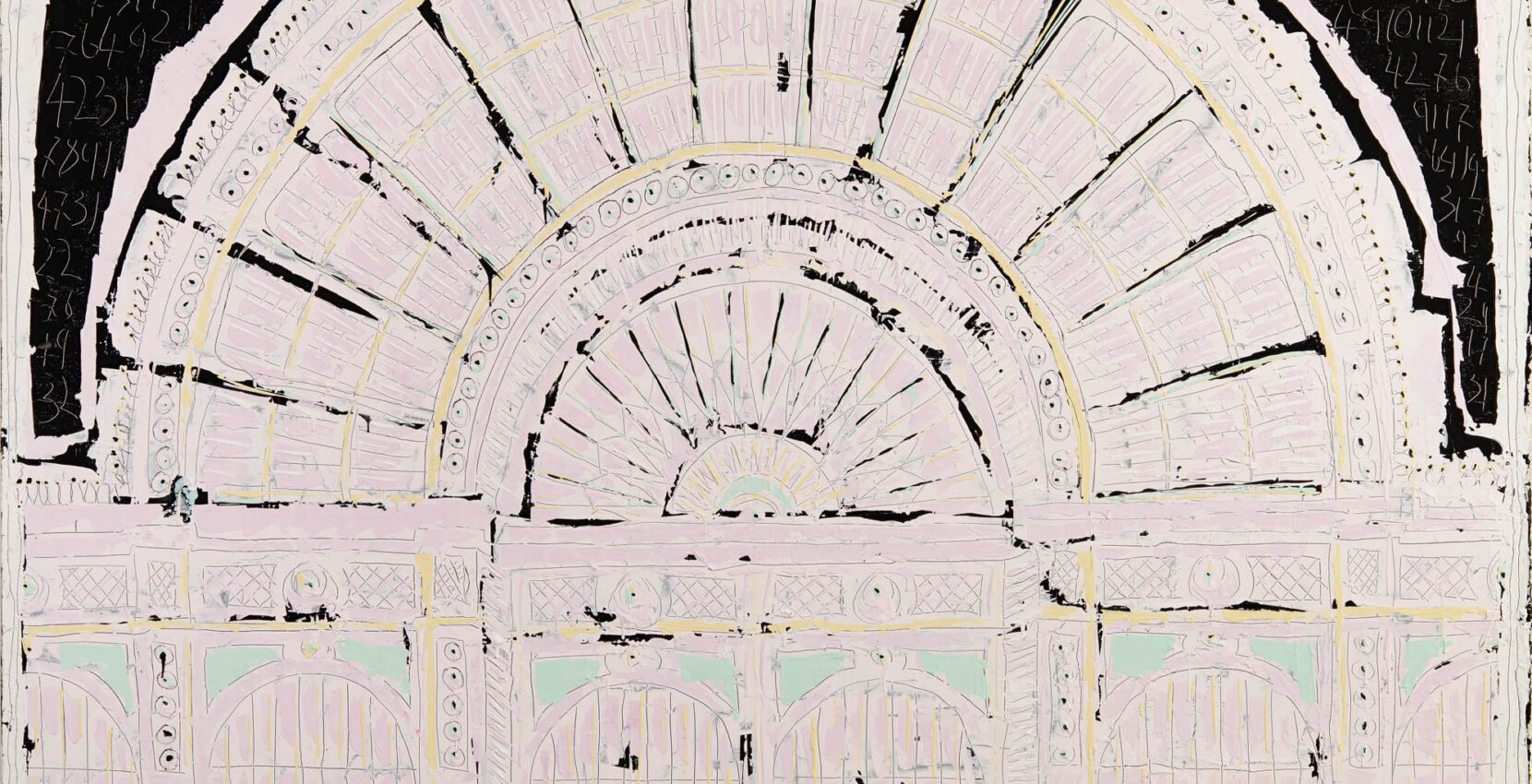
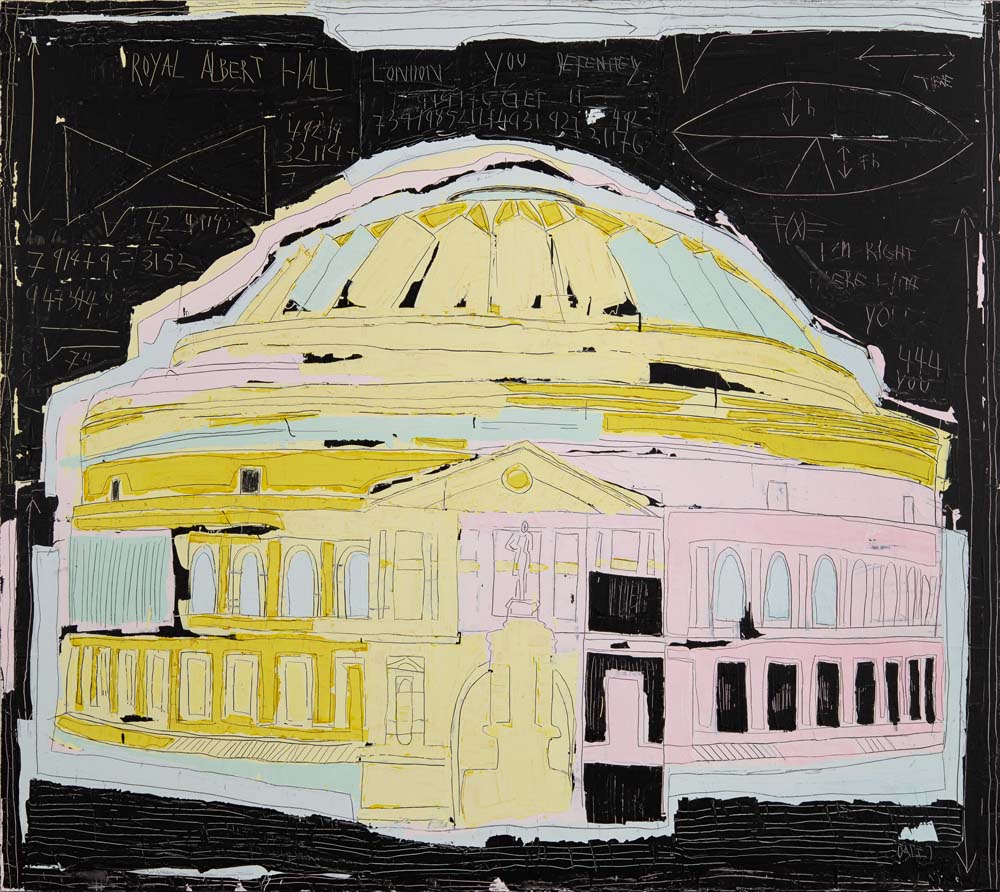
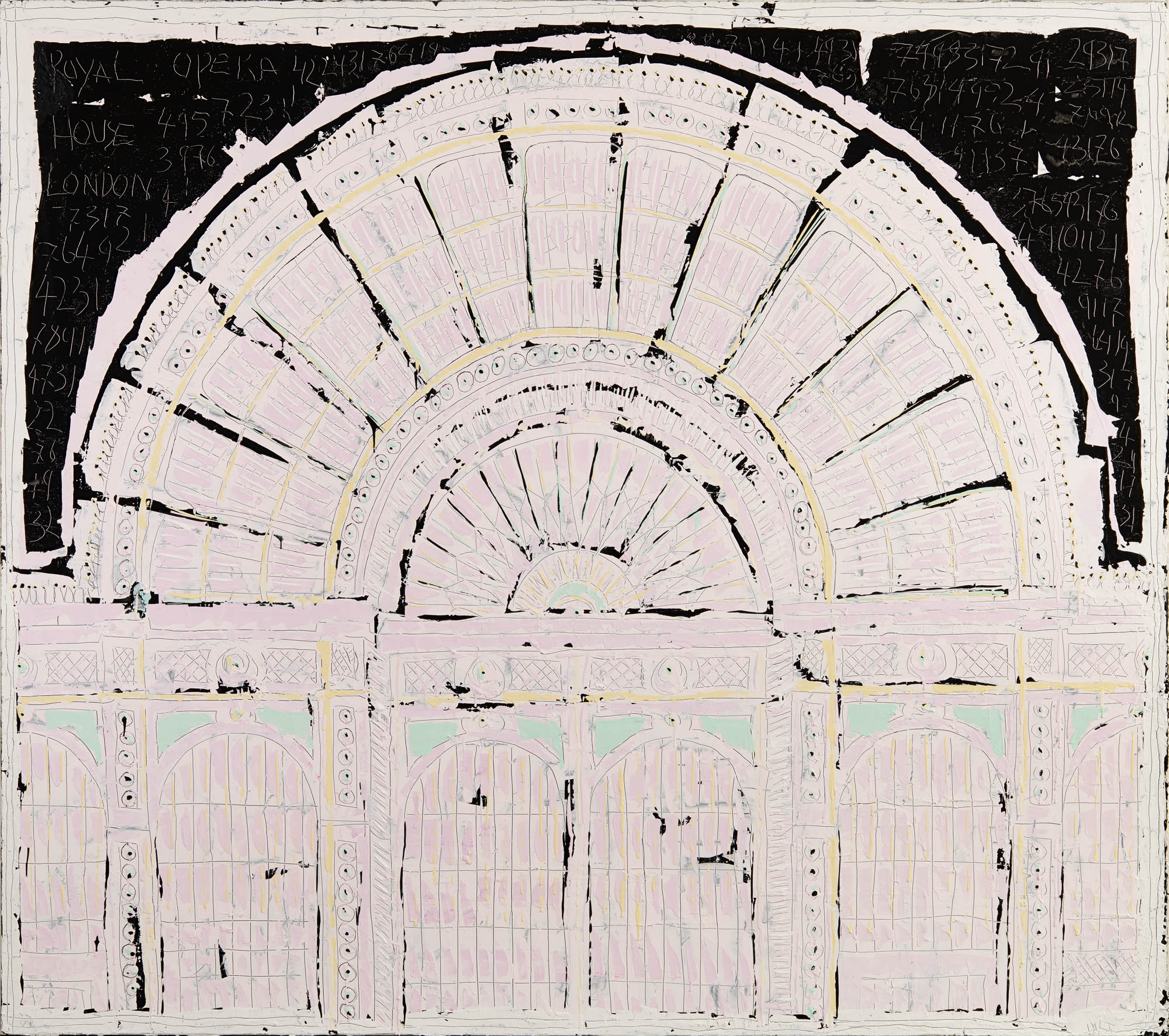
Blocks of limoncello yellow, marshmallow pink, aero blue and teal sit against chalkboard black surfaces that suggest the template of mathematical thought, scratched onto the shapes like the movements of a tense score. A Fibonacci spiral punches out from the canvas, at once a discovery and a process of reasoning. The numbers, frenzied and gestural, squeezed into corners here and stretched out there, tell a story of someone setting down facts wherever they fit: a story of displacement and declaration.
Dutch-Australian and raised in Bali, Schonfelder trained at Parsons School of Design in New York. Her approach to painting turns on finding a central source of meaning, one that catalyses a vision of the world through which she connects with it at large. For her, maths and musical structures carry more than what they connote; they enact a process of understanding that becomes a vessel for emotion.
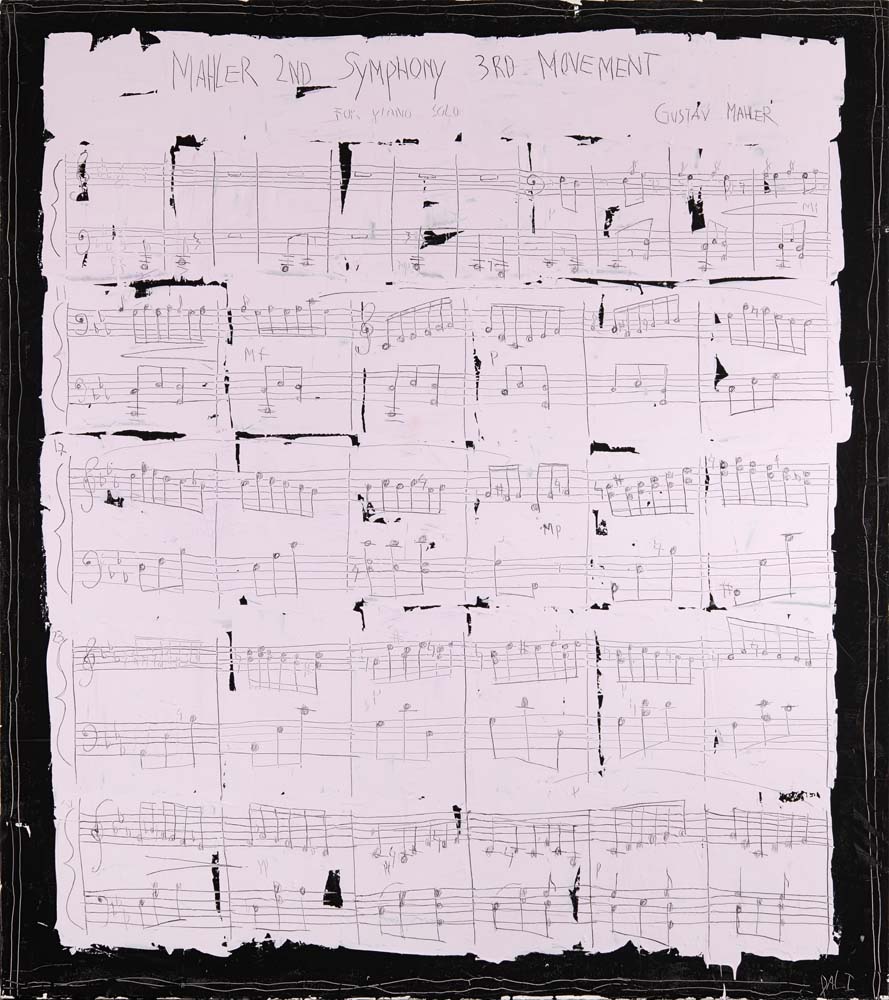
The musician and art collector Nile Rodgers, of Chic, found a personal connection with the musical scores in her work, and, more tellingly, a sense that those keys led somewhere beyond the familiar. This raises the central challenge the work presents. Do we engage with the scores and equations directly, or are they symbolic? And to what extent does the friction between the two hold the functional immanence of the pieces?
We might read the work as a reimagining of assumed knowledge, the way Ed Ruscha, or fellow Parsons alumna Barbara Kruger, used language as both a means and an output of disorientation (Whitney Museum of American Art n.d.). Schonfelder uses numbers, maths and music in the same way. Many artists have drawn on music for the formal rhythms that shape a narrative structure, and the direct use of the Fibonacci sequence and the golden ratio in painting runs so deep in the tradition that it barely warrants remark. So what does Schonfelder’s use of these practical concepts mean?
One arch reading would hold that the works reflect knowingly on the practice of art-making itself: a demystifying statement about the calculations beneath a painting. Literally, this is how painting works. That stark surface reading, though, does not survive the execution, which fizzes with a joy in how the numbers behave. As the artist explains:
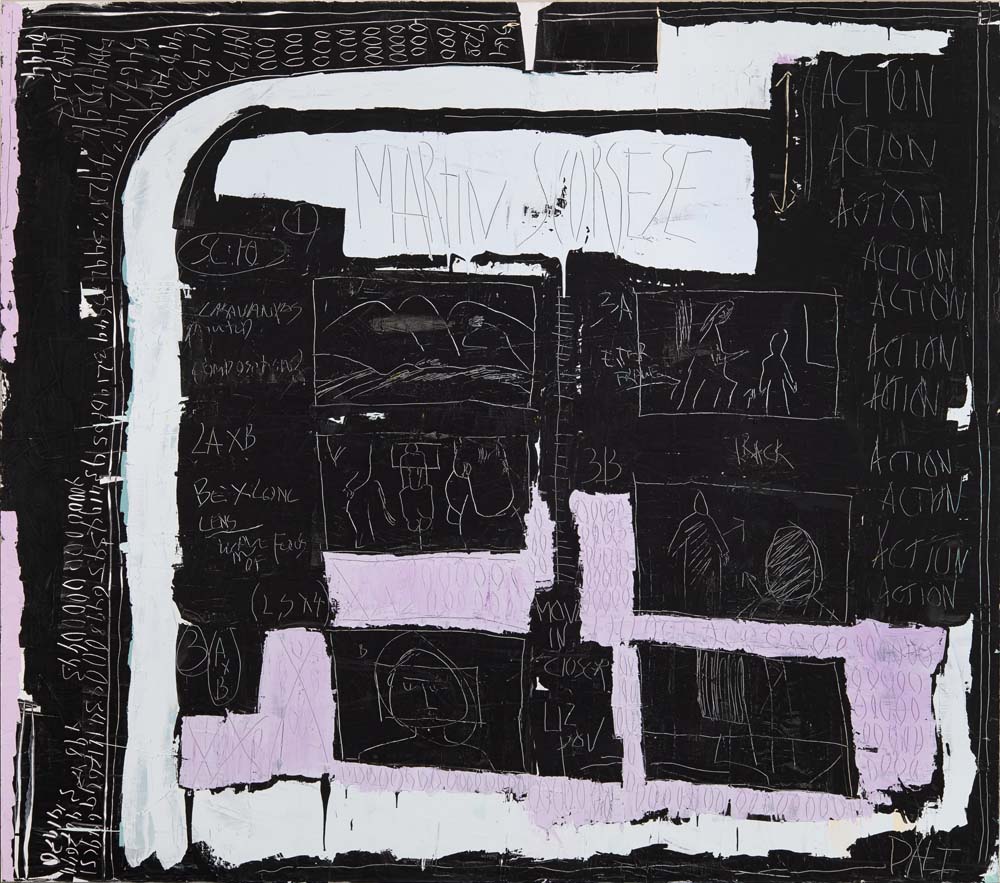
“Maths has always fascinated me. Not only do I find numbers and equations incredibly beautiful to look at, but you can use numbers to make sense of the world we live in. In my younger years I wasn’t the best at school, but numbers always made sense to me. It’s incredibly beautiful how maths allows everything to fall into place. And at the same time, as much as we can make sense of the world through numbers, there is still so much to discover, and life is still such a mystery to be lived. My recent work has lots of numbers and equations that actually don’t make sense. It was my way of connecting with numbers and maths, and also being okay with them not making sense or needing to be figured out. But my next series will go back into maths: specifically physics, and space and time.” (Schonfelder n.d.)
A harsh view of this emerging artist’s work might note that the apparent simplicity of her execution, elementary composition, reuse of palette, and what appears to be a narrow emotional range of her recent work, mark an artist at the beginning of a journey. However, a counter argument would look at the same factors as evidence of a directness, vivacity, and the sort of mature stylistic focus that puts her ahead of many peers. At this stage it’s a promising beginning, where the work poses an intellectual premise: how we encounter the ‘facts’ of our existence in ways both rational and incomplete.
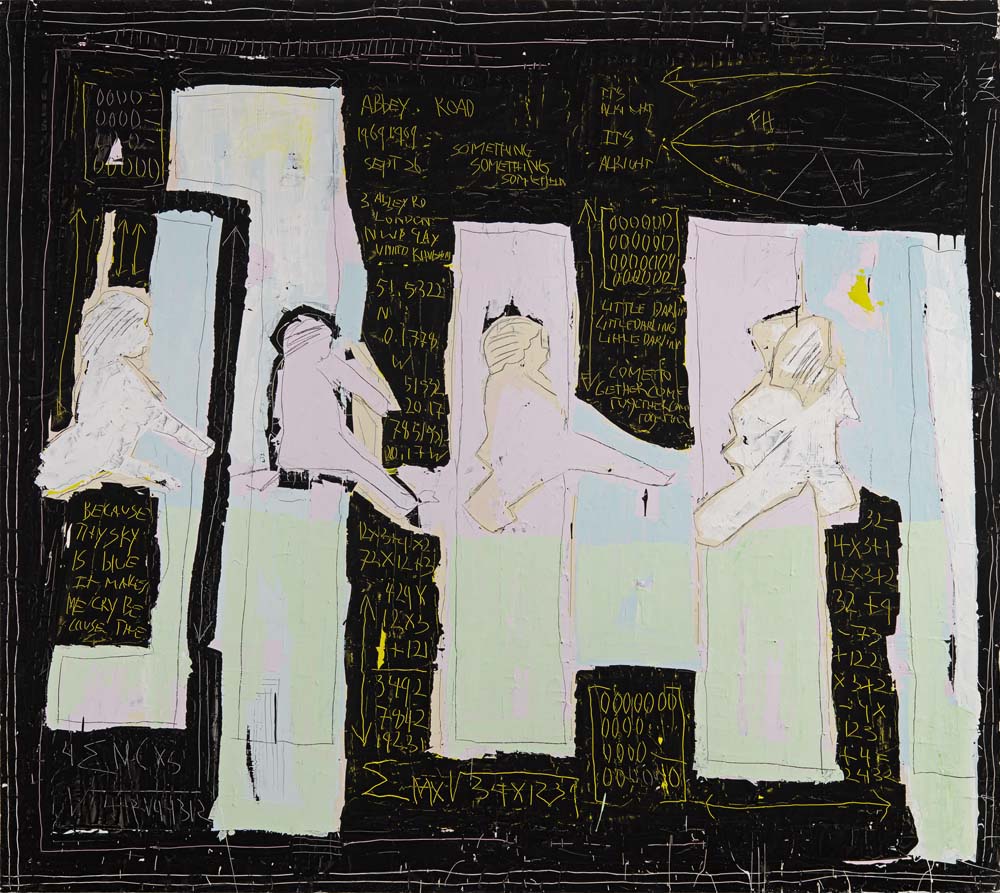
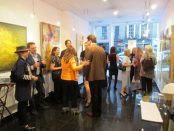
The gap between understanding, literalism and formality is where the work finds life. In her recent show at the Rebecca Hossack Art Gallery (Doors of Perception, 2026), works act as portals to other relationships with familiar structures, made symbolic through ongoing personal experience. Day and Night (2026), Flat Iron (2026), Royal Opera House (2026) and Mahler Symphony 3rd Movement (2026) each refer to places or pieces broadly familiar to most viewers. Her layering of mathematical and musical information over flat colour, with outlines drawn in the same gesture as the numbers, binds them visually and conceptually: sketches of understanding still in progress.
Like Ruscha and Kruger, she uses a literate lexicon to draw us in. Once we engage with the meaning being conveyed we find ourselves on less pedestrian footing, slipping between the known and the process of knowing. For an emerging artist, that confidence marks an interesting trajectory, though her work, like the formulae she rewilds, rarely moves toward a single correct answer. Instead, it admits us to a manner of understanding that praises the indeterminate paths we walk. And as we try to quantify the ineffable, we’re drawn onward by the promise that, though partial, knowledge is possible.
Dali Schonfelder is represented by the Rebecca Hossack Art Gallery, London.
Bibliography
Schonfelder D 2026, interview with A Tonnerre, Trebuchet.
Images courtesy of the artist © Dali Schonfelder. This article is part of a funded series (in this case Schonfelder gave us an artwork) by emerging artists including Dali Schonfelder.

Ex-London based reader of art and culture. LSE Masters Graduate. Arts and Culture writer since 1995 for Future Publishing, Conde Nast, Wig Magazine and Oyster. Specialist subjects include; media, philosophy, cultural aesthetics, contemporary art and French wine. When not searching for road-worn copies of eighteenth-century travelogues he can be found loitering in the inspirational uplands of art galleries throughout Europe.