Shenlu Liu’s practice contains a paradox. Her work, luminous, sequined, alive with light and colour, is strikingly visual, and yet its central argument is that we have lost something in our devotion to the image. Rooted in knitting, weaving, and embroidery, and extending into installation, moving image, and sensory interaction, Liu’s practice is a sustained attempt to restore what she sees as the slow erosion of embodied feeling in contemporary life: the ability to perceive beyond the visual alone.
Trained first at the Beijing Institute of Fashion Technology, where she completed a Bachelor of Art in Fashion Design (Knitwear), Liu went on to graduate from the Royal College of Art’s MA Textiles Design programme in 2024. A technical foundation that continues to inform her conceptual ambitions. Where many artists use textiles as metaphor, Liu treats them as a mechanism: a recalibration device for a nervous system overstimulated by screens and under-nourished by touch. She builds ‘ornamental energy shells,’ constructed from sequins, yarns, and colour, surfaces that are simultaneously intimate and protective: permeable membranes rather than rigid shields, absorbing the projections of anxiety, memory, and longing that contemporary life rarely makes room to hold (Liu 2025).

These qualities are not incidental. In exhibitions from Beijing to Paris, Tokyo to London, her emotional landscapes have been entered rather than decoded, functioning as spatial conditions rather than psychological diagrams. As Merleau-Ponty observed, ‘the body is our general medium for having a world’ (Merleau-Ponty 1945); Liu’s textiles work to repair, as she puts it, ‘the channels through which perception operates’ (Liu 2025). Responding to Trebuchet, Liu discusses the crisis, the philosophy, and the craft through which she responds to our times.
How does your practice of knitting, weaving, and embroidery become a mechanism that responds to a ‘crisis of perception’? Can you explain what you mean by ‘crisis’?
The “crisis of perception” I refer to is not a sudden collapse, but a slow and continuous erosion. In contemporary life, perception has become highly visualised, flattened, and optimised for efficiency. Touch is increasingly replaced by screens, and emotions are reduced to easily recognisable and consumable symbols. We are exposed to more and more information, yet our capacity to truly sense through the body — to linger, to resonate, to feel — has gradually weakened. This disconnection between perception and the body is what I understand as a crisis.
It is within this context that my craft-based practice becomes a mechanism. Knitting, weaving, and embroidery rely on repetition, rhythm, and the sustained presence of the body. They force perception to slow down and draw attention back to the hands, to touch, to the resistance and responsiveness of materials. For me, these processes are not simply means to produce an outcome, but methods for recalibrating perception itself.

Through this process, the body is no longer merely an executor of actions, but re-emerges as a perceptual system in its own right. As each stitch unfolds, I am sensing not only the material, but also shifts in my emotional state, fluctuations of energy, and inner tensions. In this way, craft becomes a practical mechanism that responds to the crisis of perception — not by generating more images, but by repairing the channels through which perception operates.
This crisis suggests something philosophical; Wittgenstein? Saussure? Could you elaborate?
My practice does not begin from a specific philosophical theory, but when reflecting on it, I recognise resonances with broader questions surrounding language and meaning. If Saussure speaks of the arbitrariness between signifier and signified, what I experience today is a rupture between emotion and its modes of expression. Feelings are excessively named and encoded, yet stripped of their sensory depth. We possess more and more language to describe emotion, while the lived experience of feeling becomes increasingly difficult to access.
Wittgenstein’s idea that “the limits of language are the limits of one’s world” functions for me more as a prompt than a framework. When language becomes insufficient or overloaded, is it possible to access another mode of understanding? My practice does not seek to replace language, but to introduce a non-verbal perceptual structure where language falters.
Textiles, in this sense, operate as an alternative language system. They do not function through representation or designation, but through touch, rhythm, density, and repetition. Meaning is not explained; it emerges through the bodily encounter between material and perception.
Are you elevating craft as an artistic practice, one that embodies the maker in the made, or is it something else?
Yes, but not entirely. For me, craft practices such as knitting, weaving, and embroidery are never simply about elevating a skill or technique. They are modes of existence — ways of being in dialogue with the world and with myself. Each stitch, each repetitive gesture, records the passage of time and the focusing of attention.
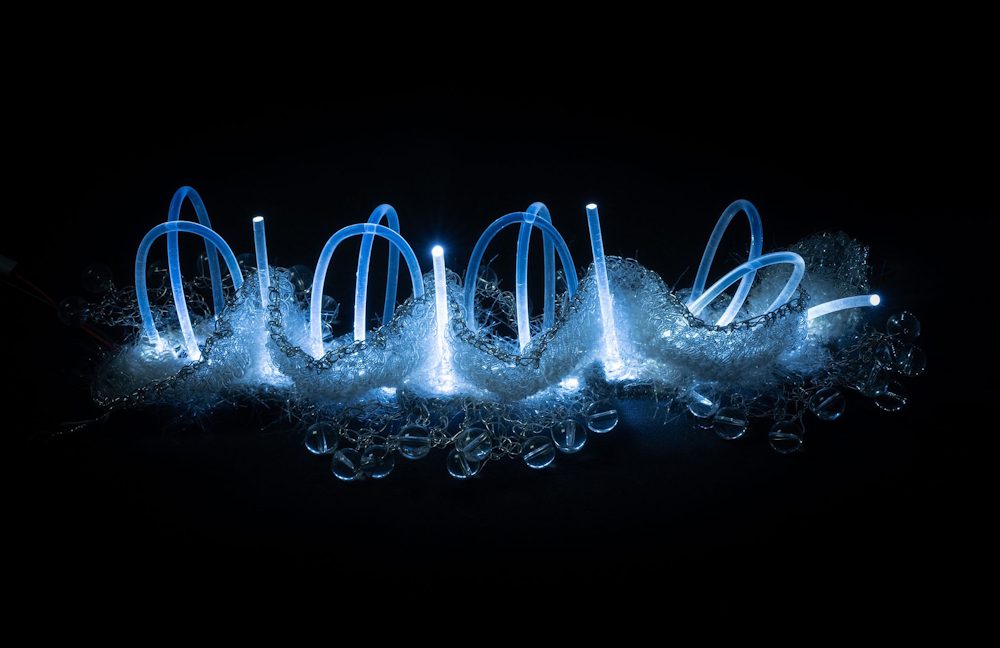
However, the practice extends beyond embodiment alone. In a moment when tactile experience is numbed by screens and emotions are reduced to consumable icons, these seemingly gentle and repetitive acts become forms of resistance and repair. They respond directly to the crisis of perception I describe. Rather than merely inserting the self into the work, I use myself as a sensor — revealing invisible currents such as emotional vibrations, energetic fluctuations, and traces of memory. Through different textile processes, I translate these intangible movements into what I describe as an ornamental energy language — both visual and tactile in nature.
‘Protective surfaces’, how do they work? In what way are they protective?
First and foremost, these surfaces function as interfaces — a transitional layer. Our emotions and perceptions are fragile and immaterial, yet constantly exposed to the intensity and overload of contemporary life. The complex surfaces I construct from sequins, yarns, and colour operate as a buffering zone, a safe intermediary space. They give form to the invisible, allowing it to be held. Anxiety, nostalgia, and the fragile connection between humans and nature — things that are difficult to articulate — can be projected onto these surfaces. Through pattern, texture, and luminosity, the surfaces receive and contain these projections, transforming inner chaos into something that can be observed and even empathised with.
At the same time, these surfaces function as tactile spiritual tools. In an era of sensory decline, the body is often reduced to a mere interface. My textiles attempt to restore the body’s full perceptual capacity. When one engages with their subtle textures, shifting light, and rhythms through sight and touch, these surfaces help protect perception from further erosion and reconnect one with their inner emotional life.
They are not rigid shields, but permeable membranes — allowing certain things to pass through while gently enveloping others, enabling nourishment and regeneration. In my world, softness is not surrender, and ornamentation is never superficial. These protective surfaces perform their most essential task through their very softness and complexity: safeguarding the integrity of our inner worlds, preserving perceptual sensitivity, and protecting the fragile bonds — between material and emotion, between the human and the natural — that are at risk of breaking within the digital tide. They are armour shaped by beauty, and healing enacted through craft.
Can you describe your concept of ’emotional landscapes’?
What I refer to as “emotional landscapes” is not an abstract depiction of a psychological state, but an externalised and structured inner space. Emotions are never isolated moments for me. They are layered, fluid, and continuously entangled with memory, bodily experience, and environment. Anxiety, longing, intimacy, or distance function more like terrains than discrete emotional labels.
Within my work, these emotions are translated into spatial forms through textile structures. Variations in density, pattern, luminosity, and material relationships create landscape-like configurations: some areas are tense and closed, others porous and relaxed; some surfaces shimmer and extend outward, while others absorb light and turn inward.
These emotional landscapes are not meant to be decoded, but to be entered. As viewers move through them — visually, physically, and tactually — they resonate differently with each structure, activating their own emotional experiences. Emotion shifts from being an internal psychological event to a spatial condition that can be shared, sensed, and temporarily held.
Shen Liu Website: liushenlu2000.wixsite.com

Selected exhibitions
- 2025 What Holds, What Drifts — 3×3 Art Space, Tokyo
- 2025 She Looked Back — Purist Gallery, London
- 2025 Aria of the Unheard — Sol de Paris, Paris
- 2024 Solo Exhibition — Luna Gallery, Beijing
- 2023 Degree Show — Royal College of Art, London
BIBLIOGRAPHY
Liu S 2025, artist statement and interview, Shenlu Liu, viewed 20 May 2026, liushenlu2000.wixsite.com/shenlu.
Royal College of Art 2025, MA Textiles Design, Royal College of Art, viewed 20 May 2026, www.rca.ac.uk/programmes/ma-textiles.
Images courtesy of the artist © Shenlu Liu. This article is part of a funded series by emerging artists including Shenlu Li.

Ex-London based reader of art and culture. LSE Masters Graduate. Arts and Culture writer since 1995 for Future Publishing, Conde Nast, Wig Magazine and Oyster. Specialist subjects include; media, philosophy, cultural aesthetics, contemporary art and French wine. When not searching for road-worn copies of eighteenth-century travelogues he can be found loitering in the inspirational uplands of art galleries throughout Europe.