Oct 24 - Mar 28
00:00
Location
Kunstinstituut Melly
Moshekwa Langa Exhibition Notes: Emerging in the early years of post-apartheid South Africa, Moshekwa belongs to a generation of artists who worked with the new enthusiasm sweeping through the country at the time and the curiosity toward a world that was opening up after decades of international solidarity through cultural sanctions and boycotts.
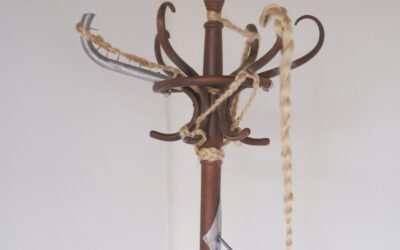
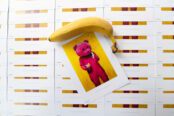
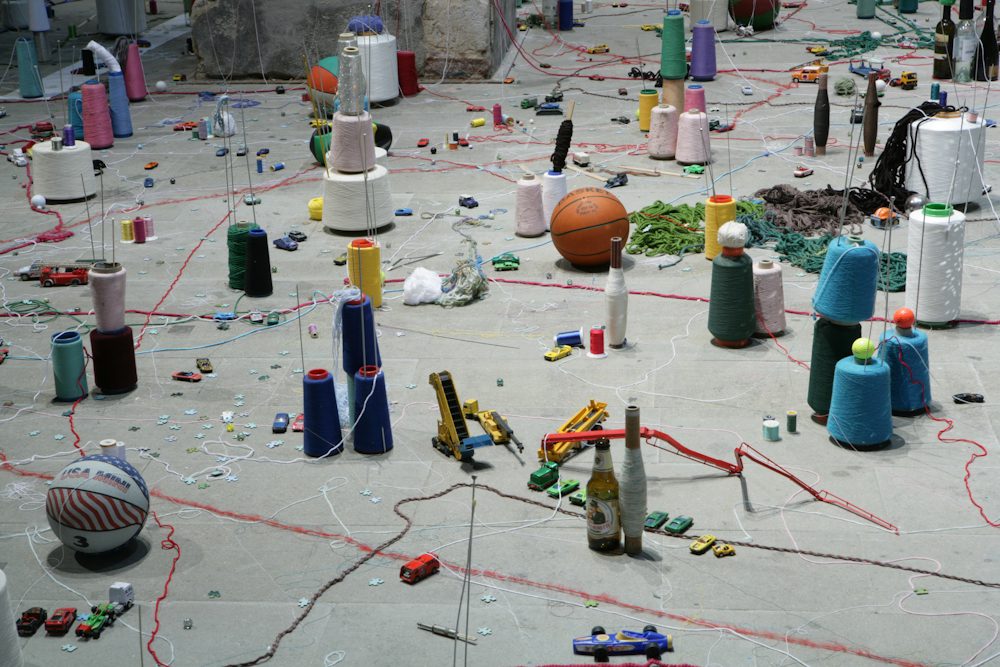
His work was widely exhibited at international biennials beginning in 1997 with his participation in the Johannesburg Biennale, the Havana Biennial, and the Istanbul Biennial, followed by biennials in São Paulo (1998 and 2010), Gwangju (2000), and Venice (2003 and 2009). In 1997, Moshekwa moved to the Netherlands to join the Rijksakademie van Beeldende Kunsten residency, where he sought an international artistic community that would challenge and inform his practice while allowing his work to remain resistant to easy categorization. His meteoric rise was due in part to his fearless handling of materials from his immediate environment. Using what is considered banal and “everyday” to create complex imagery, his work is characterized by wit and irreverence, while his astute awareness of material is reflected in the layers of meaning that emerge through repeated encounters with unconventional materials such as coffee, nail polish, lipstick, staples, yarn, car varnish, newspaper, coal, refuse bags, and tape.

Having grown up in Bakenberg in the province of Limpopo, Moshekwa later encountered official South African maps that did not feature his hometown. His recurring interest in mapping reflects apartheid South Africa’s selective cartographies and has informed a conceptual concern with the politics of landlessness, mapping, and borders. These concerns take different forms throughout his oeuvre, from lines woven across paper to installations of spools of thread, bodies of water, childhood memories, and observations of a landscape shaped by history.
Rather than reaching conclusions, ideas in Moshekwa’s practice return, repeat, and begin again. Works may start and only be finished years later; chronology and linearity are not employed, things begin again, beginnings are continuous, and instead of conclusions there are pauses and ellipses. Time is nebulous and elastic.
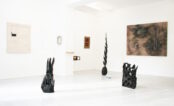
Curated by Gabi Ngcobo, director of Kunstinstituut Melly, with curator Kabelo Malatsie, You will find us in the best places offers a pause to reflect on Moshekwa’s practice across three decades. The exhibition is choreographed to reveal recurring themes, questions, and interests, marking time not linearly, but through their continuous unfolding across his practice.


Gabi Ngcobo, Director of Kunstinstituut Melly, on the exhibition: “It is an honour to be able to present the work of Moshekwa Langa at Kunstinstituut Melly during my tenure as director of the institution. My connection with the Netherlands is tied to the knowledge that one of South Africa’s most important artists of my generation has lived here since before the beginning of my own career as a curator. It is therefore significant to bring a large part of his practice into focus at this moment, while also highlighting the presence of South African artists and artistic practices in the Netherlands. Moshekwa’s practice speaks closely to our interest in complex narratives and in challenging conventional perspectives. It also enters into conversation with improvisation, which is central to our four-year institutional framework. There is something in how Moshekwa moves between materials, places, memories and forms that allows us to think about improvisation as both an artistic and institutional method: a way of remaining open to what is not predetermined. For us, this openness is also a way of advocating for freedom.”
Kabelo Malatsie, Curator, on Moshekwa Langa’s practice: “There is an insistence in Moshekwa Langa’s work that is remarkable, that you see over and over again when looking at his entire oeuvre. An insistence to be explorative and to take seriously the freedom that artistic practice has. The freedom is in the materiality, in concepts and ideas, and the freedom to be. The freedom not to be a single being. This freedom has been at a great cost to him, where there has been a refusal to see his practice for what it is and instead the contexts in the work have been mined to stereotype and pigeonhole. Moshekwa’s work is of great importance to artists, curators, writers as he shows a courageousness to continually make work of great integrity, play, darkness, beauty, and whimsy.”
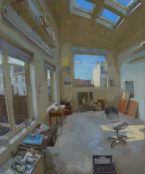
In his own words, Moshekwa Langa: “It is a moment to have earnest conversations about my work and its presentation on Dutch soil, conversations that have taken place often elsewhere, which made me feel somewhat invisible in the place I live. The show presents a musing of material reflection and reflection on my subject matter which is life and death, and history, and geography, rendered graphically in pencil, paint and an amalgam of objects and collages to allude to my curiosity and occupations. To poetry, declarations and unravelling. It is important that other stories are also relevant regardless if they are seen at first light or along the way like the Canterbury tales. Sometimes they make the long road easier to bear, and before one knows it the morning light rises again, and one can process what has gone on in the journey.”
Opening program
On Saturday 24 October, Kunstinstituut Melly celebrates the opening of You will find us in the best places with a public program featuring opening remarks, the presentation of Timeline, a project exploring Moshekwa Langa’s practice, activities for children and families, and music, food and drinks in the Melly Cantina. The exhibition opens to the public at 12:00 PM, with the official opening program beginning at 2:30 PM.
2:30–3:00 PM — Welcome and opening words by Gabi Ngcobo, director of Kunstinstituut Melly, and curator Kabelo Malatsie. 3:00–3:30 PM — Timeline, presented by Elijah Rhode and Thato Makatu in the Space for Education and Participation, traces three decades of Moshekwa Langa’s practice. From 3:30 PM — A playful educational activity for children and families in the Space for Education and Participation. From 3:30 PM — MELLY Cantina opens, with music from 4:00 PM and food from 5:00 PM, continuing into the evening. 7:00 PM — End of the opening program.
Kunstinstituut Melly, Rotterdam, The Netherlands 24 October 2026 – 28 March 2027
Kunstinstituut Melly
Witte de Withstraat 50
3012 BR Rotterdam, NL
+31 (0)10 4110144
Opening event: 24 October 2026, 12:00–19:00
Publication launch: 20 March 2027
Publication
A new publication, edited by Gabi Ngcobo and Kabelo Malatsie and published by Kunstinstituut Melly (Rotterdam) and Medupi Publishing (Cape Town), will accompany the exhibition. Reflecting the layered and exploratory nature of Moshekwa’s practice, the book brings together contributions from writers, artists, historians, and poets, including Munganyende Hélène Christelle, Nolan Oswald Dennis, Marlene Dumas, Amogelang Maledu, Maneo Mohale, Uhuru Phalafala, Philippe Pirotte, Tracey Rose, Irene V. Small, Gilane Tawadros, and others. Scheduled for release in late March 2027, the book will launch with a dedicated public program during Rotterdam Art Week at Kunstinstituut Melly, featuring conversations, performative readings, and listening sessions.
Biographies
Moshekwa Langa was born in 1975 in Bakenberg, Limpopo, and lives in Amsterdam. He studied at the Rijksakademie van Beeldende Kunsten in Amsterdam during 1997–98. Rising to international prominence in the late 1990s, he was an active participant in what is now considered the golden age of biennales, including those of Johannesburg (1997), Istanbul (1997), Havana (1997), São Paulo (1998 and 2010), Gwangju (2000), Venice (2003 and 2009), Lyon (2011), Berlin (2018), and Dakar (2018). Moshekwa presented Bele bele tšieng at Stevenson, Cape Town in 2025. Previous solo exhibitions have taken place at institutions including Museum Boijmans van Beuningen in Rotterdam (1998); Centre d’Art Contemporain in Geneva (1999); the Renaissance Society in Chicago (1999); Kunstverein Dusseldorf (2004); the National Museum of the 21st Century Arts (MAXXI) in Rome (2005); Kunsthalle Bern (2011); Krannert Art Museum in Champaign, Illinois (2013); the ifa Galleries in Stuttgart and Berlin (2014); Chapel of the Cordeliers, Toulouse (2021); A4 Arts Foundation, Cape Town (2024); and Stevenson (2016–25). Moshekwa’s work is held in the permanent collections of The Museum of Modern Art, New York; the Walker Art Center, Minneapolis; The Studio Museum in Harlem, New York; The Art Institute of Chicago; Tate Modern, London; and Johannesburg Art Gallery, South Africa, among others.
Gabi Ngcobo is a curator, educator, and cultural practitioner whose work has shaped some of the most significant conversations in contemporary art over the past two decades. In January 2024, she joined Kunstinstituut Melly in Rotterdam as its director. Before joining Melly, she was Curatorial Director at the Javett Art Centre at the University of Pretoria (Javett-UP), where she played a key role in reimagining the institution as a “living academy” through exhibitions such as Handle with Care (2021) and Scenorama (2022). Other projects include The Show is Over at South London Gallery (2022) and The ‘t’ is Silent, co-curated for the Painting Biennale at Museum Dhondt-Dhaenens in Belgium (2022). She curated the 10th Berlin Biennale, We Don’t Need Another Hero (2018), and co-curated the 32nd São Paulo Bienal, Incerteza Viva (2016). She lectured for seven years at the Wits School of Arts in Johannesburg and is a founding member of the collaborative platforms NGO – Nothing Gets Organised (2016–) and the Center for Historical Reenactments (2010–2014).
Kabelo Malatsie is a curator and organizer living in Cape Town, where she works as initiator and director of Medupi Publishing. She was director of Kunsthalle Bern (2022–2024); director of Visual Arts Network of South Africa (VANSA) (2018–2019); and worked as an Associate at Stevenson in Cape Town and Johannesburg (2010–2016). Her ongoing curatorial research project, Punya, explores the exhibitionary mode as a starting point for bringing incongruous practices together. She co-curated In Interludes and Transitions, Diriyah Biennale of Contemporary Art (Riyadh, 2025); co-curated Deliberation on Discursive Justice for the Yokohama Triennale (Japan, 2020); and participated in In the Open or in Stealth for Barcelona’s MACBA (Spain, 2018). She co-edited Matter Mattering Matters, published by Mousse and Kunsthalle Bern (2025).
Curated by Gabi Ngcobo with Kabelo Malatsie.
Supported by Ammodo, Hartwig Art Foundation, the City of Rotterdam and the Ministry of Education, Culture and Science (OCW). The publication is supported by Jaap Harten Fonds and Hendrik Muller’s Nationalfonds.
Kunstinstituut Melly is Rotterdam’s contemporary art and knowledge-sharing institution. Since its founding in 1990, it has been committed to presenting and commissioning thought-provoking exhibitions, public programs, and educational initiatives, with a focus on emerging and underrepresented practices.
Images courtesy of Kunstinstituut Melly © Moshekwa Langa/The photographer Text: Exhibition notes by Kunstinstituut Melly