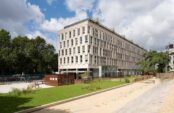
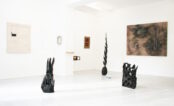
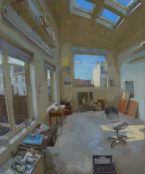
Haunted, an exhibition exploring how artificial intelligence, algorithms and data technologies are reshaping the way we produce, perceive and remember images, has recently opened at Borusan Contemporary in Istanbul. The show takes its title from the building itself, known locally as Perili Köşk, “the Haunted Mansion”: after construction stalled during the First World War, its upper floors were left unfinished and the building was considered haunted.
The exhibition reframes this history through the lens of AI and algorithmic systems. Instead of ghosts, the mansion is now “haunted” by invisible technological processes that shape contemporary life. Curated by Dr Kumru Eren, Director of Borusan Contemporary, the exhibition brings together major works from the Borusan Contemporary Art Collection by an exceptional roster of new media and technology-based artists, including Rafael Lozano-Hemmer, Memo Akten, teamLab, Quayola, Zimoun, DRIFT, Marco Brambilla and Daniel Canogar, alongside works on paper by Turkish artist Kemal Önsoy. What follows is an interview with Dr Kumru Eren about the exhibition and the possible futures of art and AI.
Tell us about the mansion’s unfinished history and how it might serve as a metaphor for the incompleteness or unpredictability of AI processes. What is the relationship between the technology used in these artworks and the historical context of Perili Köşk?
Kumru Eren: Perili Köşk’s (Haunted Mansion) history already carries a sense of incompletion. Construction of the Yusuf Ziya Paşa mansion began in the 1910s, but came to a halt when the First World War broke out in 1914, and the workers were called to military service. The unfinished upper floors eventually gave the building its name, Perili Köşk, or the “Haunted Mansion”.
For me, this history created a natural conceptual opening for the exhibition. I would not say the unfinished building is a direct metaphor for AI. Rather, both bring us into contact with something that is present but not entirely visible, something whose outcome cannot be fully predicted. This became particularly meaningful through Derrida’s idea of “hauntology”: the ghost is not only what returns, but also “what has not yet arrived.” That sense of the unknown and uncanniness resonates strongly with the unease surrounding artificial intelligence today.
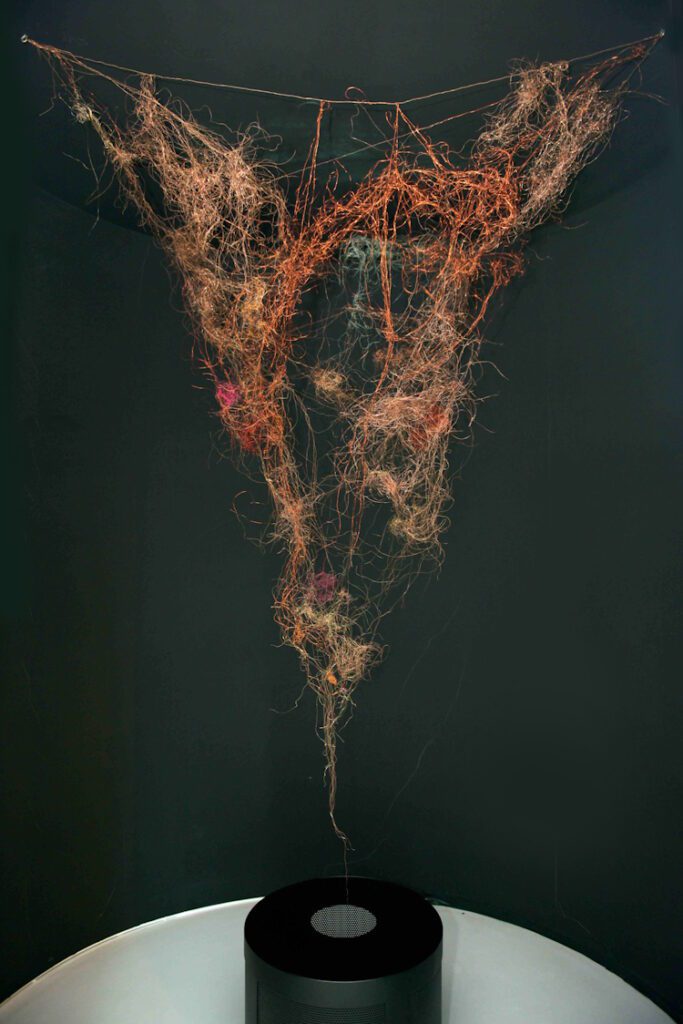
What does it mean for a work of art to be “haunted” by technological processes? How do the invisible algorithms and data technologies shape the viewer’s experience of the artworks, and in what ways might this echo the historical haunting of Perili Köşk?
To me, being haunted by technology means being affected by systems that we cannot necessarily see. Algorithms, computational systems, data and surveillance systems operate in the background, while we experience their effects. This is visible throughout the exhibition. A work responds when you approach it; another is generated through data or algorithmic processes. In some works, nature itself is measured, analysed and reconfigured by machines. That is where I see the connection with Perili Köşk. The building’s historical haunting was associated with an unseen presence. In Haunted, that presence takes another form: data, algorithms and machine processes. The ghost becomes something embedded in the systems around us, shaping our experience without necessarily revealing itself.

What criteria did you use for selecting the artists featured in this exhibition? Are there specific qualities or philosophies that resonate with the themes of Haunted?
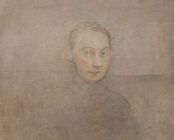
I did not want to select artists simply because they use technology. The starting point was the human being: what happens to us as forms of representation change? That is why Kemal Önsoy’s works are at the entrance. His early drawings move between figuration and abstraction, and forms that disappear or are altered remain as traces beneath later layers. The image changes, but the trace remains.
From there, the exhibition moves through sound, movement, light, data and interactive systems. I was looking for connections between works beyond their mediums: questions of perception, representation, presence, absence and memory. In fact, the collection itself became part of the process. The exhibition emerged through looking at the collection differently and discovering relationships between works that were not necessarily obvious before.
How might the works of artists like Rafael Lozano-Hemmer and teamLab challenge our perceptions of space and interaction? What kind of immersive experiences do their pieces create, and how do they engage viewers in a dialogue about technology’s role in contemporary life?
In Lozano-Hemmer’s works, your presence activates the system. In Flatsun (2011), the artificial Sun responds to your movement; in Wavefunction, Subsculpture 9 (2007), a surveillance system detects you and sets the chairs into motion. teamLab’s Universe of Water Particles (2013) works differently, but it also creates an environment rather than a fixed image. The waterfall is continuously generated through an algorithm based on physical laws. In both cases, interaction is not simply an effect added to the work. It changes the viewer’s position. You become one of the conditions through which the work takes shape.

How does the inclusion of Turkish artist Kemal Önsoy contribute to the overall narrative of the exhibition, especially in relation to local and global dialogues about technology and art?
Kemal Önsoy is important because the exhibition does not begin with technology. It begins with the human, just like the Sphinx’s iconic riddle. As I said before, his works move between figuration and abstraction. Figures disappear, distort, or survive as traces beneath later forms. They come from a completely different technological moment, yet they raise questions that are still relevant: what remains when an image changes, and how does memory survive through images? The medium changes, but the question of representation remains. Beginning with drawing was also deliberate. It allows the visitor to enter the exhibition through one of the most fundamental forms of image-making, before moving into increasingly complex technological systems.

How might this exhibition resonate with contemporary audiences who are increasingly aware of AI’s impact on art and culture? What insights can visitors gain about their own interactions with technology through the lens of this exhibition?
I think people are increasingly aware of AI, but awareness does not necessarily mean understanding. We encounter AI-generated images every day and interact with systems whose processes remain largely invisible. Haunted does not try to explain these technologies. Instead, it asks us to notice how they affect the way we see.
What role do these systems play in shaping our understanding of truth, authenticity and the nature of the images we consume?
Haunted asks us to look beyond the image itself and think about how it is produced. Algorithms, data and artificial intelligence increasingly shape what we see, but the processes behind these images often remain invisible. This is one of the main questions of the exhibition: not simply whether an image is real or fake, but how our understanding of reality is shaped by the systems through which images are made, processed and presented.

There is great concern in the wider world about the impact of AI upon humans. The extreme dystopian view is that it will ultimately destroy the human race, but more immediate concerns relate to the idea that AI technologies will increasingly make humans useless. What are your thoughts about the impact of AI on the image, and on art itself?
I think Haunted is less interested in predicting what AI will do to humanity and more interested in asking how it is already changing images and the way we see. AI can generate and transform images in ways that were not possible before. This changes our understanding of making, looking and even remembering. For me, the important question is not whether AI will replace artists, but what happens to the image, and to us, when the systems producing it begin to change.
Art has had a long relationship with technology, be it the use of oils or the emergence of the camera; each in its own way allowed art to develop in certain directions. Do you think AI is simply another technological complement to art, or does it herald a completely new horizon?
Art has always evolved alongside technology. Photography, video and other new technologies have changed what an image can be, and AI is part of this longer history. But there is also something different here. AI does not simply give us a new tool for making images; it can generate, analyse and transform images itself. This changes our relationship with the image and with the systems behind it. That is why, in Haunted, I see AI not simply as another technology, but as part of a broader shift in how images are produced and how we see.

Haunted
Borusan Contemporary, Perili Köşk, Istanbul, 19 September 2026 to 15 August 2027. Curated by Dr Kumru Eren. Featuring works by Rafael Lozano-Hemmer, Memo Akten, teamLab, Quayola, Zimoun, DRIFT, Marco Brambilla, Daniel Canogar and Kemal Önsoy. Open Saturdays and Sundays, 10:00 to 19:00.
Olivo Barbieri: Time Space Geometry
Borusan Contemporary, Perili Köşk, Istanbul, 19 September 2026 to 15 August 2027. Curated by Fırat Arapoğlu. Barbieri’s first solo exhibition in Türkiye, including a new series on nine ancient cities commissioned for the Borusan Contemporary Art Collection. Open Saturdays and Sundays, 10:00 to 19:00.
Images courtesy of Borusan Contemporary © Borusan Contemporary
Barry Taylor writes and speaks about the intersections of philosophy, theology and contemporary culture. In past, he was the road manager for AC/DC during the Bon Scott era before becoming a Los Angeles theologian.