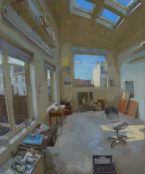
There is something satisfying about an artist who follows a technical path as a means to encounter a feeling, pursuing a sublime immanence that is more than the subject matter yet uses the visual as a conductive vehicle.
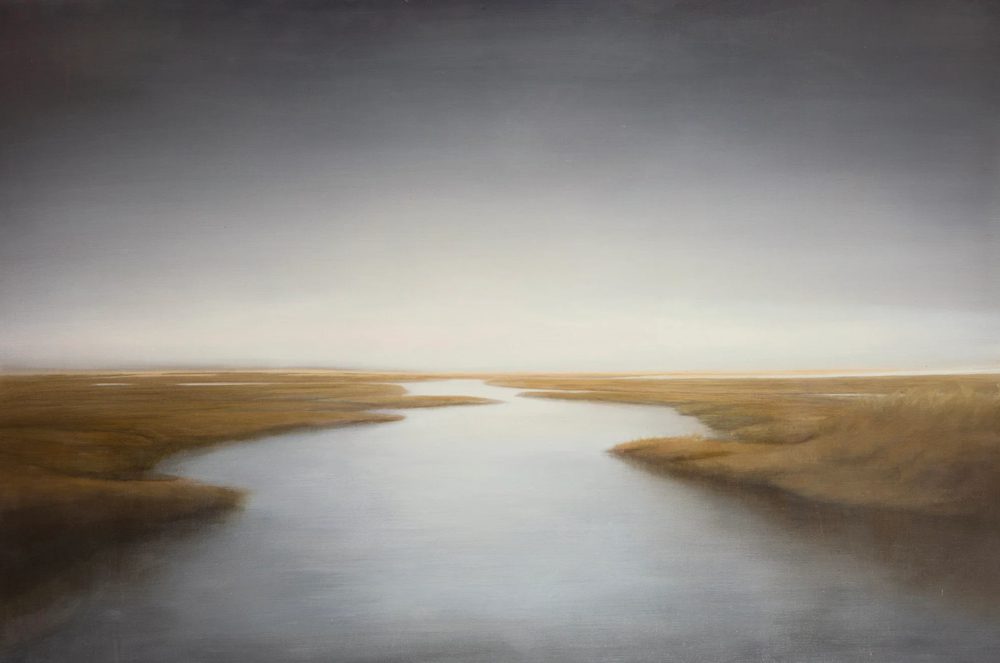
Scottish painter Victoria Orr Ewing’s latest body of work is, on the surface, empty, perhaps banal; yet it is her treatment of light and the quality of atmosphere that elevates it into something evocative. We primarily know light through what it touches, we perceive only the way it interacts with the world around it, and Ewing’s paintings capture this phenomenon as it plays with our atmosphere — littoral sites where water, air and light meet. In Ewing’s hands the result is beautiful, emotive and cosmological: Where Sky Meets Earth (2026) allows us to cherish the character of light as it finishes its journey to these shores.
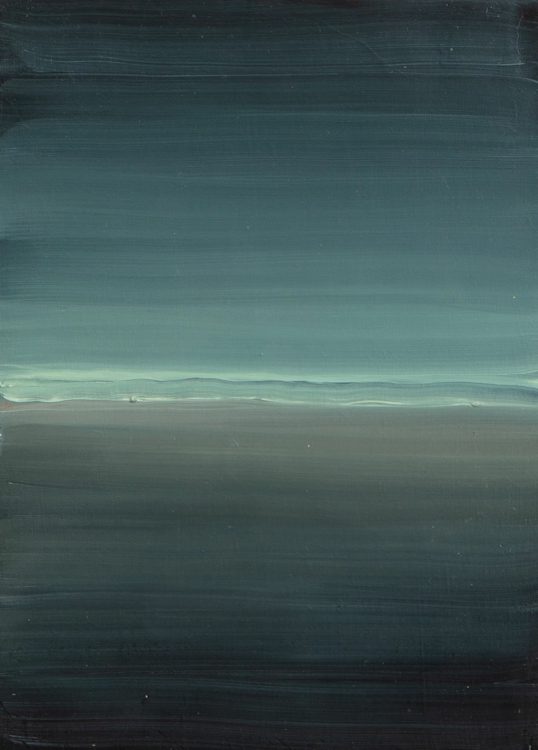
Exhibition Notes: Where Sky Meets Earth : The Luminous World of Victoria Orr Ewing
In an intimate conversation for Aleph Contemporary, conducted by her daughter Talia, Victoria Orr Ewing opens a window onto the inspirations and philosophy behind her landscapes. Her paintings, suffused with stillness and timelessness, often emerge from mist, rain, and fading light—worlds that invite contemplation and a quiet reverence for the natural world.
Orr Ewing’s affinity lies with the uncultivated—marshes, moors, and mountains. Winter captivates her most: skies heavy with weather, darkness cut by radiant shafts of light, horizons dissolved by cloud and mist. She seeks to “paint the air around the landscape,” collapsing the distance between sky and earth, drawing atmosphere down into the land itself. It delights her when people praise her ability to make “bad weather” beautiful—an affirmation of her instinct to find poetry in conditions many overlook.

A spiritual undercurrent runs through her work, though she hesitates to define it. Standing on a windswept island or among vast mountains, she feels herself small and insignificant, and it is here—rather than in formal settings—that she senses the presence of something greater. Her paintings become both reverence and invitation: a call to notice the world’s beauty, and to respect the fragility of wilderness.
Edges preoccupy her. The brink of Dartmoor, the sea-washed boundaries of the Hebrides, the liminal strip where road meets moor—these are landscapes of transition and exposure, where freedom meets restriction, safety meets exclusion. In their paradoxes she finds creative force.
Her vision was shaped in childhood on a farm in South-West Scotland. Days spent outside, facing the Irish Sea, schooled her in distance, atmosphere, and the strange illumination of dark skies split by light. Growing up “unparented,” simply thrown outdoors, left her both fearless and attuned—qualities still legible in her canvases. City life, she is sure, would have led her elsewhere.
Much of her work embraces emptiness. Canvases are often stripped of detail, inviting viewers to “dream with the work” rather than submit to the artist’s direction. Atmosphere prevails over representation; memory and sensation take precedence over sketch and record. Yet within these expanses, she sometimes places quiet anchors: a Dartmoor tor, an ancient standing stone, or the worn wooden staves of Norfolk. These presences are never narrative—they are thresholds, markers of time and spirit. Her paintings offer a space of silence, where the imagination can enter.
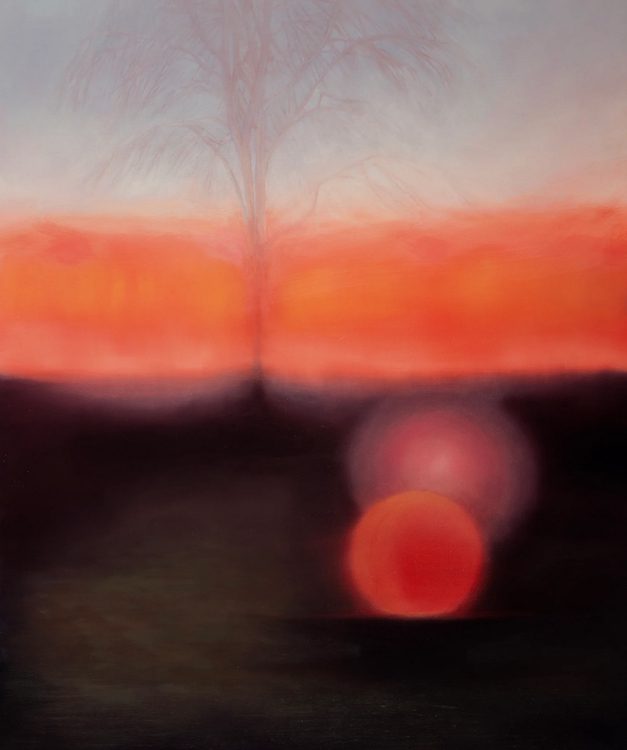
She gravitates to landscapes that unsettle as much as they console—spaces that induce awe, even fear. Yet recently she has also turned to the intimacy of her own garden, exploring how the grand can reside in the small. One new work renders a simple water feature in saturated reds and greens, its safety and enclosure as resonant as any mountain view. From airplane windows she traces the border between earth and space; from the River Severn she contemplates national boundaries. Always, she is drawn to the edges.
Orr Ewing’s practice has shifted with time. Once a dedicated plein-air painter in the Hebrides, Dartmoor, and Norfolk, she now also works from blurred photographs, memory, and even fleeting television images. Watercolours—quick and portable—feed into studio canvases, some expanding to two metres when an idea “knocks against my head.”
Her path as an artist was neither linear nor inevitable. Though not “arty” at school, she followed a strong internal pull to City and Guilds Art School. Early years were sustained by mural commissions and decorative painting in the 1980s, which funded periods abroad in India, Indonesia, and Spain. It was in Spain, surrounded by mountains and sea, that she found her subject in earnest. Recognition came with the Gibraltar International Art Prize, awarded for a painting commended for its “emptiness”—a quality that would become her signature.
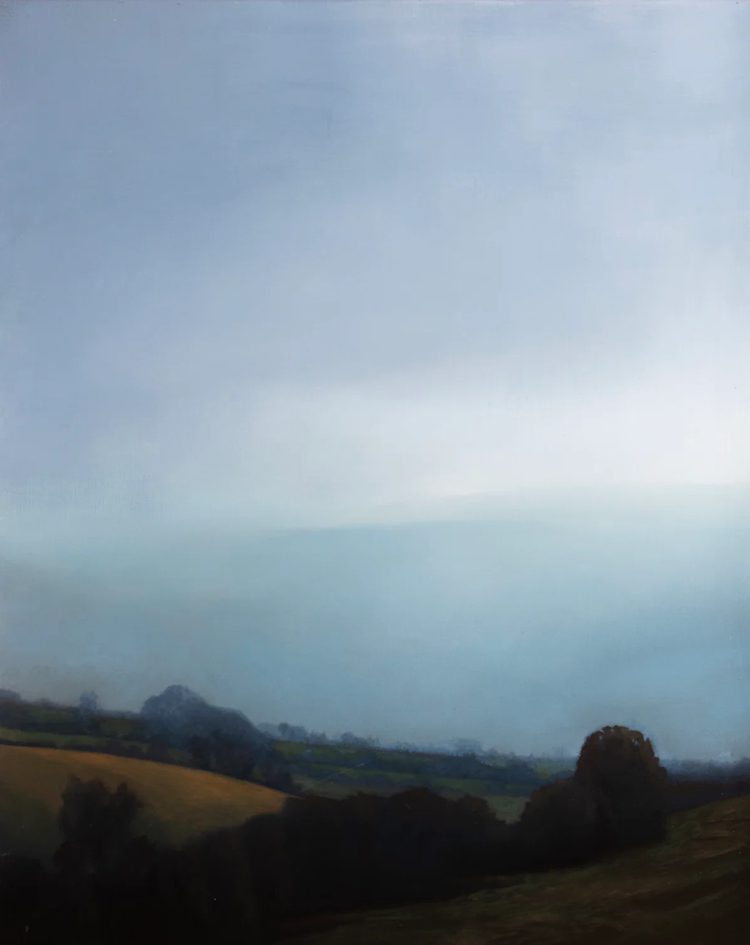
That emptiness, she reflects, is inseparable from light. She calls it “wet light,” a hushed radiance that suffuses her skies and saturates her horizons, sometimes shading into what she half-jokingly names “melancholic grace.” Her daughter Talia describes it more directly: her mother paints light itself. These luminous voids, whether storm-laden or tenderly pale, hold space for the viewer to contemplate their own smallness within the vastness of creation.
In Orr Ewing’s world, the sky is never separate from the land; the two meet, fold into each other, and open onto infinity. Her canvases are less depictions than invitations: to stand on the edge of weather, of wilderness, of time itself, and to see in that encounter the beauty and fragility of our world.
Preview 22nd May 4 – 7pm
23rd May–4th July
Wednesday–Saturday
10 am–4 pm
Aleph Contemporary
New Imperial House
Station Road, Stroud
GL5 3AR
https://alephcontemporary.com/blogs/news/where-sky-meets-earth
https://www.victoriaorrewing.com/
Images courtesy of Aleph Gallery © Victoria Orr Ewing

The aim of art is to represent not the outward appearance of things, but their inward significance. – Aristotle