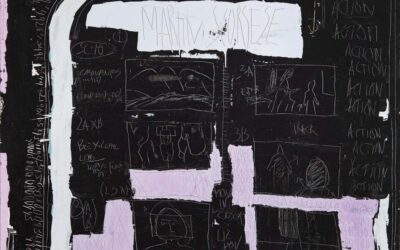
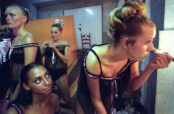
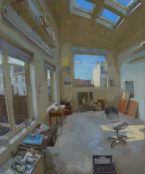
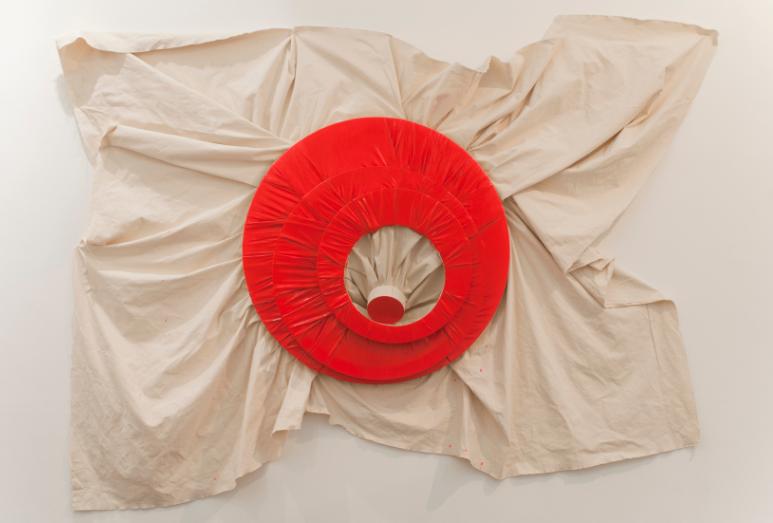
Most recently, Jake Chapman has offered a ‘Critiques for Cash‘ service in which he appraises an artist’s work across a variety of possible registers: ‘sensitive and helpful, outright flattering, rude, patronising, downright offensive, soul-destroying, or actually really very insightful and helpful’ — an initiative recently extended to fellow YBA Tracey Emin (Chapman, 2025).
Continuing from part one of an interview with Jake Chapman
Trebuchet: Returning to Critiques for Cash, what’s the response been?
Jake Chapman: It’s quite funny, lots of texts and tremulous queries. The 40-minute dry run with Tracey was the first shot across the bows, Incredibly generous of her, given that, as she said in the virtual visit “do you remember when the first time we met at the Royal College and we had a massive argument about Nietzsche.” That’s pretty amazing. Who can say they argued about Nietzsche and it caused a fundamental rift. That’s got to be a good thing and I’m proud of that, and I suspect she is too. I think the argument carried for a long time. We were both clearly very serious about Nietzsche–and art.

Trebuchet: The last ten years have been good for her. Why do you think that is?
Jake Chapman: Well I have been routinely dismissive of existential painting and anything that involves first order expression. But I realised a long time ago that my antagonism blinds me to things that have more potential than I thought. I was discussing in another interview how Tracey was grouped in as a YBA, but her work was never cool in the sense of the aesthetic ambivalence characteristic of those artists. Her work was antagonistic, outright feminist, and vicious. And that’s what was good about it. And there is a direct continuity with the work now. And even though the work is explicitly locked into painting, it makes sense because, in my view, its humanism is painful, and seems to operate at the level of negation, where the painting is neither pretty nor redeeming. I’m sure Tracey would want to recuperate it to positivity, but that’s my take on it.
When I spoke to her, she’s was so accurate about what she was doing. It was unnerving. And also, in terms of her health it has an impact on the production and the way you read the work, of course it does— the other thing is that maybe at certain points in her career, I would have taken it that her paintings were romantic. Now, I really don’t think they’re romantic, they’re much more —almost automatic or even autonomic, as if the paintings, or something in the paintings, is dragging her around and not the other way round. They’re visceral but devoid of petty intention, and she said that she doesn’t think about what she’s doing when she’s doing them, which makes them much more like extensions of her body,—I’d would say inhuman, but then I would. They reminded me of a great Bersani quote: ‘Thought is the excrement of being.’
Trebuchet: So, how many people have taken you up on the offer so far?
Jake Chapman: Oh, shit, yeah, that was the question. I did a Chinese art school yesterday, which was absolutely the most hilarious thing, because the lecturer said—he was translating for students—he said, “Right. First thing is, we don’t talk about politics or communism.” And I thought, “Well, that’s a great opener. Let’s talk about Capitalism then.’
But it was of consequence, since the students wanted to discuss their work like highly individualist artists, insisting on how everyone has their ‘own interpretation of beauty,’ and me berating them, asking what they exactly mean by beauty, as if they were the neoliberal Capitalists and I was the Communist…
Trebuchet: Isn’t that a comment on communism?
Jake Chapman: Well, maybe, but like artists obsessed by originality, uniqueness and identity in the West, their claim for difference merely amounts to a kind of existential uniformity. I think of it as a perverse form of individuation in which the human species is infected by the assumption that each of us is a species-of-one devoid of a macroscopic POV.
It made the conversation quite weird, because they were showing me immaculate pencil drawings of vases and apples, but applying words like ‘beauty’–and even in my insistent rejection of the Western metaphysics they were so keen to adopt, I couldn’t help seeing the inauthenticity of the work and their means of explanation. In their endeavour for existential exceptionalism they exemplified how identity is bound by similarity. It reminded me of the conversation with Tracey, we were laughing about the Hancock film, ‘the Rebel’, and how the Beatnik girls, all dressed the same were saying how they couldn’t work in an office or wear uniforms, one saying: ‘why kill time when you can kill yourself.’
Trebuchet: Sounds a bit like genre based iconoclasm, are you separated from that?
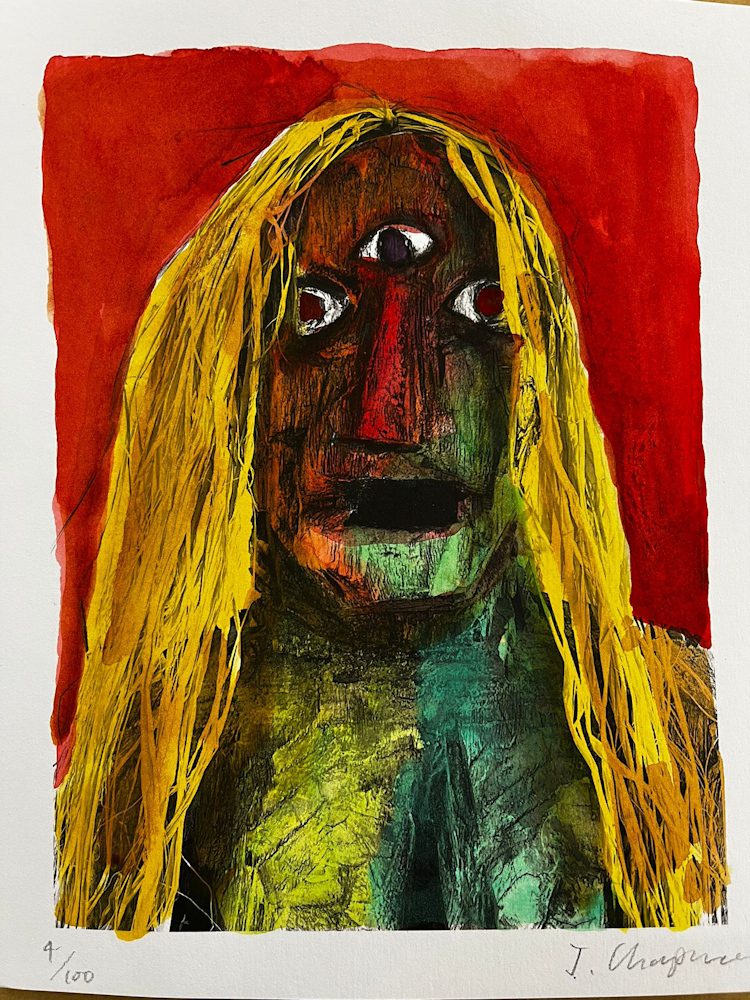
Jake Chapman: I can answer that really easily. I hate English modernity. Such an easy thing, isn’t it? I happened to watch Antonioni’s documentary Painters Painting the other day. About American abstract expressionism. The opening sequence says it all. Anything made at the same time as that stuff, and retained its affinity for depth, figural spatiality, or opticality is irrelevant. All that English art that took abstraction to be something tangible, a vase and apple, and then distorted until it was abstract fundamentally misunderstood the premise of formalist abstraction, I mean fundamentally idiotic. In my humble opinion, if they weren’t reading Greenberg or Fried, they were irrelevant, and their art was as good as Cotswolds artisanal folk trinkets–which, incidentally, is what I’ve been making.
Trebuchet: Ha. Is that what people can expect as critique!?
Jake Chapman: Well, ‘Critiques for Cash’ is an incitement. You mentioned Foucault, and in his preface to Anti-Oedipus he describes an ‘incitement to discourse,’ which also sounds a bit quaint (and also doesn’t quite match the velocity of the Anti-Oedipus text). But I guess the idea of incitement is supposed to not preclude the outcome. Because of its elastic, immaterial and material nature, art makes itself available for speculation and experiment, and that can be the material manipulation of paint, or it can be blunt-ended safety scissors and fucking cardboard. To paraphrase Shulamith Firestone “Modern art is a retaliation against bourgeois patronage.” So that once art frees itself from the obligations of patronage, from capturing endless likenesses of the bourgeoisie, it escapes into a world of psychic confusion and internal self-doubt as a means of differentiating itself from the representational limitations of patronage. But as modernity sets in, the patrons become infatuated with an increasingly absurd art, and the attraction-repulsion relationship begins to drive Modernity towards ever greater excesses, and in the pursuit of art’s autonomy, art inures itself from representational simplification by more extreme categories of aesthetic reification.
Trebuchet: Maybe the point you’re pointing to as well, but forgive me if I’m wrong, is that that’s been internalized in terms of reproducing the same mindset as the collector. So it might not be figuratively the portrait of the collector, as it once was, but now it’s reproducing the mindset of the collector. A savvy collector would also say, “I’m so—in a Potlatch fashion—I’m so distant from the idea of my own wealth that I’m going to purchase Jake Chapman’s work.”
Jake Chapman: You should say that more often! I don’t disagree with that, but I guess, historically, thinking about the period in which I was studying art, there was an appetite for theory —it was the most exciting thing.
I remember going to see the Jeff Koons in the “New York Now” show at Saatchi Gallert in Boundary Road—seeing that work and thinking, “What the fuck is this?” It was so paradigmatically different. Sculptures with mirrored surfaces, without existential texture, nothing to grip onto for existential relief. The surfaces reflected everything around them and made the objects themselves immaterial, contradicting the vast expense of their industrial manufacture. You had to ask ‘Why are they like that? What world are they alluding to? Why is a work of art become a thing that is not your friend? What is it for a work of art to invite you only to become your enemy?”
Looking for the meaning in Koon’s bronze aqualung was like putting it on and jumping in a lake. The only corollary to that work at the time was the theory that underscored its production. I remember pressing Jeff Koons on theory, but he wouldn’t have it, making a show called the ‘Gift’ and denying reading ‘Symbolic Exchange and Death’ only makes it actual, and not metaphor. The nihilism in the work is still effectively camouflaged by its banality. But of course banality is the function of Capital in its ability to perform with superconductive ease. Not so long ago I read in the news, a sidebar snippet, warning that CERN had issued a warning in advance of an experiment in which there was an infinitesimal chance that the collision of particles might cause a black hole which might suck in the universe. I imagined standing in front of a Koons’ sculpture, trying to cling on to its surface, but only the squeaking sound of my fingers and grease marks as I am dragged, along with the silver rabbit, cuckoo clocks and stolen Nazi gold into a big hole in Switzerland.

Trebuchet: People are prefiguring the end before they’re there.
Jake Chapman: Well, nihilist art is an attempt to speed it up, but anthropogenic art is a vain attempt to ward off the future. What’s interesting about Koons’ work is that its acute nihilism has been recuperated to happiness and smiles. As if, “What’s our best line of defence against obsolescence? Oh, just become even more human.” Great. That’s going to work. Koon’s is quite clearly a hyperstitional terminator sent back to goad us into a kind of misanthropic nihilism presented as joyful glee, I’m all for it.
Trebuchet: So his use of symbols is counter to contemporaneous ephemera? Art elevates and by being current (to the time of his works) he’s still courting an established idea of the timeless no? To transpose it into a different thing, people used to talk about the museumification of Native cultures. And by extension, it sounds like you’re saying humans are bound by what inherited ideas of humanity are?
Jake Chapman: Maybe it’s the provincialization of the human as something self-withering and self-sorry, based, predicated upon a return to just post-Christian miserablism —I’m in the world, and the pressure upon me as an individual is awful, and that’s why I’m going to paint a picture of a fucking rainbow.
It’s also interesting how liberalism which is interchangeable for neoliberalism (self-improvement, performative exceptionalism, self-optimisation)—leads to a corporatist right, and to open fascism. Self-optimisation and wellness mean living sincerely, and so parody, irony, sarcasm, lying, inauthenticity are expelled, leaving a gap for the right to take up the mantle of parody, irony, sarcasm–used as weapons against political earnestness. And now the right possess the agility and ability to relentlessly and openly libidinize ‘truth’ (which of course was always libidinized, but the drain covers were on). Of course the rightist revolution need not take place in the streets –unlike the traditional mayday cosplay of the Black Blocs and riot police in Paris each year– so what shall we do, write a poem?”
Trebuchet: Yeah but let’s be honest, the right seems vital.
Jake Chapman: There’s a very funny scene in Manhattan when Woody Allen is at a private view, and he and his friends are standing around in a group saying, “Hey! There’s gonna’ be a neo-Nazi march in Washington Square tomorrow. What should we do?” One says, “I’m gonna’ to write a satirical piece for Village Voice.” Another says “I’m gonna’ write a poem… I might write a discordant composition…” And Woody Allen, being so diminutive, and in the middle of the circle, is saying saying, “What about baseball bats? What about baseball bats? Nazis hate baseball bats!’ But no-one can hear him.
Trebuchet: So backtracking I have to ask, as an art writer, is your offering of cash for critique actually itself a critique of contemporary art writing?
Jake Chapman: The problem with making art has always been a discrete payoff between the urgency of meaning and plain prostitution. Art writing is the sticky glue that makes this strange conflation work. Art critics mark the passing of an exhibition with encouraging or tepid or mildly castigating words for artists, whilst offering a leg-up for collectors to be in on the ‘meaning game’. No one ever dies from criticism. The question is, what’s really at stake. Are artists engaged beyond the soliciting of flattery from critics obliged to politeness in fear of retaining their employ, and collectors that resent being alienated from their righteous sense of taste.
My critique thing is behind the scenes. For me it’s an opportunity to tire myself of words and sleep better at night for being exhausted. For the artists, it’s an opportunity to pick from those words to their liking, or disliking and to act upon them–my assumption is that an artist seeking a critique is opening themselves up for rupture rather than praise, unless they specify praise, in which case the malevolence will be more harsh, but sugar coated and slow release. I guess one of the tensions implicit in such an interaction is the degree to which unnecessary politeness will be tantamount to prostitution, and both parties will be aware of that performative revelation.
Trebuchet: So it’s masochistic or something trying to be honest.
Jake Chapman: The thing is, if you get me in someone’s studio, I will talk until I drop dead. I’m interested. And I don’t think that anything is uninteresting. I started looking at some of the stuff that’s being proposed, and looking at some of these pictures and thinking, “God, that’s going to be tricky.” Well, that’s the fun of it. And also, to try and do something, even with artists that maybe you would probably not feel that you can have anything to say, but make it my job to say something that’s going to be valid for them. There’s got to be some way of doing that–or plucking my eyes out online, or them committing suicide by eating paint. Let’s see.
I really enjoyed teaching, and maybe this project derives in part from the discipline such a thing demands, when other forms of interaction in the ‘artworld’ are often based upon flattery. Students have demands and deserve answers–they also need productive clues as to how to operate. Art schools were much like honeycombs of white cells in which students attempted to gestate their signature product. I found students twiddling their thumbs in self-petrification because they had no basis for the invention of angst. I enjoyed being generative, because it emphasised external communication rather than myopic rumination. It’s better to tell students to steal, rob and pillage books and magazines rather than extricate some personality foible and endlessly paint it into puerile abstraction, although that’s not a bad idea.Emotional performativity means that we experience everything directly, and capture our opinions from the ricochet of glances that conform into popular agreement. Forget the Cyborg Manifesto, or the title of one of those objects: “Zygotic Acceleration.” The discourses that were generative of those works have been forgotten in favour of communal reinforcement. Koons’ art was reflective, but paintings have become mirrors in which the observer really sees themselves. Confirmation of identity is the thing, but in its perpetual anxiety, identity reveals its precarity, which requires ever more acts of reinforcement. Happy art makes happy, sad art makes sad, and the three or four emotional permutations in-between make themselves available too. But the emotional spectrum is limited.

Images courtesy of the artist © Jake Chapman
Bibliography
Collings, M. (1997) Blimey!: From Bohemia to Britpop: The London art world from Francis Bacon to Damien Hirst. London: 21.
Hirst, D. and Burn, G. (2001) On the way to work. London: Faber and Faber.
Kent, S. (1994) Shark infested waters: The Saatchi collection of British art in the 90s. London: Academy Editions.
Stallabrass, J. (1999) High art lite: British art in the 1990s. London: Verso.

Trebuchet editor and art critic. Kailas is often away in some distant city searching for the latest artistic vision of the future. He has written for Trebuchet for over a decade, specialising in art theory as it evolves in contemporary art, the re-emergence of the monumental, and the personalisation of Modernist tropes in individual works.