Resistant, entrepreneurial and playful, the Young British Artists (YBAs) were a notorious coterie who kicked against what they saw as a static and hierarchical art world. Arising in the late 1980s, they attracted significant acclaim by the mid-1990s, championed by writer and broadcaster Matthew Collings (1997), who identified a vitality in the group’s critical engagement with the media-saturated, hyper-sloganising, tacitly speculative aesthetic of the 1980s and early 1990s.
Arguably, just as the drift of Modernism did not conclude with Postmodernism but reached a post-objective plateau, the YBAs reflected a trajectory established a decade prior; that their commentary became the artistic mainstream of the 1990s and 2000s was perhaps their collective ambition all along. With varying degrees of satisfaction and chagrin, their success resides in the fact that their works became both a symbolic and an actual currency for a new era of wealth culture. Was it not ever thus? To hijack the art world by revealing its secret signs and codes is a story as old as the institution itself. In due course, many of these arch-provocateurs have accepted establishment positions in art education — and who better to shape young minds than those who persuaded the world their work had worth?
Most recently, Jake Chapman has offered a ‘Critiques for Cash‘ service in which he appraises an artist’s work across a variety of possible registers: ‘sensitive and helpful, outright flattering, rude, patronising, downright offensive, soul-destroying, or actually really very insightful and helpful’ — an initiative recently extended to fellow YBA Tracey Emin (Chapman, 2025).
[watch] https://www.instagram.com/reels/DTqaYK6jSQc
Yet where do these critiques originate, and what still inspires Jake Chapman (Artwork features in Trebuchet 12)? Speaking to Trebuchet, the artist discussed how his current practice finds direction in his distinctive form of social enquiry — and what form positivity, let alone agency, might take from within such an existential crucible.
Jake Chapman: The undeniably catchy title “Critiques for Cash” actually gave birth to the idea of conducting virtual studio visits–and then the thought of me being subordinated to the task became even more compelling. The idea of a user-friendly sliding scale that went from ‘pleasantly helpful’ to ‘unpleasantly unhelpful’ seemed a natural facet of the service, especially when the usual amicable studio visit could be either–really helpful, or really brutal, depending on the artist who would pay for the pleasure or unpleasure.
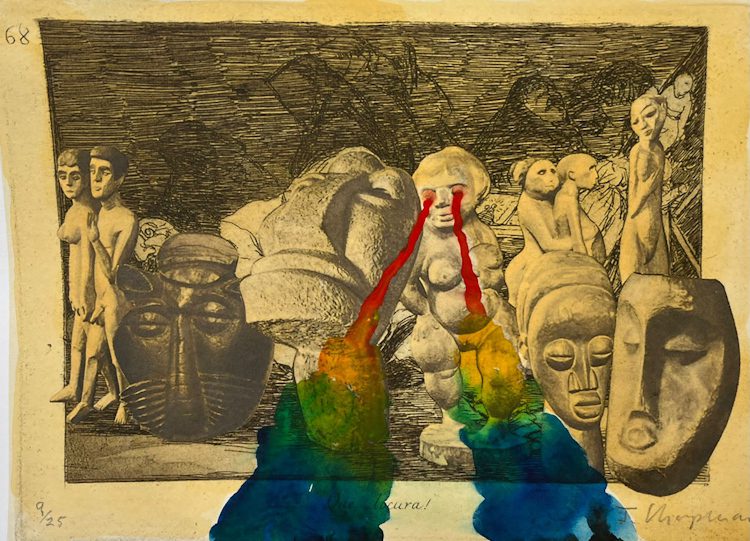
I confess that my dislike for the word ‘critique’ was perhaps the conceptual pretext for the project, and by offering it as a service for ‘cash’, I could debase its meaning. But there was also a glimmer of curiosity in terms of exposing myself to the demands of an artist in the studio, and the demand for sincerity implied in the contract. Also, I really like talking about art and ideas.
I was a visiting lecturer at Goldsmiths, and what I understood from students was the demand for rigour–to discuss their work and ideas without a reduction to identity or ego. You are obliged to have something to say about someone’s work, which is not just simply an entrenched opinion, it requires a kind of speculative flexibility.
The discourses that I was interested and involved in at that time (when I was young)—loosely, posthuman, transhuman and anti-humanist discourses arising in the late 1980’s —have now shifted, made way to a much warmer ‘palette,’ a return to singular identity, to confessional narrative and the autobiographical self as the chosen modes of artistic activity. And so maybe, my subconscious aim was to intervene into that by offering a more resolutely, theoretically sharp, vigorous, pessimistic, cynical, spiteful approach to art production–to insinuate myself into the innocent studio, as it were–at least that was the fantasy. The reality is quite different.
Trebuchet: There is a line in your work, and certainly the work you did with your brother, where you take the idea of Joseph Beuys’ of art as social activity and turn that on its head. And it seems to me that Critiques for Cash is itself a critique of contemporary art where you’re saying, “Look, actually, there is a real response here that we’ve missed, and I’m going to give it to you.” Let’s go back to first principles.
Jake Chapman: Well, it seems to me that the return to the body in its most cuddly and temperate form represents something of a last-minute pre-emptive resuscitation of the endangered human in the face of the threat of AI. There’s a tangible contraction against the notion of the future, in which the human can only retain its valorisation by differentiating ‘sentience’ against the ‘soulless’ machine, to optimise humanism’s sapience as the basis for a counterattack. I also see that much that engages with technology does so from an overtly humanist position, still emphasising the human as the subject of the future.

In the infancy of my work, I was interested in the idea of human obsolescence being connected to the emergence of something not bound by anthropomorphic limitations–which I saw as a ‘political’ potential. Pete Wolfendale (philosopher) recently suggested that for any consideration of the future, it’s essential to ‘dehumanize the human,’ which is to make us human available for a Prometheanism which dispenses with the essentialised division between the human and technicity, to produce–or in fact, continue-the coalition of forces…
Faced with the threat of human obsolescence by encroaching ‘sinister machinic processes,’ the tendency is to invoke sentience as the discriminating factor that ensures sapient primacy. Acting as little more than technical organ grinders or ‘machine ticking aphids’, we insist on machinic intelligence being measured by anthropic standards-that is, literally hobbling machines (in the sense of the mechanical contraptions used to minimise the movements of slaves) by enforcing human capacity as the blue-print for success. We say: “Well, yeah, okay, they may be thinking faster than us, processing more efficiently than us. And they may be able to do a somersault and not spill a cup of hot tea, but they’re not sentient and nor can they ever be.’ And it is this statement that reveals the fallacy of our presumed rights over the future–considering that rationality and reason were the essential elements that raised humans from ‘darkness,’ and elevated us from superstition and irrationality, it now seems that machines are the true inheritors of Enlightenment teleology, since they already easily outpace sapient neural capacities. In retaliation, reverting to ‘sentience’ is simply an invocation of the ‘soul,’ and we roll back into the dark caves, rub sticks together and snuggle up and are teased by primordial gods.

Trebuchet: But isn’t art production essentially a human endeavour? And creative choice-making the crux of being an artist?
Jake Chapman: Well, maybe. I became interested in the paradoxical fact that making art was already implicitly anti-anthropomorphic. That is to say, its internal contradictions undermine the very proposition of the human being differentiated from a dumb unthinking world because of its higher, objective intelligence. For example, when I make a painting I am motivated by a set of intentions to which the paint and canvas are organised to correspond. I force the materials together to form the desired meaning. Considering that painting is generally considered one of the highest forms of civilised activities–a form of human expression placed upon the pantheon of human intention (it will be a source of wonder for future Martian visitors when we are no more). And yet, this fluid, elastic object seems incapable of containing meaning in any fixed sense at all, neither the artist’s, nor the observers. And in this indifference, each painting deposes its originator, mocks their intention, and presents itself as the epitome of the unconscious drives that renounce the human as an objective participant in the world. There. Done. To steal a phrase from Bataille, the painting is ‘in the world like water-in-water,’ but the human still believes it is not.
Trebuchet: Yes, but meaning is the implicit material you’re working with which requires sentience. I’d argue art is about the push of ideas, rather than the pull of reception. I mean, you’re using meaningful tropes all the time. You’re playing on the assumption of human belief in art.
Jake Chapman: That’s it. I’m going to hang up! (laughs)
Trebuchet: How dare you? I’m going to hang up first!
Jake Chapman: The same thing over and over again. No—we were talking about the old work and saying, “Well, what’s interesting about this return to identity and stuff?” But the idea that there’s a minimal requirement for art, which is just simply the notion of expressing how I feel about myself, for myself, to myself with the expectation that my feelings will match other selves, is really reductive, oddly enough, a kind of expressionistic black hole. I mean, if I’m advocating nihilism, this is actually it!
It’s a symptom of the fact that the opposite is impossible. What I mean by that is that we find ourselves in a situation where, as Mark Fisher says, we’re caught in a permanent present. You know, he proposes the question: ‘why is it easier to imagine the end of the world, than the end of Capitalism.’ Obviously, the question refers to a willing fantasy for catastrophism that eclipses the structures that will deliver it. I prefer when he says, something like, “Counterculture allows us to act out our self-loathing whilst still participating in capital.” Now, that, for me, is everything.

Trebuchet: Well, that ties into your recent stuff on wellness a lot.
Jake Chapman: Yes, absolutely so. Self-loathing has governed my work generally, and I mean ‘the self’ in general. I’m interested in Fisher’s claim for inertia, and how the possibility of a fantasised terminal end blocks the present and gives rise to an imaginary pre-capitalist political feudalism and cultural folk-art. Again this is the panic of a future that causes its own stagnation. Someone told me, with absolute sincerity that ‘at least when Trump is lying he’s telling the truth.’ They unwittingly revealed how the myth of truth has collapsed in on itself, in so far as Trump’s lies denude truth of the desire that motivates thought– in some weird Nietzschean turn—Trump is reiterating: ‘the truth is that there is no truth.’
Trump is also affirming Orwell, but not in the usual liberal sense of the trite dystopian term ‘Orwellian’- Orwell’s 1984 began as a dystopian tale about Stalinism and became a bible for neoliberalism.
I think my (our) early work is fully implicated in the idea of inertia. The KKK figures were a kind of noise cancellation, their hoods and cloaks colliding with Bob Dylan’s rainbow socks and Birkenstocks, or the sculptures of Nazis being subjected to industrial annihilation, anticipated a kind of cultural neutralisation, by compounding opposites into a meaningless and vacant stasis. If the critical motive in art was supposed to be liberatory, the effect was that emancipation became total inertia–a kind of ‘peak human’ in which the future is waiting for something other to occur.
Speaking of waiting for something to occur, I’m enjoying reading gallery press releases right now, and how they optimise the ‘juxtaposition’ of the ‘universal with the personal’, or the ‘abstract with figurative,’ as a kind self-neutralising stab at ambiguous meaning, a kind of treading water and not drowning.
Trebuchet: Well, you remember John Berger, right? Because he pointed out that a lot of the press releases or the artistic statements were paradoxical to the point of negation.
Jake Chapman: Absolutely right. But you remember Bank? Bank used to do that. They used to mark press releases and send them back to the galleries. Absolutely brilliant, genius. Bank were fantastic. Too good for their time.
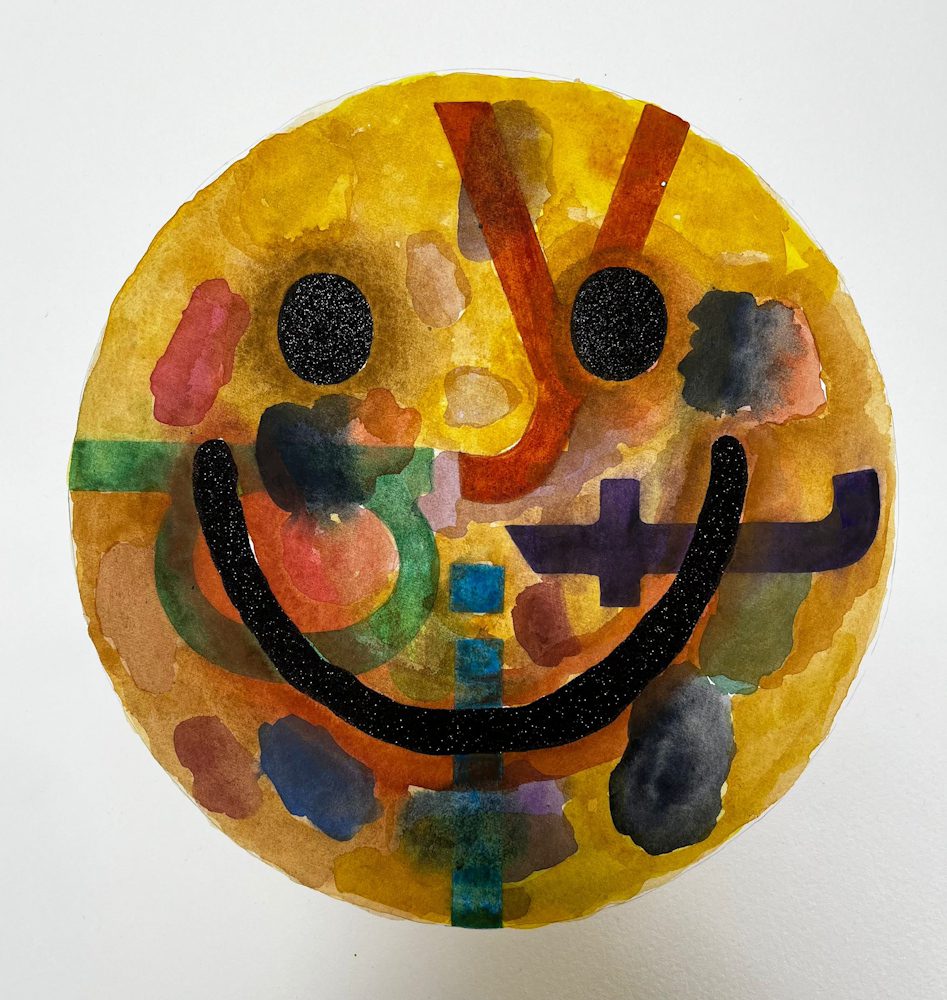
So yeah. So, I suppose you’re right about wellness. My parents were generationally compound liberal, communist, anarchists. What I learned from them was that their failure, or their idealism and their perpetual sentimentality for a revolutionary past that never arrived, and their contempt for the capitalist present, was absurd– because in a sense, we came to understand that any ‘critique’ of Capitalism is also Capitalism. Reading Deleuze and Guattari, you get the sense in which, through the involuting processes of territorialisation, that critique is the functional drive of capital, in so far as it provides invention and modification–this of course motivates Fisher’s comment on ‘counter-culture’ as a compensatory component of Capital itself.
Trebuchet: Foucault showed that in Madness and Civilization, when he was talking about how any form of resistance actually only presented an opportunity for the governing ideology to reinforce itself. More than that, it was probably the primary methodology, like a parasitical virus that used the foundations of resistance as a means of propagating itself.
Jake Chapman: Yes, a kind of wellness affirmation. I was thinking of a speed-garage cover of Bob Dylan’s “The Times They Are a-Changin’,” but change the words to “The Times They Aren’t a-Changin’.”
Wellness is enormously interesting because it’s such a brilliant reservoir of opportunity, in a way, because it’s riddled with the opposite, isn’t it? The notion of wellness is so embrittled by a fear of the loss of longevity. We experience strange oscillations between desiring wellness but indulging the lingering threat of extinction, which seem instrumentally connected. But what is extinction? One of the odd things about the imminent threat of human extinction is that it never seems to arrive.
Trebuchet: Well, you said it, or someone said it about you. You said it when you were talking about a neoconservatism of wellness, was that, okay, we’re all reaching, almost in a Scientological way, an idea of “clear”—this endpoint of perfection that we’re all trying to work towards, apparently.
The idea of clearness as a holistic thing is pure biopolitical power. It’s mental, physical governance. It’s absolute conservatism. It’s a self-regulating technology.
Jake Chapman: Well, I think the upsurge in self-confessional wellness—a neoliberalism of health—is in itself a perverse abreaction to general obsolescence, as if we must greet the end of the world in the best of health, to be our best ever selves before we fade to nothing.
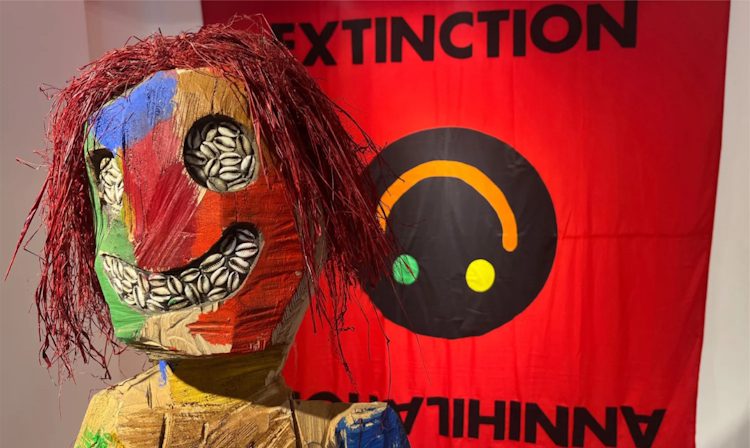
In a casual conversation with an advocate of Extinction Rebellion, I asked, “Can you rebel against extinction? And what’s the premise of your objection to extinction?” They said, “But don’t you want your children’s children to breathe fresh air?” And answered, “Well, that’s like… two fucks, right? I mean, your generational projection is two ejaculations long, and that’s not an adequate measure of time at all, or an adequate determination of extinction.”
Trebuchet: The problem is that then you’re in with the nihilism of the anti-natalists which often reads as right-wing conservatism masquerading as laissez-faire fatalism. The apparent naturalism of systemic monopoly.
Jake Chapman: I’m certainly interested in the ethics of voluntary euthanasia. I mean it’s a touching sacrifice because it subtracts humans and leaves a Disneyesque nature in its absence. But the more relevant question is “how can there be a future if the human is a precondition? How can there be a concept of progress if the standard unit across space and time is the human?”
Trebuchet: I’m going to hit you back with a hallmark type point on extinction, which is that, effectively, if a tree falls in a forest and no one’s there to hear it—
Jake Chapman: Yeah, and at night the roses aren’t red, because red is a refraction of light. For all the varied approaches to the future and the myriad means of extinction, the human is the one thing which avoids scrutiny. It persists as an indivisible constant, as a given value– as an essentially closed, monadic unity. This is the problem of anthropomorphism, is that it colonises the past, present and future with a value based upon its presumed overseeing function (hearing trees fall and experiencing red roses), as the objective prime mover in all things…
Images courtesy of the artist © Jake Chapman
Bibliography
Collings, M. (1997) Blimey!: From Bohemia to Britpop: The London art world from Francis Bacon to Damien Hirst. London: 21.
Hirst, D. and Burn, G. (2001) On the way to work. London: Faber and Faber.
Kent, S. (1994) Shark infested waters: The Saatchi collection of British art in the 90s. London: Academy Editions.
Stallabrass, J. (1999) High art lite: British art in the 1990s. London: Verso.

Trebuchet editor and art critic. Kailas is often away in some distant city searching for the latest artistic vision of the future. He has written for Trebuchet for over a decade, specialising in art theory as it evolves in contemporary art, the re-emergence of the monumental, and the personalisation of Modernist tropes in individual works.