This is an ambitious and revealing exhibition of the work of Frida Kahlo, and of those drawn into her vision of the world. Historical shows might exhibit the background conditions from which she emerged, providing a context for that emergence. This one does not. Instead, it places her at the heart of a progressive movement, a broad gathering of artists whose work draws upon hers. It is not that no context is provided, rather that the context sits apart from modernism. Unless, that is, one regards her, as many have tried, as a Surrealist. (She rejected that placement in history, notwithstanding André Breton’s enthusiasm for her work.)
The context is germane to contemporary art. The present is a self-reflective period. Long-held convictions of modernism are under revision, as is the intellectualism that sustained its post-modern aftermath. To review a Mexican artist whose work is so personal, yet so tethered to the social ambit in which it surfaced, is to reckon once again with naïve or folk art. Her work is that direct. It bears noticeable similarities with the work of the European Surrealists. Yet she rejected the label, even as André Breton declared her ‘a self-made Surrealist’ (Tate Modern 2026b). The likeness of her paintings to that branch of modernity derives from the folk art element revealed by both. Kahlo’s practice, however, remained theoretically inured against the cerebral programme of the Surrealists.

Frida Kahlo (1907-54) endured a short and painful life. She contracted polio as a child, with the associated trauma that ensued. In 1925 the bus carrying her collided with a tram, leaving her seriously injured and in chronic pain for the rest of her life (Tate Modern 2026b). Small wonder, then, that her extraordinary misfortunes became the occasion for work expressive of the life she must lead, documenting its trials, tribulations and joys. Small wonder she sought, for consolation or for the expression of anger, imagery from her ethnic environment with its heavily adapted Catholic symbolism. Self-portraiture was, of course, a means of looking at herself from the outside, whilst simultaneously revealing her interior world. The pictures are, therefore, both religious in their imagery and blasphemous in their religiosity.

Most striking is the sheer expression of love, angst, bitterness, pain and despair, raw in its direct force. There is also something childlike in her dressing up, and in painting that resembles the cut-out dresses a child might fit onto a flat cardboard manikin.
The ambition of the exhibition comes to the fore when visitors are introduced to global artistic interpretations of her work by contemporary artists. This is revelatory to a western audience more used to contemporary art from white cube galleries. (The show is organised by the Museum of Fine Arts, Houston, in collaboration with Tate Modern (Tate Modern 2026a).)

A great deal is currently made of evolving conceptions of sexuality and gender, and the politics thereof. Frida Kahlo has thus been appropriated by gender studies enthusiasts and others who seek to cloak the world in a mysterious exoticism. A heavy weight is placed on sexual activity, and the emphasis falls on political thought: demands for rights that protect freedom of behaviour. Much of this is interesting and rewarding. However, as a philosopher, some of it is less so. The waters grow cloudier, and it is not clear where the argument points. The claims can seem outlandish. Thus Francisco Casas says:
![Frida Kahlo, Untitled [Self-portrait with thorn necklace and hummingbird] 1940. Nickolas Muray Collection of Mexican Art.](https://b276103.assetcdn.net/2.0/276103/wp-content/uploads/2026/07/Frida-Kahlo-Untitled-Self-portrait-with-thorn-necklace-and-hummingbird.jpg?lossy=1&strip=0&webp=1)
‘Becoming’, as defined by French philosopher Gilles Deleuze, is a parodic metaphor of the symbology and simulation of the other – in this case the female ‘other’. Identity is shifted to other bodies under perpetual flux in order to mobilise them; the homosexual body, for instance, has to be in constant flight under repressive power systems in the reinvention of desire and its aesthetics, moving between the private and the public, the secret and the open. (Casas cited in Museum of Fine Arts, Houston & Tate Modern 2026)

Is this really necessary? Francisco Casas and Pedro Lemebel (the Mares of the Apocalypse pictured) share a love for each other. As Casas puts it, ‘two souls separated yet united forever’. (Who amongst us cannot recognise that emotion?) But he then adds, ‘the decolonised alter ego with heart exposed’. Within that lies a rather grandiose theoretical claim, yet it rests upon an emotional, rather than an intellectual, premise. Surely art, of all worlds, both permits and promotes feeling as a means of understanding.
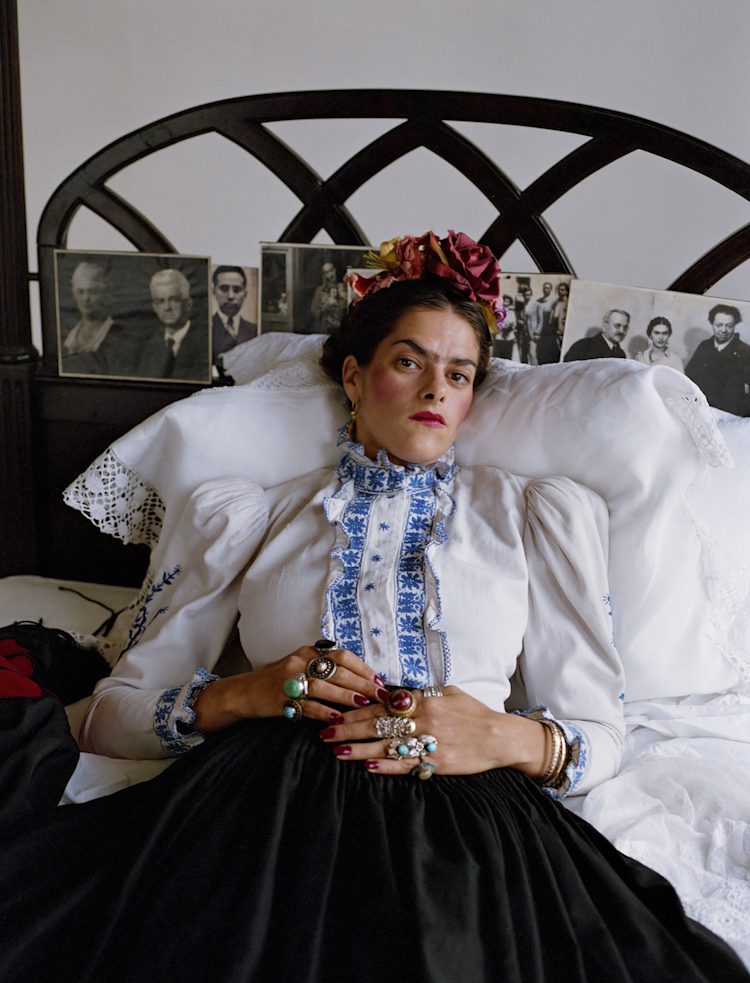
Many of the artists reaching back to Kahlo call upon the pain she suffered, the non-binary nature of her love affairs, her struggle with her broken body and her constant chronic pain. Nevertheless, one feels her bravery in facing down the cultural climate and standing up to the weariness of her failing health.
Kindness is a virtue. It is in short supply from the political powers whose administrations dominate much of our lives. Do we need, then, to insert divisions between those who ‘belong’ and those ‘others’ who do not? A less intellectual stance, one that puts kindness and tolerance above all, should surely be enough to console us in our various pursuits of those whom we desire.
Apart from some of the cluttered intellectual bluster, heart-warming images of affection run through the exhibition, and through Frida Kahlo’s work in particular.
FRIDA: The Making of an Icon is at Tate Modern, 25 June 2026 to 3 January 2027.
Images courtesy of Tate Modern
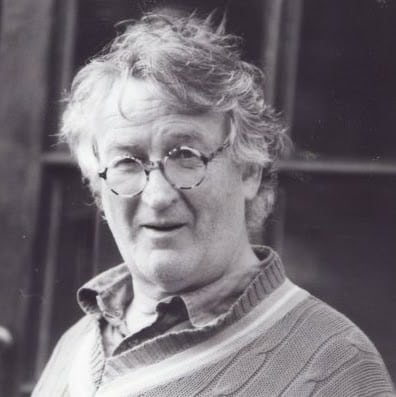
Ed studied painting at the Slade School of Fine Art and later wrote his PhD in Philosophy at UCL. He has written extensively on the visual arts and is presently writing a book on everyday aesthetics. He is an elected member of the International Association of Art Critics (AICA). He taught at University of Westminster and at University of Kent and he continues to make art.