Trebuchet is making space for artists to write in their own voice as thinkers whose practice generates and reflects on its own philosophy.
Sofia Cianciulli is a multi-disciplinary body artist from Florence, Italy, whose work spans painting, performance, digital media, and augmented reality. Raised within Renaissance art history’s long tradition of the female form, and later shaped by the individualism of New York feminism, she has spent her career asking what it means to represent a woman’s body in a post-feminist media age. She holds an MA in Fine Art from Central Saint Martins and was shortlisted for the Ingram Prize.

Here she brings that lens to Euphoria Season 3, and finds in its characters something she recognises from eight years of her own practice: a generation that didn’t reject tradition so much as discover it was something they could no longer afford to keep. It is a piece of cultural criticism, but also something rarer, an artist thinking in public about what her work means, and what it costs.
Hot and Invisible: What Euphoria Got Right About Being a Woman
Essay by Sofa Cianciulli
Euphoria has always been good at making the uncomfortable comfortable. That’s why so many people love it, and why so many don’t. It takes the messiest parts of a generation and gives them good lighting and a great soundtrack, which somehow makes it easier to sit with. Season 3 did that for me, except this time it also made me think about my own work in ways I wasn’t expecting.

I started making art in 2018 with a question: what is the role of women in media? I’d grown up surrounded by fashion magazines, anorexic models, and an industry that had very clear ideas about who a female body was for. I was confused, and confused in the way you can only be when something feels wrong but everyone around you treats it as normal. Over the past eight years, that question evolved. It moved from Instagram to TikTok to OnlyFans, from representation to commodification, from image to transaction. I thought I’d moved past it. Euphoria made me sit with it one more time.

The Algorithm Thinks I’m Hot
Here’s where I should probably be transparent about my position in this conversation.
The algorithm has opinions about me. Positive ones, mostly. Blonde, green-eyed, conventionally attractive, I fit the parameters the system rewards. I’m not saying this to be self-congratulatory, or to perform humility. I’m saying it because pretending this isn’t a variable would make everything I write about bodies and commodification somewhat dishonest.

It comes with strange privileges. Smiling at the right person gets me perks I didn’t earn. People remember my face before they remember what I said. There’s a kind of social currency I carry around without asking for it, and it would be disingenuous to claim I never spend it.
It also comes with its own exhaustion. People don’t always take me seriously. In relationships, it’s hard to get past the surface, to get someone to actually listen rather than just look. There’s an irony in spending years making art about the female body and having people respond primarily to the fact that the body belongs to me.
Which is exactly why Euphoria Season 3 hit a nerve.
Sex is Not the Point, Except That it Kind of Is
Look at what each character is actually doing this season. Jules is in art school with a sugar daddy. Cassie runs an OnlyFans. Rue works in a strip club. Maddy manages hot influencers. Every single one of them has found a way to turn their body, or someone else’s, into leverage. None of them frame it that way. That’s what makes it interesting.
I wrote about this in 2019. The argument then was blunt: social media hadn’t liberated women, it had just given them a more efficient way to commodify themselves. The feminist gains of the 20th century, fought for with genuine urgency, had somehow culminated in OnlyFans as a career path and “authentic self” as a branding strategy. Progress, presumably.
The vocabulary has changed since then. The platforms have multiplied. But the logic hasn’t shifted: in the attention economy, the female body is still the most reliably liquid asset. Euphoria doesn’t challenge this. It dramatises it with excellent lighting.
People read my art the same way. I use my own body as material, raw, unclothed, unretouched, because the question I’ve always been asking is about the primordial female form, the one that predates the editorial, the filter, the brand. How do you make an honest image of a woman’s body in an era when every image is already a negotiation? I’m both the subject and the object, and that changes everything.
People read it as sexual. I understand why. But the nakedness was never meant to titillate, it was meant to strip something back. There’s a difference between naked and exposed, between vulnerability as artistic choice and vulnerability as performance. The confusion between those two things is, I’d argue, exactly what this season of Euphoria is about.

Beyond the Sex: What This Generation Actually Lost
The most interesting tension in Season 3 isn’t between characters. It’s between two ideas that used to feel stable and now don’t: tradition and freedom.
I was raised Catholic. I used to pray every night before bed, and then something broke. It didn’t happen dramatically, more like a slow leak. The values I was handed stopped fitting the world I was living in, and I didn’t know what to put in their place. Euphoria shows us this happening in real time, to an entire generation.


Cassie and Nate are the clearest example. They wanted the traditional American dream, the house, the wedding, the defined roles. Then money gets tight and the architecture collapses at exceptional speed. Cassie walks away from the marriage the moment the financial fantasy dissolves. Nate, who was appalled that his wife would sell her body online, quietly reconciles once her earnings land in his account. The values didn’t disappear. They just had a price.
Rue goes the opposite direction. Broke, unglamorous, and completely outside the economy everyone else is navigating. And yet she’s the one expressing the most old-fashioned desires, sobriety, faith, a family someday… Her turn toward God reads less as conviction and more as someone who has exhausted every modern substitute for meaning and is going back to the oldest available structure.
Then there’s Jules. Art school, sugar daddy, no survival job, just art, sex and a luxury penthouse. The artist’s dream, on paper. She made me more uncomfortable than anyone else. I recognised the fantasy: someone else handling the financial reality so you can just make things. What unsettled me wasn’t judgment toward her, but the quiet recognition that the path exists for me too. That it wouldn’t even be difficult. That’s the part I didn’t enjoy sitting with.
Together they make a strange argument: that this generation didn’t reject tradition so much as discover it was something they couldn’t afford to keep.
What the Dead Come Back to Say
Season 3 chooses to honour its dead rather than erase them. Angus Cloud, Eric Dane, their presence is felt, and the show is better for resisting the easy happy ending. The final scene hit me harder than I expected. I won’t say more than that.
My own work has been moving in a similar direction, not toward grief exactly, but toward the same underlying recognition. The body is temporary. Fragile in ways we prefer not to think about until something forces the thought. Over the past few years I’ve become less interested in the body as subject, its politics, its surface, its negotiations with culture, and more interested in what animates it, and what remains when it’s gone. The work has gotten quieter. More metaphysical. Less about the flesh and more about whatever lives inside it.
Euphoria, for all its maximalism, seems to be arriving at the same place. In this final season, every character is navigating the same question underneath all the noise: what do you do with your body, your desire, your energy, when every available structure — tradition, faith, love, money — turns out to be more fragile than advertised? Cassie sells it. Jules trades it. Rue tries to transcend it. None of them have a clean answer.
Neither do I. But I think the question is worth sitting with, longer than is comfortable, longer than the algorithm would recommend. The body is temporary. What we choose to do with it, and what we choose not to do, might be the only real authorship we have.

About Sofia Cianciulli
Sofia Cianciulli is an Italian multi-disciplinary artist based in the US. Through the lens of contemporary issues shaping our generation, she explores the complex dynamics of feminism, social media, psychology, and the delicate balance between humans and machines. Navigating the tensions between societal expectations and personal authenticity, Cianciulli offers a poignant exploration of her innermost coming-out-of-the-closet emotions and thoughts. After a series of traumas, observations and of righteous rage about a generally toxic culture, she responds with absolute transparency, and a twist of irony, while negotiating a space to heal and coexist.
Cianciulli graduated from Central Saint Martins in 2020 and quickly gained recognition through accolades such as The Ingram Prize and Mona Hatoum Scholarship. She has exhibited in prestigious venues such as Saatchi Gallery, Art Basel Miami and V&A Museum, and in 2022, she was commissioned with a major public installation in Wembley Park, London.
Images courtesy of Sofia Cianciulli © Sofia Cianciulli
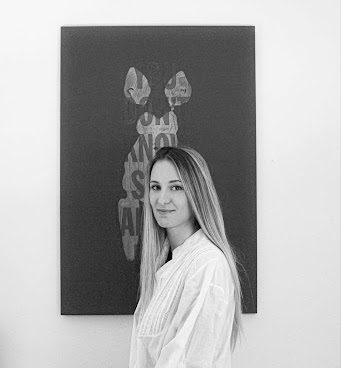
Sofia Cianciulli is an artist whose work explores the female body, identity, and the politics of representation.