Nuremberg’s Galerie VON&VON has held the Playground Art Prize for a number of years, but is this year the best? Selected from over 200 applicants, the final three artists were remarkable in demonstrating that art-school art is more than i-hate-you-dad sexual reimaginings of childhood cartoons, fabric-led sculptures about puberty, Robotech maquettes, and abstract paintings about alienated feelings. Instead, there is talent here that has something new to say.
As curator Helga Krutzler explains: “This year was particularly special. That was the main feedback from the jury: all three finalists already have remarkably distinctive voices, more developed than those of many artists with ten years of professional experience. You can really see the depth of research behind their work, the thought they put into every aspect of their practice, and the unique perspective that comes through in each piece. I think that’s what makes them so exceptional.”
The key thing from the year is that, like many years, the jury selecting the winner and finalists comes from within the art world, giving the artists vital exposure to people who have an interest in proving their choices were correct. No one wants to say they gave the prize to an artist going nowhere; it is in everyone’s interest to pick long-term winners.
As such, the gallery’s choosing of the jury is as important as the winners, something Krutzler attests: “We have incredible people from major museums who have the experience and the eye to recognise talent at a very early stage. We also have an excellent art academy here in Nuremberg and more generally Germany has a long tradition of outstanding art schools. From the beginning, it was important for us to identify young artists with real potential, and with the expertise of the jury it’s much easier to spot that talent early on.”
This year’s jury was made up of Angela Stief, Director of the Albertina Modern and Chief Curator for Contemporary Art from 1945 at the Albertina, Vienna; Dr Claudia Emmert, Director of Kunstmuseum Bonn; Anna-Catharina Gebbers, Curator at the Hamburger Bahnhof – Nationalgalerie der Gegenwart, Berlin; Benedikt Seerieder, Curator at the Museum Brandhorst, Munich; and Dr Daniel Zamani, Artistic Director at the Museum Frieder Burda, Baden-Baden.
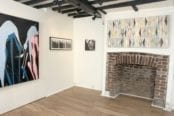
This is a formidable group who via the prize can help the artists reach a wider audience of art-world players. The prize itself offers the three winners monetary awards of €1,000 (first prize), €300 (second prize) and €200 (third prize), however the real prize is a showing at the Nuremberg gallery (2 July to 29 August 2026), which then takes the work of one winner to the influential art fair Artissima in Italy.


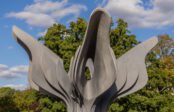
Prizes like these are barometers of the art world as a whole and the winners’ practices were strong compared to the general level of degree shows that audiences are used to. The first-prize winner, Sophie Constanze Polheim, currently a student at the University of Fine Arts Hamburg, creates sculptures that are 3D-printed from instructions that are subtly altered. This results in vases that reveal processes of manufacture rather than mechanically perfect objects. Sitting on plinths that reference the punch cards at the foundation of computing and weaving, there’s an historical depth to the works that feels importantly ambiguous. Is this a statement on historical manufacture and what those relationships mean in the 21st century? Polheim downplays this reading, rather emphasising how she uses weaving, ceramics, sculpture and digital processes to explore historical narratives, patriarchal violence and human relationships to fire through queer-feminist and ecological perspectives. This is a thematic drive perhaps more fully realised in her tapestry work that layers image, text and texture, which is also on show.


Second place winner was Lin Htet Aung whose multimedia work, twisting the narrative of propaganda in Myanmar by doctoring a political broadcast, apparently has things to say about migration, propaganda, faith and political violence through film, installation and found materials. However, it’s the presentation that draws people to the work; the unreality of the footage-based installation and its attendant meaning belies the wonder of the work itself. The disjuncture of the works to expand a field of conjecture against reality, we read something different to what is visibly said, reaches everyone. It touches the universal, a signal through the noise, human to human. The paradox of lost people finding themselves in the wilderness, still lost but no longer alone, is where the work finds its power.

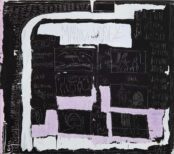
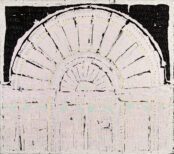
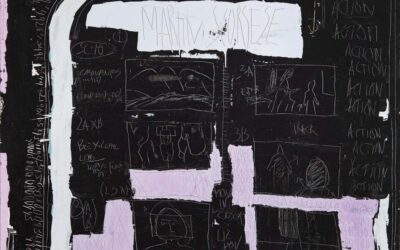
The third place winner from the Städelschule, Frankfurt, Jiacheng Li’s work has perhaps the more curious and subtle effect. Creating works that reflect Singaporean society and history, he approaches painting as layered sculpture with a sense of moment. Verbal and conscious, the various works create a painterly space for contemplation, but it’s the aesthetic distancing that reveals how the works reach people. Paradoxically, while many works attempt to draw us close through familiar hooks and narrative, his maintain a distance. The ghostly ambience, the poised figures, Li’s works contain the heat and sweat of a tropical environment with a sense of emotional disquiet. Emanating from the presence of a complex history, one feels the manifestation of darkness seeping through the white concrete of municipal buildings, car parks, and the living decay of foliage.
Li, a sculptor who only recently turned to painting, describes his work as being examinations of Singapore’s colonial legacies and systems of representation. Looking at the lost or muted stories in the national identity, he explicitly questions the official depictions of modernity, which reveals the violence and contradictions embedded within colonial and postcolonial realities (VON&VON Press release 2026). Layers of symbology, history, found footage, and media ontology are given a luminous transparent treatment reminiscent of the language and colour of Michael Armitage’s post-colonial paintings and Gauguin’s Tahiti paintings. And yet the paintings’ wall text garnish of critical or reductive features never quite manages to overtake the aesthetic and emotive quality of the works themselves. This is equally true of the other winners. While there are lots of clever and inspirational things to say, in the end it’s how the materials are transformed and manifest as art that holds your attention.
It is reassuring that the immanent presence of great work rises above the discursive clamour of its creator, and even the gallery that supports it. A quality that, speaking to Krutzler, might be something they’re looking for through different juries each year in an effort not to favour an artistic type or methodology: “What really stood out was the diversity of the submissions. Over the years, we’ve had winners and nominees working across every imaginable medium, from performance and painting to sculpture and everything in between. So I wouldn’t say there’s one particular technique or discipline that stands out. Many art prizes tend to favour painting or sculpture, but I don’t think that’s the case here.”
This favours the gallery as it means that they’re looking for talent rather than genre, a true relationship that lets them build partnerships with the artists that grow from the prize and forward. Krutzler muses on this, noting that while the prize and its money are important now, what the prize really offers is something deeper, intangible but essential for new talent coming through; a chance at meeting people with influential scope who are willing to help.
This is something VON&VON has fostered with winners since the prize’s beginning. “In the best-case scenario, it becomes a long-term relationship. Our hope as a gallery is to work with our artists for as long as possible, because that’s when you really get to see their practice evolve. With artists at such an early stage in their careers, there’s so much potential to grow together, and ideally to continue working with them for decades. … It’s something that seems so easy when you’re working in the industry and have done so many shows, but for young artists, it’s something of a continuous mystery. How to transport your works, how to organise your works, how to write about your work, they’re all subjects we talked about previously. What kind of text would you like to read about your own work? How would you like to present yourself as an artist? Those are all important decisions at the beginning of a career, and Cornelia (Stalker, founder VON&VON) saw this opportunity to create something that was missing.”
An art prize is only as good as the artists in it. Sure, there are larger headlines about controversy, prize money, the oversights and under-representations in judging, all the subjective gumps and gripes that add a fun frisson, but at the core it’s about transcendence. It is genuinely astonishing the quality of the three artists for the 2026 Playground Prize and having the opportunity to see these artists at this stage is a thrill. Yes, there’s a layering of art-speak, virtuous concerns and the usual pitter-patter of theory, but these are forgivable sins from artists either at or recently graduated from art-school. The prize accepts submissions from artists in German-speaking institutions in Germany, Austria and Switzerland, and keeping the catchment tight adds a sustainable scope to what VON&VON can offer, feed, and see succeed. It feels gauche to say triumph, but where there is mystery there is art. It is the only prize worth winning.
Playground Art Prize 2026, 2 July – 28 August 2026
Galerie VON&VON, Königstraße 5, 90402 Nürnberg, Germany Exhibition
galerie-vonundvon.de/exhibitions
Prize:
Playground Art Prize, Galerie VON&VON Prize Details & Open Call

Bibliography
Galerie VON&VON (2026) PLAYGROUND ART PRIZE 2026 – Emerging Contemporary Artists Competition in Germany, open call prospectus, Galerie VON&VON, Nuremberg.
Travel and accommodation supported by VON&VON. Images courtesy of Galerie VON&VON. All photos: Christine Blei

Trebuchet editor and art critic. Kailas is often away in some distant city searching for the latest artistic vision of the future. He has written for Trebuchet for over a decade, specialising in art theory as it evolves in contemporary art, the re-emergence of the monumental, and the personalisation of Modernist tropes in individual works.