The tranquil garden of the Estorick Collection, an oasis of peace in busy Islington, offered welcome respite from the oppressive midsummer heat of London.
The invitation, to supporters of the gallery but also open to the public, in return for a contribution, promised an evening of art and organic wine tasting. It began with a short introduction to the museum’s current exhibition, Emilio Isgrò: Erasing to Create (20 May to 6 September 2026), before an intimate tasting that celebrated artisanal Italian winemaking (Estorick Collection 2026a).
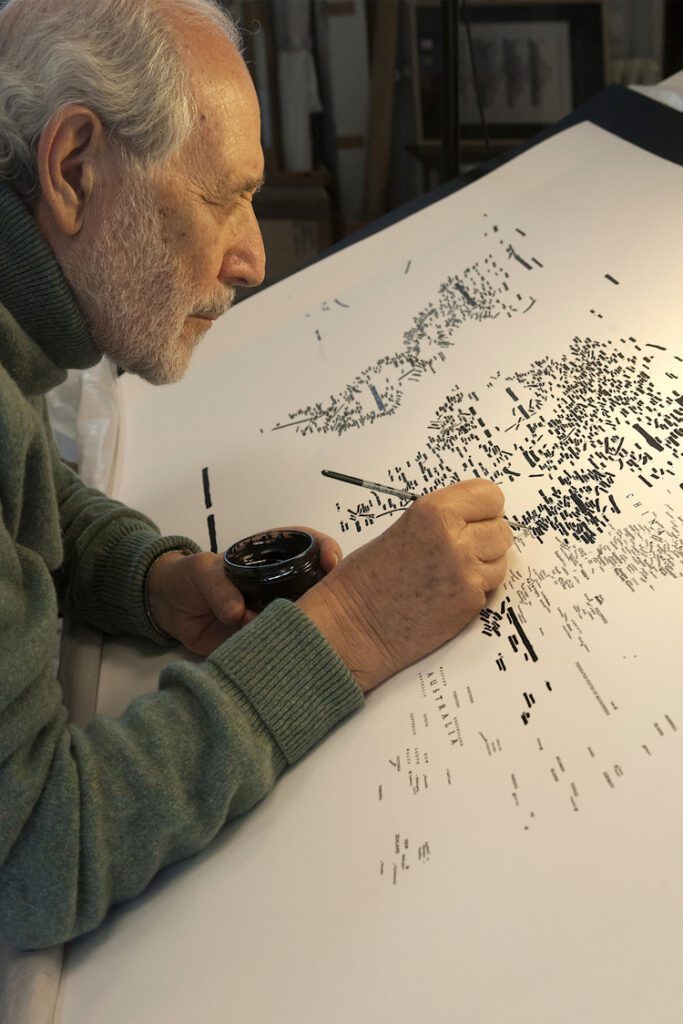
Born in Sicily in 1937, Isgrò made his name through pioneering verbo-visual experiments in the early 1960s. The exhibition traces his path from those beginnings to his latest work, charting the evolution of ‘Cancellatura’ (Erasure), the practice of judiciously obscuring the words and letters of printed texts to suggest new meanings and visual rhythms (Estorick Collection 2026b).

For Isgrò, meaning lies buried beneath layers of information, ideology and convention, and erasure digs it out. His technique is radical in its simplicity. It strips away verbiage so that what remains speaks with greater force (Estorick Collection 2026b). As the artist himself asserts, Cancellatura “does not destroy but creates; it does not censor but reveals” (Isgrò cited in Estorick Collection 2026b).
Maps and globes form one of the defining threads of the work on show. Since the late 1960s Isgrò has subjected cartography to the same treatment as his texts, obscuring place names, borders and routes, the very instruments through which humanity orders and divides the world. These works invite viewers to reconsider the relationship between geography, identity and power (Estorick Collection 2026b). The show also includes a new piece on Brexit, made specifically for London, a timely reminder of the tenth anniversary of that momentous event. (Ministero degli Affari Esteri 2026).
After the tour of this vibrant and intriguing work, guests sampled a broad range of Italian wines. From the rolling vineyards of Lombardia, Pasini San Giovanni presented a refined selection of Brut, Lugana Bianco and Rosé (Estorick Collection 2026a).

From the other end of the peninsula, Sicily’s Masseria del Feudo poured an elegant Rosé alongside two distinctive reds.
Every bottle came from small, independent producers working with fully organic methods, celebrating craftsmanship, authenticity and the character of their regions (Estorick Collection 2026a). On a sober note, both producers shared with the audience how climate change is impacting their produce, and the way they are tackling that challenge, by planting on higher ground, and developing new forms of irrigation.

Guests began with the Brut, Rosé and Bianco, a chance to decompress after the intensity of the artworks on display, before moving on to savour the full body of the Sicilian reds. The informal seating in the shade of the lovely garden invited strangers to become acquaintances, comparing notes on the works on display and the flavour of the grapes, making the event a pleasant and balanced social and artistic gathering.
Emilio Isgrò: Erasing to Create runs until 6 September 2026 at the Estorick Collection of Modern Italian Art, 39a Canonbury Square, London N1 2AN.
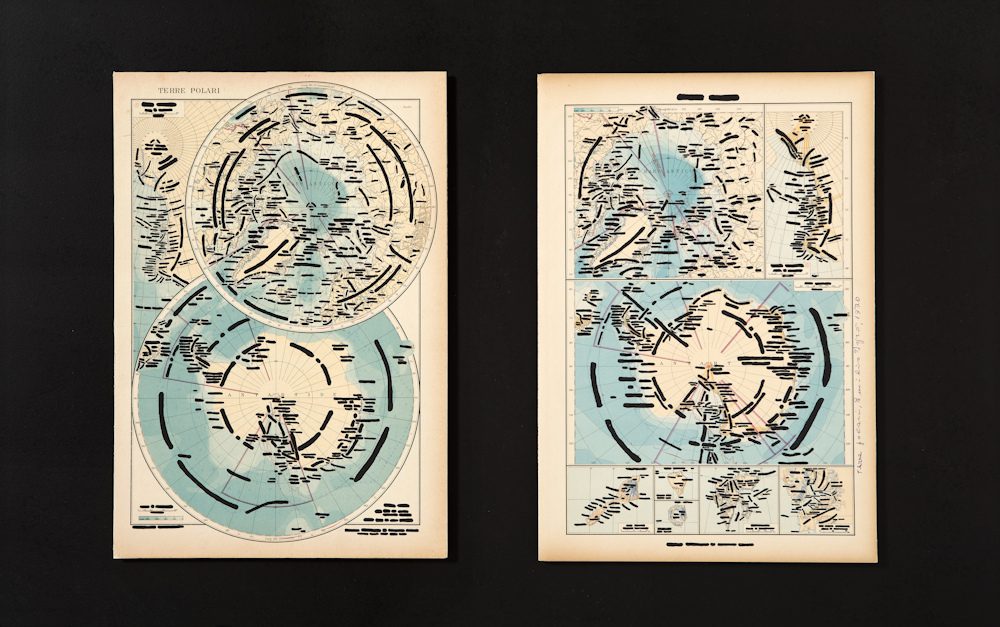
of wood and plexiglass, 50.3 x 80.5 x 9.7 cm. Courtesy Fondazione Emilio Isgrò
Images courtesy of Julio Etchart and Estorick Gallery

The aim of art is to represent not the outward appearance of things, but their inward significance. – Aristotle