Woven together by ideas of migration, rhythm, and expression, curator and advisor Julia Campbell Carter and Octavia gallery founder Pamela Bryan have brought together a multi-national vision of art that asks a pressing question: what, amongst our differences, binds us to one another?
The featured artists maintain varied practices, so it falls to viewers engaging with the exhibition’s theme to consider each individual experience as demonstrated by them. The way they bring their personal histories into creative work cannot help but carry certain cultural frames into the contemporary present. The past informs the present but need not be a limiting frame, as the artist Alia Ali [b. 1985, Austria; Yemeni-Bosnian-American] explained to Trebuchet:
“From an early age, I understood that materials — specifically textiles and architecture — can carry history more powerfully than language. Cloth travels across borders and generations, translating notions across classes and religions while absorbing memory, labor, ritual, and trade. Growing up across multiple cultures, I came to see textiles not as decoration, but as social architecture: something that can simultaneously conceal, protect, seduce, identify, and divide. Materials are a way for me to express ideas of movement, migration, colonial histories, and belonging without reducing them into fixed narratives.”
Culturally the clothing of women has many different meanings from personal expression to religious edict, what symbolic language are you drawing from?
First, this is not only about women- it’s about everyone. The sitters and makers within my work exist across genders and identities, and that disruption is intentional. One of the first assumptions the work challenges is the idea that what we see is what we think we understand, only to realize that we don’t understand anything at all.

I’m interested in the instability of knowing: how one garment can represent devotion, resistance, elegance, control, and protection for the person wearing it, while carrying an entirely different projection depending on who is looking. The work draws from textiles, symbols, and material as language, particularly across indigenous communities of the past, present, and multiple futures.
I think it’s important to insist on multiple futures rather than collapsing cultures into singular meanings, which is a classic form of active erasure and colonial violence. I’m interested in the tension between visibility and obscurity, individuality and collective identity, ornament and camouflage. The body becomes a site where so many things exist all at once- where politics, beauty, gender, labor, and history coalesce into multiple surfaces, textures, and possibilities within a single garment, and furthermore, within specific communities.
Where does the balance of the creative act lie for you; in the construction of the mis en scene or the photography?
The photography is inseparable from the construction. The work begins long before the camera, with an idea followed by travel, time, and months spent within communities, markets, kitchens, workshops, and homes. From observing, listening, meeting masters, building trust, and experimenting until eventually a narrative begins to emerge. From there, I begin working within a specific region or community alongside makers, pulling together patterns, symbols, and techniques, understanding what they mean within those communities, but also how they can collectively paint a story and an idea.

For example, within the JADE series, the process began with finding a Chanderi silk: a textile made from a mixture of silk and cotton with a particular translucency and softness. That understanding also comes from childhood, from markets, from touch, from learning material through texture and instinct as language. The textile then moves through the hands and studios of master makers: hand-dyed, often in tones that can never be replicated exactly again, before being taken through multiple stages of block printing. In the case of JADE, nine different wood blocks were carved, each corresponding to a specific layer of the pattern: the border, the filling, and the gold illumination across four patterns. The fabric was then sent to Kashmir where it was hand-embroidered using zari thread (gold or silver mixed into cotton or silk thread) by master embroiderers.
At the same time, I design the garments and develop them with master tailors. The silhouettes often exist somewhere between what is considered “home” and “away,” reflecting diasporic movement and hybrid identity. Once completed, the textiles are brought into the studio in Marrakech where the photographs are made, often with sitters who are close to me: family members, close friends, both men and women.
The digital photographs are then sent to Paris alongside swatches of the actual textiles straight from India so that the photographic color correction can be matched precisely back to the fabric itself. One of the only digital interventions within the work is this color calibration. From there, the works are printed onto cotton paper and laminated. Frames are built in Paris or New Orleans by carpenters creating specialized handmade structures. The frames are then physically hand-upholstered by me with the Chanderi silk, layered over four layers of cotton, before I mount the photographs into them. In parallel, additional artisan groups sew walls and borders through pattern-matching, which I then use to upholster fabrics directly into the exhibition architecture itself to create scapes (dreamscapes, landscapes, mindscapes…)
To think of the work as only photography would flatten the hundreds of histories, gestures, materials, borders, and forms of labor embedded within it. Each piece is a translation across communities, hands, and geographies often involving more than fifty master makers working across borders without visas, from multiple communities and generations. Within my exhibitions, every artisan is acknowledged and credited by name. There is also an economic impact that extends beyond the exhibition itself, where the public can access particular studios and Etsy pages and purchase ready-made works directly from the artisans’ studios.

In terms of what you’re trying to say, do you feel that you’ve said it all with the latest series or is there more to explore, and if so what would you change or explore (different fabrics, different poses?)
There is no “latest series.” The work has never been linear for me — it behaves more like a living world that keeps expanding. Rather than thinking in terms of singular works or series, the question for me is about practice. My practice is not moving toward resolution. If anything, it continues to become more layered, more spatial, and more complicated, which naturally leads into increasingly varied materials. Lately, I’ve been leaning into questions of futures: multiple futures, material futures, environmental futures, diasporic futures.

While textiles remain central, for years I’ve also been quietly developing sculptural languages within the studio that are only now beginning to emerge into exhibition spaces: glass, stone, moving image, dye processes, garment-making, talismanic objects, and sculptural forms incorporating semi-precious materials such as lapis. I’m interested in speculative future languages inspired by ancient indigenous systems of communication, and in works that function not only as images, but as immersive environments that physically move viewers through space, memory, and atmosphere. Strong work is not only work that moves someone emotionally, but work that also moves them physically around it. The artist, the practice, and the work do not serve the viewer; we move around and with one another — poetically, with tension, sometimes with aggression, but always with feeling.
If you were to draw a line from previous artists to where you are how would you describe that historical timeline? ( same question) Similar to the previous question, what artists/experiences have shaped you and how has that affected your work?
I feel connected to multiple histories simultaneously. The work exists within conceptual photography, sculpture, textile practice, and installation, but I’m equally shaped by markets, dye houses, migration routes, oral histories, and the politics of material exchange outside of formal art history. I’m deeply influenced by the master makers with whom I work across Yemen, Uzbekistan, Morocco, India, Mexico, Indonesia, Vietnam, France, and the United States.

Artists such as Seydou Keïta, El Anatsui, Sheila Hicks, Shirin Neshat, Jumana Manna, Cauleen Smith, and Cecilia Vicuña all opened different doors for me — materially, politically, spiritually, and spatially.
Living between cultures shaped me more than any singular artist. Constant movement made me deeply aware of how identity shifts depending on geography, language, and power structures. Artistically, I’m drawn to practices that blur boundaries between image, object, installation, ritual, and architecture rather than remaining fixed within one discipline.
Without wanting to over-explain what one question would you like viewers to first consider when looking at your work?
I hope viewers first question their own instinct to categorize what they are seeing. So much of contemporary life is structured around immediate identification — nationality, religion, gender, politics, belonging, even authorship between artist and maker. I’m interested in slowing that process down and creating ruptures within these deeply internalized colonial structures of seeing and knowing.

The work asks what happens when visibility becomes unstable, when beauty and discomfort coexist, and when a body, material, or history cannot be easily translated or consumed. But beyond unlearning, I hope the work also opens space for reimagining — for people to consider how identity, sanctuary, community, and selfhood might exist outside inherited systems and imposed categories. At its core, the work is also about permission: giving ourselves the freedom to imagine and become otherwise.
What material/movement/global or personal event has inspired you recently – and how do you think it’ll affect your work going forward?
The enormous pride that I have in Yemenis comes from witnessing how strongly Yemen has stood by Palestinians after experiencing more than ten years of active violence and erasure by bordering states such as Saudi Arabia and United Arab Emirates, with strong military and arms support coming from Europe and the United States. Violence against civilian areas such as schools and markets, alongside blockades on aid, food, and press, has made the situation incredibly volatile… and yet, for us, we are a nation of thousands of years. Ten years of violence is nothing in comparison to the thousands of years that we have existed and will continue to exist. That comes with a mentality that having no fear means freedom, and that being fearless is freedom. There is also this sense of loyalty — true loyalty — not leading by example, but simply being; that is who we are for our own.
This participation in resisting genocide is not something new. Yemenis also stood beside Muslim Bosnians against Serbian forces during the genocide of the 1990s, as did members of my own family. I’m interested in reframing how Yemen — and I myself — sit within the world, not based on Greenwich time or imposed geopolitical constructions such as “the Middle East,” but rather as part of a much larger
Afro-Asiatic maritime trade circulation. Yemen is often translated in the press as a site of extraction moving in a linear direction from East to West through oil, gold, and resource economies, but it has long been part of millennia-old circulations of objects, ritual, spirituality, language, and experience across the Afro-Asiatic Ocean, incorrectly renamed the “Indian Ocean” by British colonial powers.
Through tidalectics — understanding history, identity, and belonging through the rhythms and movements of oceans rather than fixed land borders — Yemen becomes deeply connected to places such as Zanzibar, Ethiopia, India, Singapore, and Indonesia. These movements created forms of exchange while still maintaining distinct identities, rituals, and material languages. This is where I see myself reflected, and those reflected within me.
I often think about textiles, garments, and objects as portable sanctuaries — things that carry memory, protection, identity, ritual, and home across movement, exile, migration, and trade. That understanding deeply shapes how I think about materials, belonging, and the work itself.
Exhibition Notes: Rhythm in the Blues. Curated by Julia Campbell Carter
Featured artist: Alia Ali, Aigana Gali, Azadeh Ghotbi, Naomie Kremer, and Lucille Lewin Curated by Pamela Bryan and Julia Campbell Carter

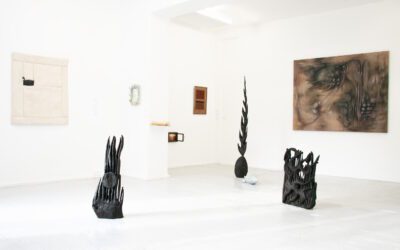
Founder of Octavia Art Gallery, New Orleans, Pamela Bryan and London-based curator and art advisor Julia Campbell Carter are proud to co-present Rhythm in the Blues, a dynamic group exhibition at 14 Percy Street, London, taking place from 11 – 20 May.
In a world of geo-political fracture and uncertainty, this exhibition unites and celebrates the creative voices of five acclaimed international contemporary artists each embodying a distinct multiplicity of nationalities, cultures, perspectives and medium – Alia Ali, Aigana Gali, Azadeh Ghotbi, Naomie Kremer, and Lucille Lewin. The exhibition affirms the vital importance of art and multi-disciplinary culture and their impact on how we understand the world and our place within it.
The works on view engage in a dynamic dialogue around rhythm, migration, memory, and place, forged through an exchange between New Orleans and London – two cities deeply rooted in layered musical histories. Rhythm in the Blues draws from the cultural and historical legacy of Rhythm and Blues as an art form shaped by movement, resilience, and lived experience. Through repetition, tonal variation, and intuitive form, the artists explore rhythm as both structure and inheritance, reflecting on diaspora, identity, and the transmission of memory. The result is a resonant visual language that invites viewers to not only see but feel the enduring pulse of history.
Alia Ali’s practice draws on Yemeni heritage and is shaped by movement, displacement, and research. Collaborating with Indigenous communities worldwide, her multimedia work engages material traditions and shared systems of knowledge across time and place. Language is central to her practice, understood as embodied beyond speech or text. Through photography, textiles, sculpture, and installation, she explores cultural memory, lived histories, and lineage while examining power and how knowledge is preserved and reimagined. She is a Jameel Fellow at the Victoria and Albert Museum and a Global Nikon Ambassador.
For the Georgian-Kazakh painter Aigana Gali, meanwhile, ancient cosmologies such as Tengrism, inform luminous abstract canvases that evoke the vastness, light and mythic landscapes of the Eurasian Steppe. Her work explores colour, spirituality and human connection to nature through expansive, atmospheric forms. Gali’s paintings, shown internationally – including at the Saatchi Gallery and the Royal Academy of Arts – blend intuitive gesture and movement, like a musician improvising with an instrument.
With a practice based on movement and a multiplicity of perspectives, London-based Iranian-American painter and photographer Azadeh Ghotbi explores themes of transience and belonging in stunning, abstract, gestural canvases that are deeply rooted in her unique personal experience and keen sense of observation. Her work aims to foster a deeper understanding and empathy for others. She invites us to pause, reflect, look beyond the surface and reveal the beauty in noticing the unseen.
A suite of abstract oil paintings by Israeli-born American artist Naomie Kremer, with their jagged, geometric forms, create a disorienting perceptual experience, an ambiguous atmosphere inviting the viewer to get lost and allow new, free associations to form in the mind. Although largely abstract, Kremer’s imagery draws from the real world, incorporating references to nature, architecture, language, letterforms and the human figure. Her work is informed by art history, music, poetry, and literature, and is included in the collections of the Whitney Museum of American Art and the US Embassy in Beijing, China, among others.
British South African sculptor Lucille Lewin – formerly the founder of Whistles and Creative Director of Liberty – creates works that are fractured metaphors for human experience through time. Her seemingly delicate, poetic pieces are personal and political. She models porcelain clay, dips, slips, casts and throws it before it is cut-up, pressed, extruded, broken and reassembled, a rigorous process of construction and deconstruction, akin to a composer, building her works to a gradual crescendo.
This celebration of bold, borderless creativity is both empowering and enlivening – bringing together distinct yet resonant practices.
Rhythm in the Blues celebrates the power of art as a shared language through which these artists transform rhythm, harmony, sound and ancestral echoes into bold visual expression.
Rhythm in the Blues, May 11 – 20, 2026
Octavia Gallery
14 Percy Street London, W1T 1DR
Exhibition open 10am – 6pm daily

Images courtesy of Octavia Gallery © each artist. Preview and interview supported by artists initiative

The aim of art is to represent not the outward appearance of things, but their inward significance. – Aristotle