Xinyi Liu’s work is dark. It references Heidegger’s idea that death gives meaning to life. It brings to the present the shadow of the inevitable end that lingers over the horizon. It’s this constant that makes the present moment that much more spectacular; from the position of individuation, we are here and compared to the endless road of days leading onward after our passing, we should revel in the pain, doubt and failures we face as much as we are drawn towards joyous moments. We are after all alive.
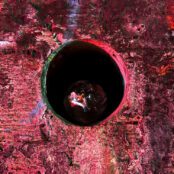
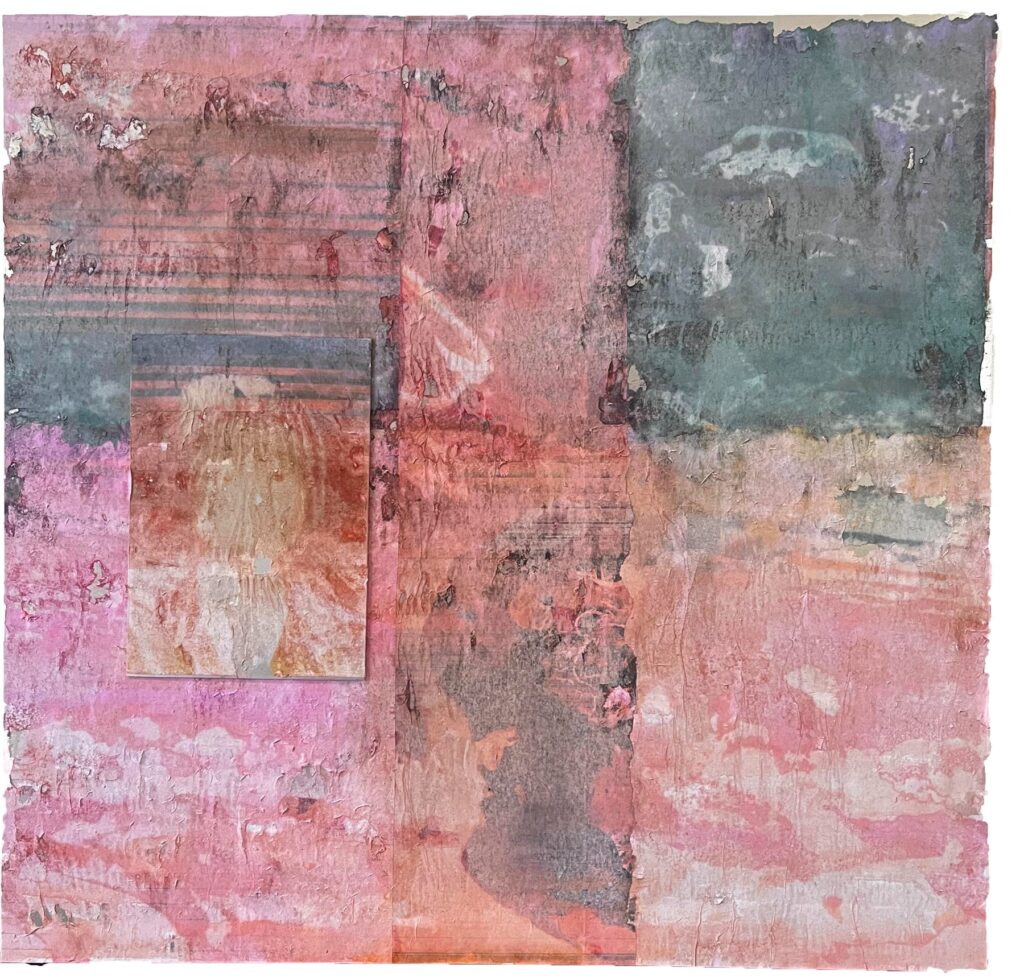
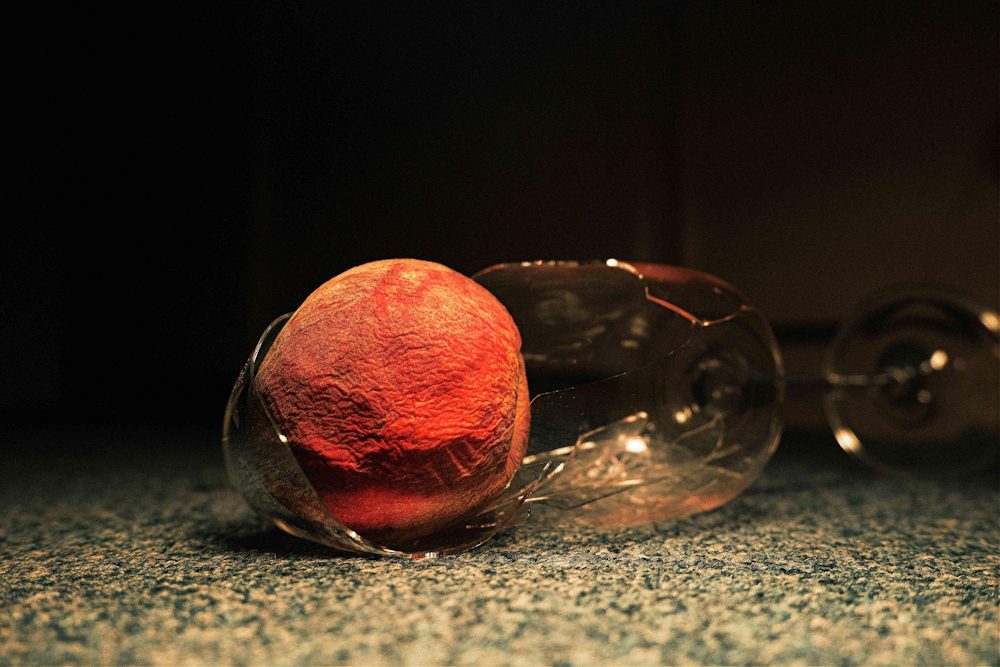
In Liu’s work Labyrinth of Growth (2025), she frames a 35mm print in a fluid clay frame. The image itself is blurred, changing, perhaps something organic, resonant with feelings of nostalgia. A picture in a frame is an image kept in aspic, a stationary point when life keeps moving around it. A ritualised grounding. In this piece the frame itself is a distorted symbol of a frame, still strong and structured, but uneven like the image it holds. It makes reference to what a frame should be. But isn’t. Rather than being an objective ‘frame’, it suggests a perspective on reality where all points are in flux – there is no static place to stand. No even place to commit to judgement. Compare this with her recent work A Detox Chronicle (2025) where the subject of indeterminacy again emerges, as per her artist statement for the series:
“A Detox Chronicle engages with the erosion of intimate bonds through the lens of visual fragmentation and material decay. The work examines the sociocultural mechanisms of emotional withdrawal, presenting intimacy not as a site of connection, but as a construct subject to disintegration and distortion. Drawing from postmodern theories of identity and alienation, the piece suggests that contemporary intimacy often collapses under the pressure of self-preservation and the fear of dissolution. Visually, the layered surface evokes the peeling strata of memory and affect, mirroring the ways in which modern individuals detach and
retreat as a form of psychological self-cleansing. Through the aesthetics of corrosion and absence, the work poses a quiet resistance to the romanticization of intimacy in the age of hyper-fragmented subjectivity.”
In Liu’s artist statement, the auteurist nature of filmmakers Maya Deren and Park Chan-wook (Korean director of Joint Security Area, 2000 and Oldboy, 2003) appears perhaps as milestones in her growth as an artist. One can see traces of Deren’s avant-garde films in the way Liu’s work eschews narrative and tries to impart an experience of time and object in her practice. Deren herself sought to free herself from movie conventions in order to explore what critic John Martin called ‘choreocinema’, namely moving images that link the movement of beings with the profile (actual or imagined) of objects. A fluid exchange whereby moderns:
“…discovered that that which seemed simple and stable is, instead, complex and volatile; its own inventions have put into motion new forces, toward which it has yet to invent a new relationship” (Deren 1984)
This presents a slippery world where all things exist in a web of psychological or magical connections. The organic objects in Liu’s practice, things that resist ideas of fixity, work in the same vein. The separation between body and object is erased, making meaning flow both ways between subject and object.
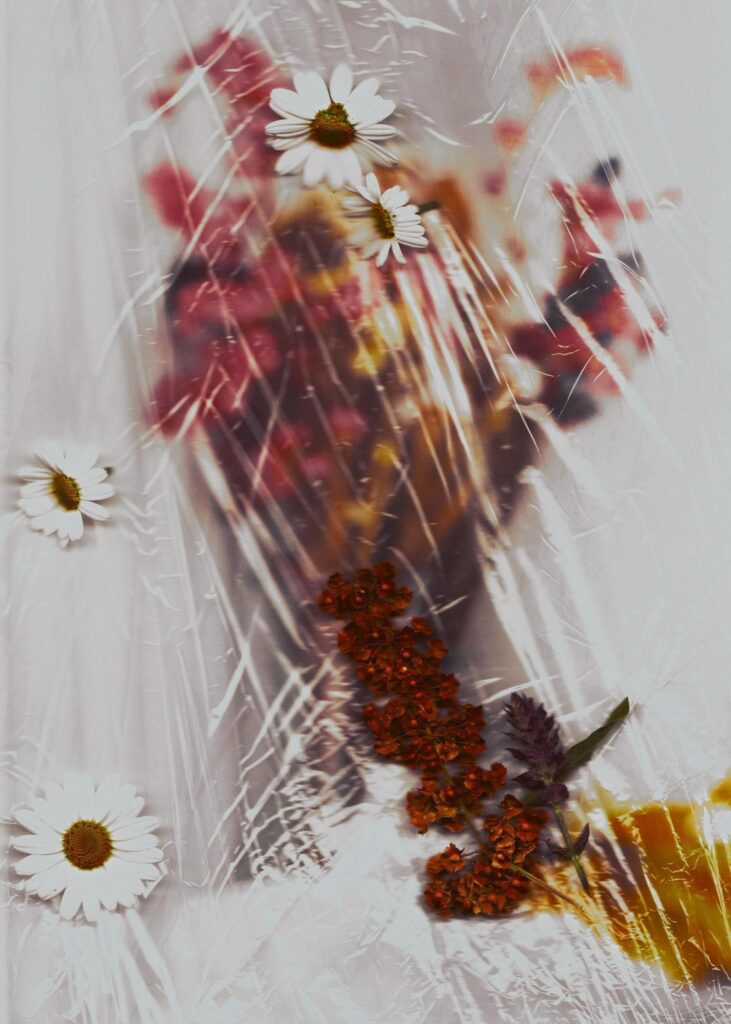
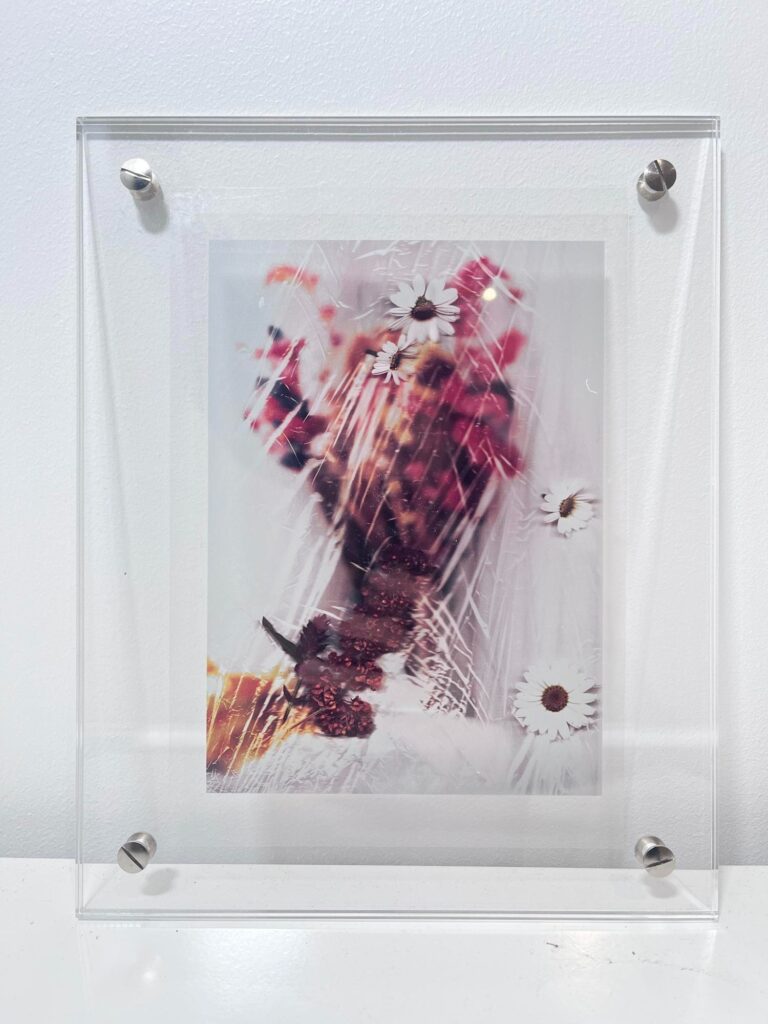
The difficulty in Liu’s work is often that these relationships, self-evident to the artist, are harder to find for the viewer. Familiar as we are with conceptual abstraction and neo-abstract figuration, her embodied connections with person, place, and object as conceptual points can feel disjointed or personal, rather than directly immanent. In Field Resonance (2025), we see a flower layered over a picture of a flower, under a plastic sheet. Each semiotic layer deconstructs the idea of the bloom by making them discrete. These layers, against holism, perhaps work against the artist’s intentions to reveal ‘The unseen current. The resonance that binds’ because our initial impulse is to see these states as distinct, didactically alienated from our embodied idea of a flower.
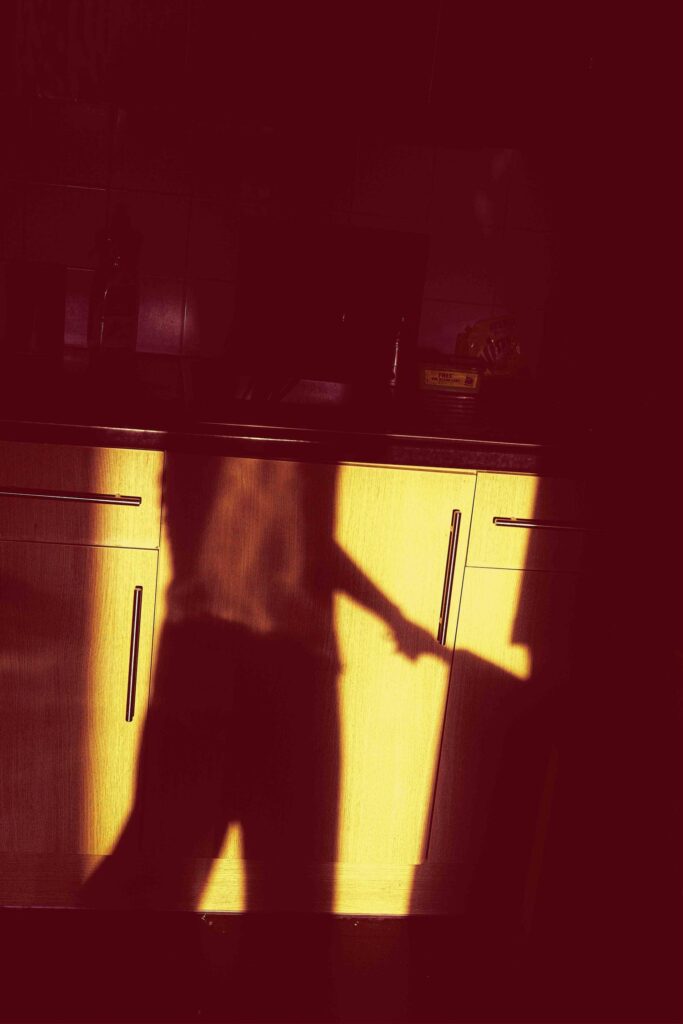
However, these disconcerting moments are resolved when the viewer perceives the object, a concept with edges feathering into other states, as a familiarity, fluid in relation to the surrounding context and the viewer’s own process of cognition. Like the films of Park Chan-wook where the perspective of the viewer changes as the context reveals itself, time and the layering of events play their part to elicit a sense of experience which mirrors the characters portrayed, Liu’s works are catalysts for layered experiences, which lead forward without definite conclusions.
If this process is the work itself, then that subjectivity is the aesthetic practice to be analysed. The first emotive gateways opened by her pieces feel alienating as familiar objects dissolve, leaving something uncertain. People like certainty. It’s a point from which to make sense of the unknown. But something remarkable happens after that, an appreciation of the fluid nature of objects defined by the nature of their change rather than the fixity of their definition.
This is a particularly current philosophical topic aligning with the post-object imperative of Manuel DeLanda and Graham Harman. These philosophers’ recent ideas suggest that until we appreciate the changeable nature of defined objects, we’ll fail to grasp the static present, let alone navigate the chaos of the near future with its mess of fluctuating interrelations. Harman (following Spinoza) also holds that objects have an obscure immutable centre that remains regardless of their context. As he states in Towards Speculative Realism: Essays and Lectures (2010):
“To treat an object primarily as part of a network is to assume it can be reduced to that set of qualities and relations that it manifests in this particular network.”
To that end, it’s what exists beyond the contextual moments that gives things life. An appreciation one feels that Liu would approve of.
The aim of Liu’s work is to make the viewer become conscious of the milliseconds that mark cognition. To become aware of the processes through which we perceive, judge and define. And taking each of these moments as passages to the next, circumnavigate the dark centre of object-being itself. The point is that stopping is a death unto itself and Liu is an artist for whom conscious movement through time is the key to perception.
Xinyi Liu Website
Images courtesy of the artist © Xinyi Liu
This review is part of a supported series on emerging artists including Xinyi Liu.
Bibliography
Deren, M 1984, The Legend of Maya Deren: a documentary biography and collected works, vol. 1, pt. 2, eds VèVè A Clark, MM Hodson & C Neiman, Anthology Film Archives/Film Culture, New York.Harman, G 2010, Towards speculative realism: essays and lectures, Zero Books, Winchester.
Harman, G 2010, Towards speculative realism: essays and lectures, Zero Books, Winchester.
Ex-London based reader of art and culture. LSE Masters Graduate. Arts and Culture writer since 1995 for Future Publishing, Conde Nast, Wig Magazine and Oyster. Specialist subjects include; media, philosophy, cultural aesthetics, contemporary art and French wine. When not searching for road-worn copies of eighteenth-century travelogues he can be found loitering in the inspirational uplands of art galleries throughout Europe.