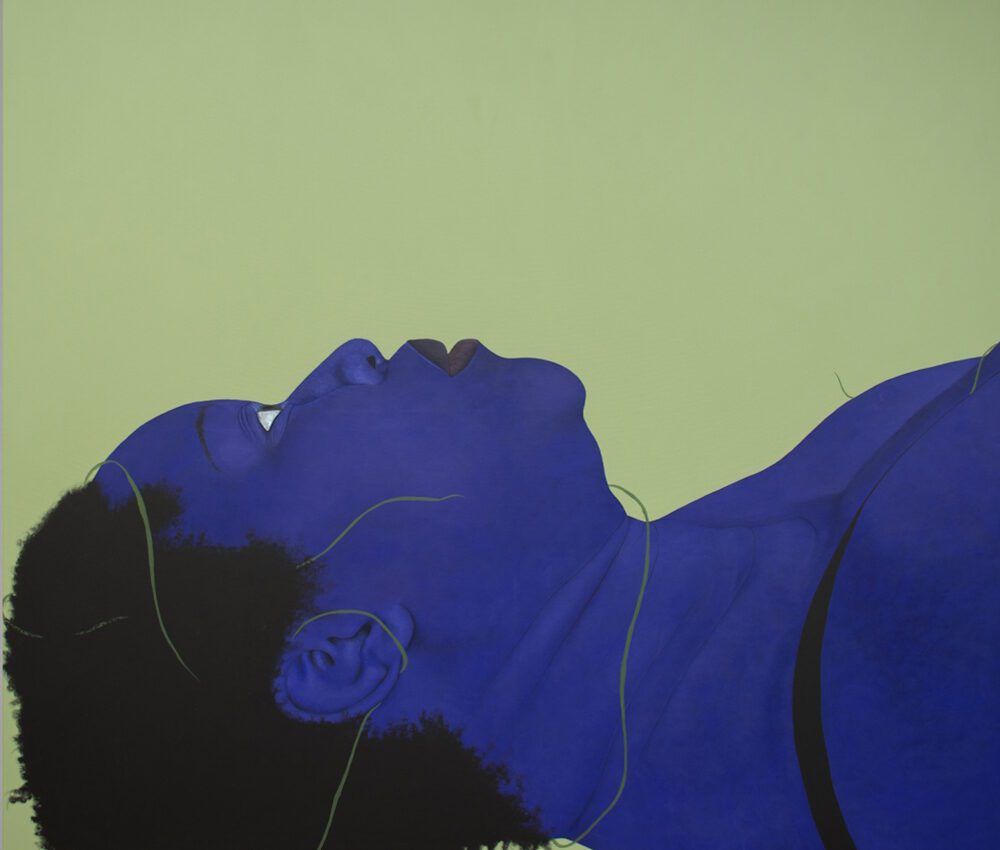
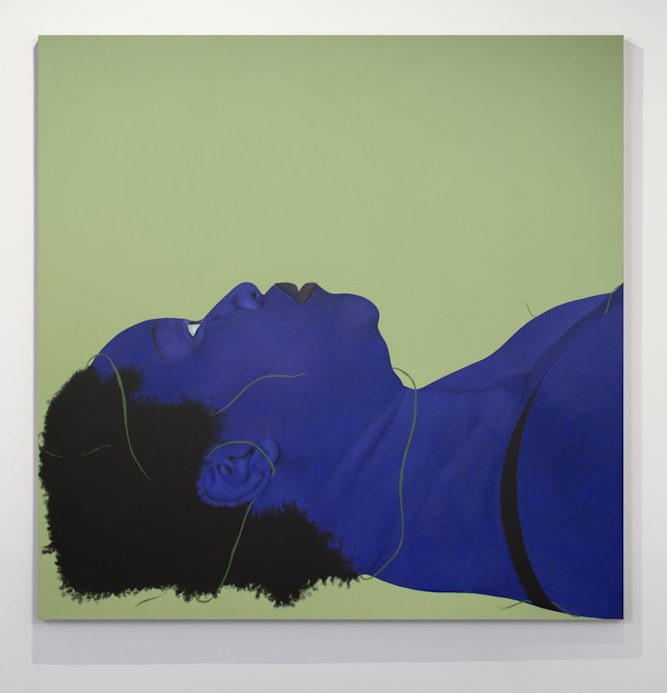
It’s the colour that grabs you first. The rich indigo blue that Stacey Gillian Abe uses in her figurative paintings now on show at Unit London. Abe uses indigo to allow viewers to think about Black subjects in a different way. It’s a colour steeped in the history of Africa, with a complicated legacy on that continent. At once a sacred symbol signifying spiritual protection, babies were often wrapped in indigo cloth, and at the same time, it has links to the slave trade where indigo textiles were used as a currency exchange for enslaved people.
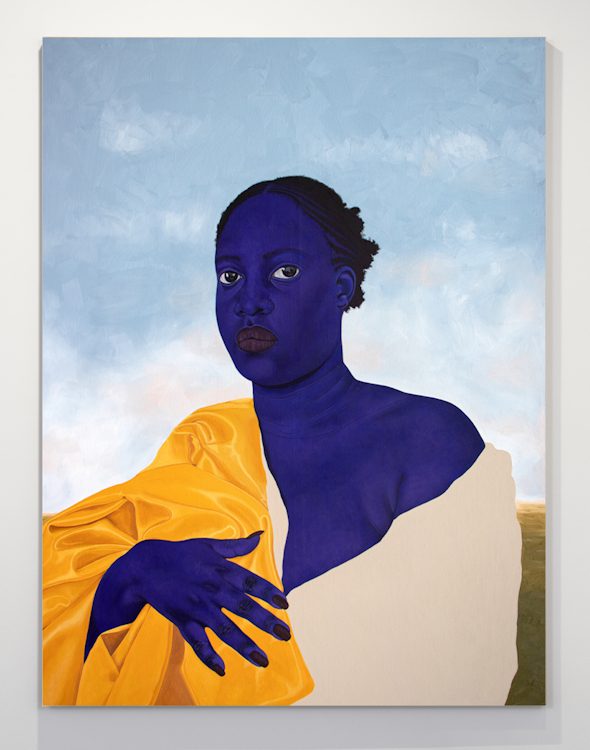
Abe mines this colour in her latest show, titled Garden of Blue Whispers, which is a personal and cultural exploration through familial and cultural heritage with paintings that explore past and present through evocative, almost meditative, figurative works. The exhibition was inspired by time spent in her native Ugandan village during the dry season, which marks a transitional time between the heat of summer and the refreshing rains to come. The works, mostly single figures that rest against single-colour and sparse backgrounds, evoke the heat of the dusty period and the wind that blows through the grasses bringing the rain. These paintings ache with both melancholy and celebration of life. The paintings also feature embroidery, a traditional practice passed through maternal lines, which becomes a symbol of continuity in these works. Portrait of my Grandmother (2025), features the artist’s grandmother, gazing powerfully out of the canvas with golden material draped over her, one hand clutching it to her body. The luminous gold and indigo draw you into the painting, functioning in an icon-like manner. This homage to her grandmother sums up the beauty and tenderness of these works and the way the artist paints herself into these works, examining her own experiences of grief and loneliness. They evoke deep feelings about connections—to family, home, traditions and culture.
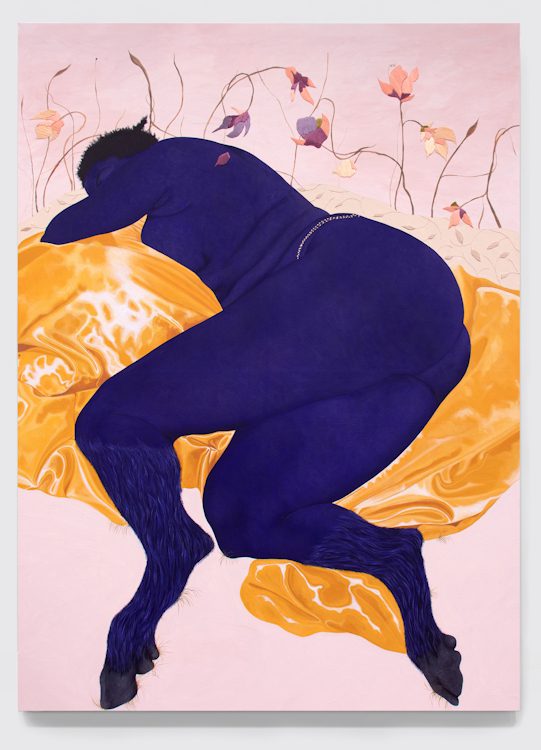
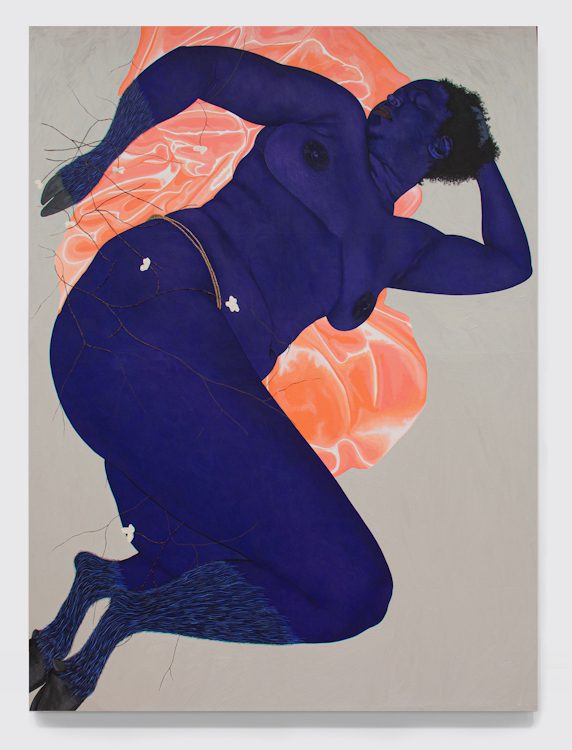
In many of the paintings, figures are nude or dressed in delicate summer fabrics as they lie in open, natural spaces, and they capture subtle moments, and deep connections the artist feels between family and the natural world and animal life in her village. In The Garden (2025), the surreal sight of the figure’s cloven hooves and furry lower legs meeting with fleshy thighs reminds us of the connection between human and animal in the village, of life lived in interdependency.
Garden of Blue Whispers is a homage to an artist’s love for her grandmother and an invitation for us all to linger over these works and reflect on our own memories, and the connections we have with time, family and tradition.
Garden of Blue Whispers, Stacey Gillian Abe, Unit London, 3 December 2025 – 31 January 2026
Images courtesy of Unit London © Stacey Gillian Abe

Barry Taylor writes and speaks about the intersections of philosophy, theology and contemporary culture. In past, he was the road manager for AC/DC during the Bon Scott era before becoming a Los Angeles theologian.