Aldona (2013), the first work presented in Emilija Škarnulyté’s new exhibition at Tate St Ives, might lull the viewer into an assumption about what’s in store for them as they enter the exhibition. It is a deeply personal and poignant short film following her grandmother as she goes on her daily walk through Grütas Park, a sculpture garden devoted to Soviet-era statuary, in southern Lithuania. It follows her as she slowly makes her way through the park, using her hands to feel the shapes and contours of the statues.
Aldona is permanently blind; her doctors claimed that this was from poisoning due to the explosion of the Chernobyl nuclear power plant. The ceiling of the room showing the film has herbs and flowers from Aldona’s garden, which hint at her lifelong exploration of the healing power of plants. The film is tender and deeply personal, and the viewer could be forgiven for assuming that the exhibition will follow similar themes, but then you enter the main room and find yourself thrust into a bold and wild futuristic ‘temple’ of sorts, a circular environment made up of four massive curved screens, where the major portion of this marvellous exhibition can be found.
Škarnulyté regards herself as a ‘future archaeologist’, desiring to expose the multi-layered challenges facing us in the 21st century. In this exhibition, she creates a haunting and immersive sonic and visual environment which explores a wide array of diverse topics and issues: nuclear energy, space travel, folklore and mythology, all blended together to imagine a lost human culture in order to consider the ramifications of unbridled technological advancement on both the environment and the human. Traversing the personal and the scientific, the mythological and the metaphysical, Škarnulyté explores deep time and invisible systems hidden in the cosmic and geological.
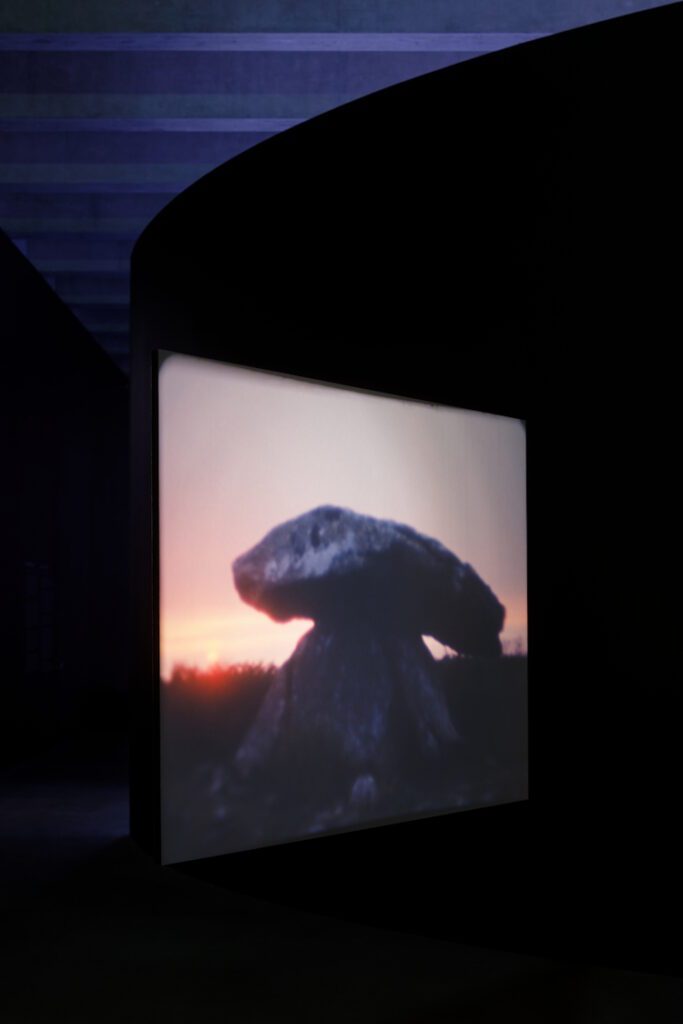

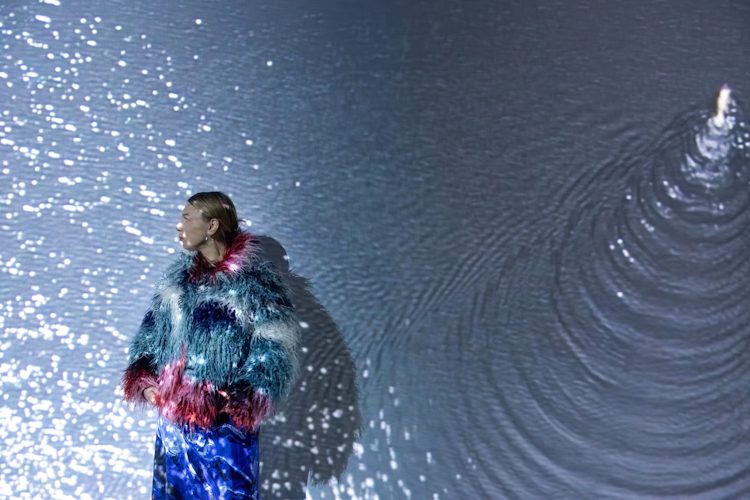
The artist spends long periods immersing herself in various disciplines across all fields, and this is reflected in the beautiful images drawn from across the world and across disciplines, that fill the cavernous space of the main gallery. Multiple works, visual and textual, micro and macro, offering different perspectives and different scales, form a singular experience of past, present and future. Æqualia, is part of a series of films in which the artist imagines a pantheon of feminine deities. Filmed at the confluence of the Rio Negro and Rio Solimões, a natural wonder in the Amazon Basin, where the two rivers meet but do not blend, the artist, films herself as an almost mythical post-human creature, gliding through this stunning spectacle, where, due to speed, temperature and densities, the black, murky waters of the lowland Rio Negro and the milky Solimões run side by side, highlighting both the beauty and complexity of the natural world and the havoc and destruction caused by the forces of capital on the region.
Deep time and hyperobjects – the vast, incomprehensible history of Earth and things distributed in time and space that transcend human perception – are key themes in all of Emilija Škarnulyté’s work. This exhibition shows the breadth of her practice and invites the viewer into her vision of how mythology and technology can offer a transcendent experience, in a visually stunning, meditative environment, that is not to be missed.
Emiljia Škarnulytė
6 December 2025 – 12 April 2026
Tate St Ives, Porthmeor Beach, St Ives TR26 1TG
March – October: Open daily 10.00 – 17.20
November – February: Open Tues – Sun 10.00 – 16.20
Tickets available at tate.org.uk and +44(0)20 7887 8888
Emilija Škarnulytė is supported by Tate Members. The exhibition is curated by Anne Barlow, Director, Tate St Ives with Dara McElligott, Assistant Curator, Tate St Ives. Images courtesy of Tate St Ives / Emilija Škarnulytė © Emilija Škarnulytė / as listed
About Emilija Škarnulytė
Emilija Škarnulytė is a Lithuanian-born artist and filmmaker. She most recently presented works at MoMA PS1, Palais de Tokyo, Louisiana MoMA, Villa Medici, MORI Art Museum, Kiasma, Gwangju Biennale, Helsinki Biennale, Penumbra. Her work was presented in solo exhibitions at Kunsthall Trondheim (2024) Canal Projects, NYC (2024), Kunsthaus Göttingen (2024) Ferme-Asile, Sion (2023); Kunsthaus Pasquart, Biel/Bienne (2021); Den Frie, Copenhagen (2021); National Gallery of Vilnius (2021); Künstlerhaus Bethanien, Berlin (2017); Contemporary Art Centre CAC of Vilnius (2015). Prizes awarded to her include the 2023 Ars Fennica Award and the 2019 Future Generation Art Prize. She represented Lithuania at the XXII Triennale di Milano and participated in the Baltic Pavilion at the 2018 Venice Architecture Biennale. She has films in the collections of the Centre Pompidou, Kadist Foundation, Kiasma, Fondazione in between Art and Film, IFA, HAM, FRAC Corsica, LNMA, MO Museum, and private collections. Her works have been screened at Tate Modern and Serpentine Gallery in London, Centre Pompidou in Paris, MoMA in New York, and numerous film festivals, including Oberhausen, Visions du Réel, Rotterdam, Busan, among others. She is a founder and currently co-directs Polar Film Lab, a collective for analogue film practice located in Tromsø, Norway and is a member of the artist duo New Mineral Collective.
Emilija Škarnulytė is supported by Tate Members. The exhibition is curated by Anne Barlow, Director, Tate St Ives with Dara McElligott, Assistant Curator, Tate St Ives.

Barry Taylor writes and speaks about the intersections of philosophy, theology and contemporary culture. In past, he was the road manager for AC/DC during the Bon Scott era before becoming a Los Angeles theologian.